Newspapers lead. And newspapers follow. If they manage to do both at the same time then they have a successful formula. So it was with the Daily Mirror in the 1960s. It helped to shape society, and was shaped in its turn by that society.
The paper had built its popularity among the Labour-voting working class in the 1950s as it sought to represent their opinions, and their hopes, in a country struggling with post-war austerity.
Its editorial content was imbued with a flat-cap, blue-collar and largely male ethos. It had a cheeky chappie image, exemplified by its iconic cartoon strip, Andy Capp.
Although it tried to reflect a less deferential spirit, it was not prepared to break with tradition, so it poked fun at "high society" and Tory grandees while also doffing its cap.
This paradox was evident in the attitude of the paper's mastermind, its editorial director, Hugh Cudlipp. He liked to make mischief at the establishment's expense but did not appear eager to upend society.
Cudlipp's strength, however, was in taking risks and, just occasionally, being willing to listen. By 1961, when he was 48, he was vaguely aware that change was afoot.
That year, having already hired a young woman to run a short-lived experiment called the Woman's Sunday Mirror, he appointed her as associate editor of the Daily Mirror.
Felicity Green, then 35, was to prove one of Cudlipp's most far-sighted hirings. She set about reinventing the Mirror because she recognised that the emergent baby-boom generation were refusing to accept the customs of their parents. They were ambitious, irreverent and iconoclastic. It was the first age of the teenager.
Green was quick to seize on the fact that those teenagers were expressing their difference from their parents in their clothing, and Cudlipp gave her licence to feature that in the Mirror despite his own misgivings.
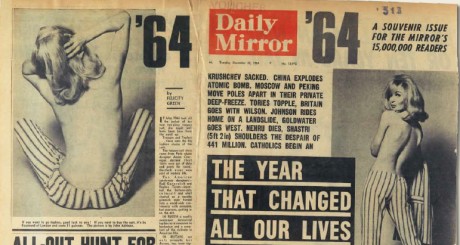
For example, in December 1964, he told her: "I don't understand what you're doing but I trust you. So I've decided to give you the front and back pages of the Mirror to tell our readers what the Swinging 60s are all about." You can see the result above.
Green's fashion pages were quite unlike those in any other popular paper of the time. She encapsulated the youth of the 1960s, the freshness, the willingness to take chances, the joie de vivre.
She recognised that fashion was no longer for the privileged few; it was for the masses. She endorsed the wearing of trousers by women - then regarded as revolutionary. She reported on, and supported, the original craze for mini-skirts.
Green's 1964 promotion of a pink gingham summer dress designed by Barbara Hulanicki was so successful it made fashion and mail order history, paving the way for the Biba success story.
She employed the most famous models of the era - Jean Shrimpton, Paulene Stone and Twiggy - to be pictured by the best photographers of the time, such as John French, John Adriaan and Terry O'Neill.
The greatest designers of the period, notably Mary Quant, were only too eager to appear in the spreads devised by Green. Her pages were daring but never vulgar.
They also say a great deal about Green as a journalist. She recorded the changes in society through fashion but was never a "fashion journalist." She has always believed style is far more important than fashion.
This emerges clearly in her book, Sex, Sense and Nonsense, which was launched at a party last night at a London hotel. Green, stylish as ever, lived up to the apt description of her by Telegraph writer Anna Murphy as "the chicest 88-year-old imaginable".
The book is a glossy production, featuring scores of pages of her work for the Mirror throughout the 1960s. It is a testament to her journalism and to the Mirror.
It shows just why the paper became so amazingly popular in that decade, managing to hold on to both the generation that had lived through the second world war and also to attract the attention of their offspring.
At its zenith in 1967, the Mirror reached a dizzying regular sale of 5.2m copies a day, by far the highest daily circulation ever recorded by a British newspaper.
Green and Cudlipp had proved to be a formidable team. They were not alone, of course, because the Mirror had a host of skilled writers, photographers, sub-editors and designers.
But Green should be seen as a pioneer as the first woman to join the main board of a newspaper group. Sadly, and reflect on this, she resigned when she discovered that she was being paid far less than a newly-appointed male director.
As she notes in her book about Cudlipp - "a feminist? Well, just a little bit." Quite.
*Sex, Sense and Nonsense (ACC Editions) £29.99