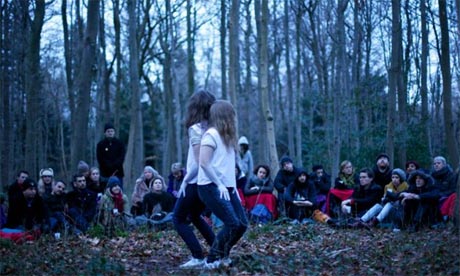
The In Between Time festival, which took place in Bristol last weekend, is programmed with intimacy in mind – in both senses of the word. Some works were designed for an intimate audience: Mental was staged in a bedroom, for an audience of just 12, all huddled under a king-size duvet; while Dead Line offered a one-on-one telephone conversation with a specialist on the subject of death.
Over in the more conventional theatre spaces there was intimacy of the genital kind. In How To Become a Cupcake, the self-styled Famous Lauren Barri Holstein inserted a Twister lolly into her vagina and spent several minutes melting it with a hairdryer. Kein Applaus Fur Scheisse, by two young graduates from the School for New Dance Development in Amsterdam, contained a sequence in which the boy vomited bright blue liquid over the girl's stomach, before urinating directly into her mouth.
Clearly this isn't art for everyone – either on grounds of accessibility or taste. Yet In Between Time is one of Arts Council England's National Portfolio Organisations, a status that would seem to carry certain responsibilities: towards wider audiences, and social engagement.
It's a responsibility that the four women who run IBT, led by director Helen Cole, take very seriously. They do this in quite pragmatic ways: IBT now has an associate artist scheme, through which several Bristol-based artists (including performance duo Action Hero, and Alex Bradley, who works in digital installation) were invited to present work at this year's festival. Some of that work was integral to opening up access to IBT: Bradley's Field Test was a light-and-sound piece created for a churchyard that anyone who happened to be passing could enjoy.
Unexpectedly, even these outdoor events contributed to IBT's sense of intimacy: Simon Faithfull's Fake Moon gave the impression that a faraway satellite had defied gravity to draw close to us; while Kate McIntosh's Work Table invited passers-by into a series of small shipping containers, where they could have fun destroying objects before trying to remake them.
What Cole and her team understand exceptionally well is the need to challenge audiences – whether with work of quiet fragility, or work that is aggressive and contradictory. More than that, they understand that challenging art needs protection: the fragile, to ensure that its voice can be heard in the push towards art that is easier to consume; the aggressive, because it antagonises social boundaries and questions the limits otherwise placed on freedom and imagination.
Importantly, traditional theatres are waking up to the need not just to talk about risk but offer audiences that challenge. Later this week, West Yorkshire Playhouse in Leeds announces the programme for the third Transform, a two-week festival that has brought new life into the building – not only in terms of the kinds of work shown, but the people coming to see it, many of whom spend the rest of the year ignoring the Playhouse's existence. Much of the excitement that surrounds Erica Whyman joining the Royal Shakespeare Company and Vicky Featherstone moving into the Royal Court in London stems from the fact that both challenged audiences to expand their ideas about theatre in their previous homes, respectively Northern Stage and National Theatre of Scotland.
Perhaps nothing in theatre is more challenging than intimacy. The works at IBT made audiences think about attitudes towards the representation of women, porn, mental health, youth and death, in unusual and thrilling ways. Isn't this the vital function of art? At the heart of the festival was an installation, constructed by Helen Cole herself, called We See Fireworks, in which disembodied voices described encounters with experimental art. One by one, they talked of being deeply moved, having their way of thinking changed, becoming more receptive to the world around them. Such stories remind us why it's so important to accept the challenge of art – and to allow that art the opportunity to exist.