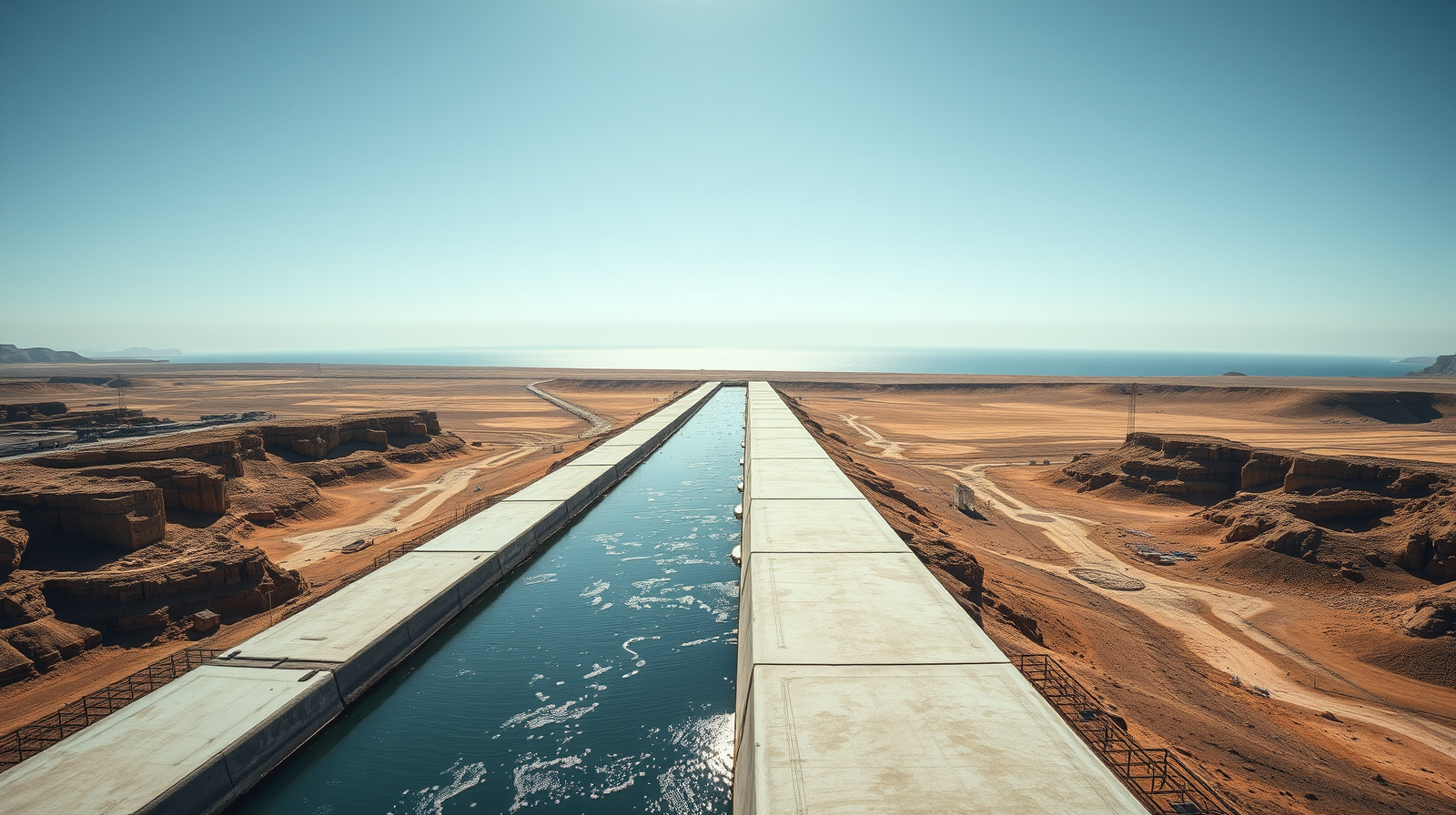
More than a century ago, engineers proposed an audacious idea for Egypt's Western Desert, cutting a canal from the Mediterranean Sea into the Qattara Depression, a vast basin sitting well below sea level, and using the resulting flow of water to generate electricity indefinitely. The concept first surfaced around 1912 and was developed further by British geologist John Ball in 1927, who mapped the depression in detail and outlined how the elevation difference between the sea and the basin could be converted into a steady, self-sustaining source of hydroelectric power. More than a hundred years later, the idea has still never been built, yet it continues to resurface periodically as engineers revisit its potential. Modern renewable energy advocates occasionally revisit the concept alongside newer technologies like solar power, wondering whether Egypt's abundant desert sunlight might eventually offer a less environmentally disruptive path to similar large-scale electricity generation.
Get breaking news anytime, anywhere. Download the TOI app now!
How the Qattara Depression project was meant to work
According to a technical paper archived by the International Atomic Energy Agency's INIS repository , the fundamental concept behind the scheme was to channel Mediterranean seawater into the Qattara Depression, using the difference in elevation between the sea and the basin floor to produce hydroelectric power. Once inside the depression, the seawater would evaporate steadily under the desert heat, and as long as new water flowed in at roughly the same rate it evaporated, the project could theoretically generate a continuous, unending source of electricity rather than relying on a finite reservoir.
Why the depression made such an attractive target
The Qattara Depression sits well below sea level across a large stretch of Egypt's Western Desert, making it one of the few places in the world where this kind of gravity-driven power generation could work at meaningful scale. Bringing in Mediterranean seawater would require excavating a canal or tunnel roughly fifty-five to one hundred kilometres long, depending on the route chosen, according to a study titled Environmental assessment for major development projects, a case study Qattara Depression , published in the Journal of Cleaner Production. The same research outlines that once filled to around sixty metres below sea level, the resulting lake could support an underground hydroelectric power station, offering Egypt a large-scale source of electricity without relying on additional dams along the Nile.
Germany and Egypt's serious attempt in the 1970s
The idea moved beyond theory in the 1970s, when a team of largely German scientists and engineers, led by an engineer named Bassler, began detailed planning under commission from Egypt's government. Bassler's initial feasibility study in 1973 laid the groundwork for a more formal government-led study two years later, carried out by a group of companies known as Joint Venture Qattara, marking the most serious engineering effort ever undertaken on the project. Despite years of technical planning, the scheme was ultimately never built, largely due to the sheer scale of excavation required and unresolved questions about long term environmental effects on the surrounding desert.
The environmental tradeoffs behind the hydropower promise
The same Journal of Cleaner Production study highlights a core tension built into the entire concept: the same evaporation that would make continuous power generation possible would also gradually turn the flooded depression into an increasingly saline lake, with consequences for the surrounding desert ecosystem that remain difficult to reverse once the process begins. This tradeoff between steady, low-carbon electricity generation and long-term environmental disruption has remained one of the central sticking points blocking the project's approval across successive planning attempts over the decades.
Other routes and scenarios engineers have proposed
Beyond the original Mediterranean canal concept, later studies have floated alternative approaches to filling the depression. According to the same peer-reviewed research, one alternative scenario proposed digging a channel from the Nile River instead, allowing floodwater to be redirected into the depression during the seasonal flood period, while a separate proposal considered desalinating seawater to support agricultural development around the basin rather than filling it entirely for power generation. None of these alternative routes has advanced beyond the study stage, largely for the same cost and environmental concerns that have followed the project since its earliest conception.