NFL teams are, by their nature, secretive operations.
Consider how teams like the New England Patriots handle their injury reports. Some of their designations are reminiscent of the summertime, when an NHL player can suffer a broken leg and rather than give away their true injury, the organization will release news that the player suffered a “lower body contusion.” When you are chasing the Stanley Cup, you cannot give your opponents a literal target to hit. It is the same with the Patriots. Reports are filled with grey areas.
But every so often we get a window into how a team actually views themselves, and one of those windows is the draft. We get a chance to see how teams view their roster and what positions they feel must be addressed, and we even get a glimpse into how they might tweak their schemes as the next few years unfold.
One of the more interestin potential scheme fits from this entire draft is the marriage of Jalen Hurts to the Philadelphia Eagles’ offense. Head coach Doug Pederson is a branch off the Andy Reid coaching tree. An offensive system built upon the traditional West Coast offense. Carson Wentz came out of a West Coast system at North Dakota State, making his fit in the Eagles’ system an easier transition than other rookies face.
But Hurts? Hurts comes from an Air Raid system. While Lincoln Riley and Pederson both have versions of “Mesh,” that Air Raid staple, in their playbooks, there are other elements of those two systems that are not as similar. So how can Hurts project into such a system? Furthermore what, if anything, does this mean for Carson Wentz?
Before diving into this, one thing to remember. Scheme fits – particularly projecting them – sometimes cause the fiercest debates in NFL front offices. Former NFL scout Dan Hatman, now the director of the Scouting Academy, has told me many times about how scouts and executives might evaluate a given player the same exact way in terms of his traits and abilities, but clash bitterly over what scheme fit the player would be best suited to operate in. Getting that fit right might be the toughest – but most critical – part of the draft process.
Projecting the West Coast Fit

The first step in projecting Jalen Hurts into the Philadelphia Eagles’ offense, as it currently stands, begins where all nerdy deep film dives begin.
In a playbook.
Thinking about Hurts in the Philadelphia offense requires an analysis of what the Eagles do offensively. Working through their playbook, you can then cross-reference some of what Hurts was asked to do under Lincoln Riley and see what worked, and what did not.
Let’s start with a design that the Eagles love to run, fade-smash. This is a fade route from the slot receiver with a hitch route on the outside. The Eagles can also run it out of a trips formation, using a stick route or a hitch route from the #3, or inside receiver. That looks like this:

As you can see, the middle receiver “F” runs a vertical route that will adjust depending on the coverage. If the secondary is in a coverage that is part of the Cover 2 family (the “2H” indication) then there will be a space between the safeties in the middle of the field. This is commonly referred to as a “middle of the field (MOFO)” coverage. Then the F receiver bends his route towards that vacant area of the field. If there is a single-high safety (“1H”) such as in a Cover 3 scheme, the F receiver stays more vertical. If there is man coverage, he will bend to the outside on more of a fade.
Here is Hurts running virtually this design against South Dakota from 2019, with a trips look to the right side of the formation:

Put yourself into the mind of the quarterback before the ball is snapped. Working outside in on the trips side of the formation, you see a press coverage cornerback with inside alignment. Then you see three safeties in the middle of the field, with one of them aligned over the middle trips receiver, seven yards off the football and using outside leverage. Then you see the inside receiver, with a bubble over him. The linebackers are down in blitz posture and perhaps the nearest defender in a coverage position pre-snap is a safety, 11 yards off the ball.
If you were the quarterback, which of those three routes are you throwing the football to?
As you might expect, Hurts sees pre-snap that the inside route is the best option, and that is what he throws:
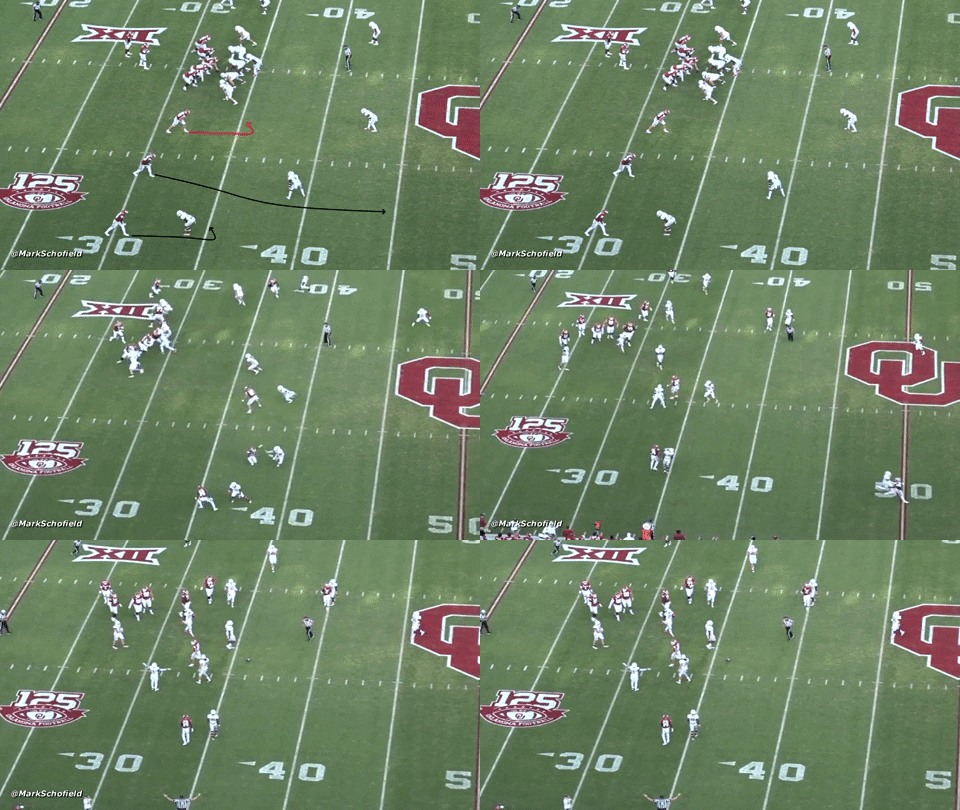
The snap is slightly low, which might play a slight role in the result of the play, but more distressing is the loop in the throwing motion. Hurts has an elongated drawback to his motion here, akin to an English longbowsman drawing his bow hand back before letting loose. It might seem like nothing at first blush, but in a West Coast system, where the core philosophy is getting the football out of the quarterback’s hands quickly to targets in space so they can operate after the catch, even the slightest of delays is deadly.
Consider this. As illustrated in our writeup of Hurts before the draft, his average snap-to-throw time last year was 3.08 seconds. Now some of that can be attributed to his ability to scramble, extend plays and make things happen in scramble drill situations, but 3.08 seconds would have been dead last in the NFL last season. Only Kirk Cousins, with an average snap-to-throw time of 3.01 seconds, would have been close to that mark, and Cousins was also the only qualifying quarterback north of three seconds. Wentz (you know, the starting quarterback in the offense we are analyzing) averaged 2.71 seconds. Other quarterbacks in West Coast-based systems put up similar numbers, such as Mitchell Trubisky (2.64 seconds), Jimmy Garoppolo (2.65 seconds) and Drew Brees (2.57 seconds).
Perhaps comparing Hurts to his true peers and not NFL starters would be a more fair comparison. Looking at the other draftable quarterbacks in this class, Hurts was the only passer who eclipsed a snap-to-throw time of 2.75 seconds. Steven Montez, from Colorado, was next-highest with an average of 2.73 seconds. Joe Burrow averaged 2.70 seconds, Jake Fromm averaged 2.50 seconds, and Tua Tagovailoa averaged 2.57 seconds.
So, this is an issue, and part of the problem is the elongated release. On this example we also saw another issue with his mechanics, a very wide throwing base. Putting these together, Hurts on film displayed some mechanical inconsistencies that are not a great fit for a quick-strike, West Coast offense.
Now to his credit, Hurts has done a good job of cleaning up his mechanics. His throwing session in Indianapolis during the Combine, for example, was one such illustration of the work he has done in this area. After the Combine Touchdown Wire declared him one of the “Winners” writing in part:
But scouts and evaluators knew that the Oklahoma signal-caller was athletic. What they wanted to see was more evidence that he can develop into an NFL passer. That is where his throwing session comes into play. He impressed during his throwing session, displaying tighter and crisper mechanics. In addition, the ball popped out of his hand very well. For example, he delivered on a well-placed out route to Isaiah Hodges along the left sideline, as well and a great dig route to Antonio Gandy-Golden off of a deep drop into the pocket. Those throws highlighted some improved footwork from the quarterback. Hurts helped himself this week, especially when you consider how well he likely performed in his interviews with teams.
Yet…how often have we heard and seen stories like this? Consider the saga of Blake Bortles. Coming out of UCF one of the knocks on him as a quarterback was his mechanical flaws. In his pre-draft report on him at NFL.com, Nolan Nawrocki wrote: “Could stand to shorten his release — wraps the ball slightly at the beginning of his windup.” Bleacher Report described him as having a “somewhat elongated delivery.” But he worked on his mechanics, and when he made the decision to throw at the Combine, he left people impressed with his suddenly “perfect mechanics.” Dane Brugler described his throwing session by saying that Bortles “didn’t disappoint with the spotlight on him, displaying his smooth set up and release and tossing darts down the field.” That continued into his Pro Day, vaulting him to the top of the board.
But you know how this story ends.
Bortles’ mechanics were a consistent issue during his time in Jacksonville with the Jaguars. Every preseason there were stories about how he worked on his throwing motion during the offseason, and yet once the games started, that elongated delivery was back. For example, there is this story from March of 2017 highlighting how he adjusted his mechanics. Or a story from that summer here at Touchdown Wire outlining how he has fixed his mechanics…again. Then just a few months later, the poor mechanics are “back” and his issues might be “not easily solved.”
It is an issue of muscle memory. When you are throwing routes versus air during the offseason or one-on-ones during training camp, you can keep those mechanical fixes in your mind. But when the Von Millers of the world are trying to cause you physical harm, you don’t care about the tinkering you’ve done with your throwing motion, because you’re trying to stay alive. Muscle memory takes over, and the poor habits of the past surface anew.
Can Hurts avoid such a fate? Only time will tell, but it poses a problem for a potential transition to a West Coast based system where quick throws and timing are essential.
There is another issue here, and that is one of a mental perspective. At this point in his career, Hurts is more of a “see it, throw it” passer. Anticipatory throws are not his strong suit. Far too often on film he waits to see a route come open before releasing the ball, and again, this is an issue in a West Coast system.
Take this play against South Dakota:
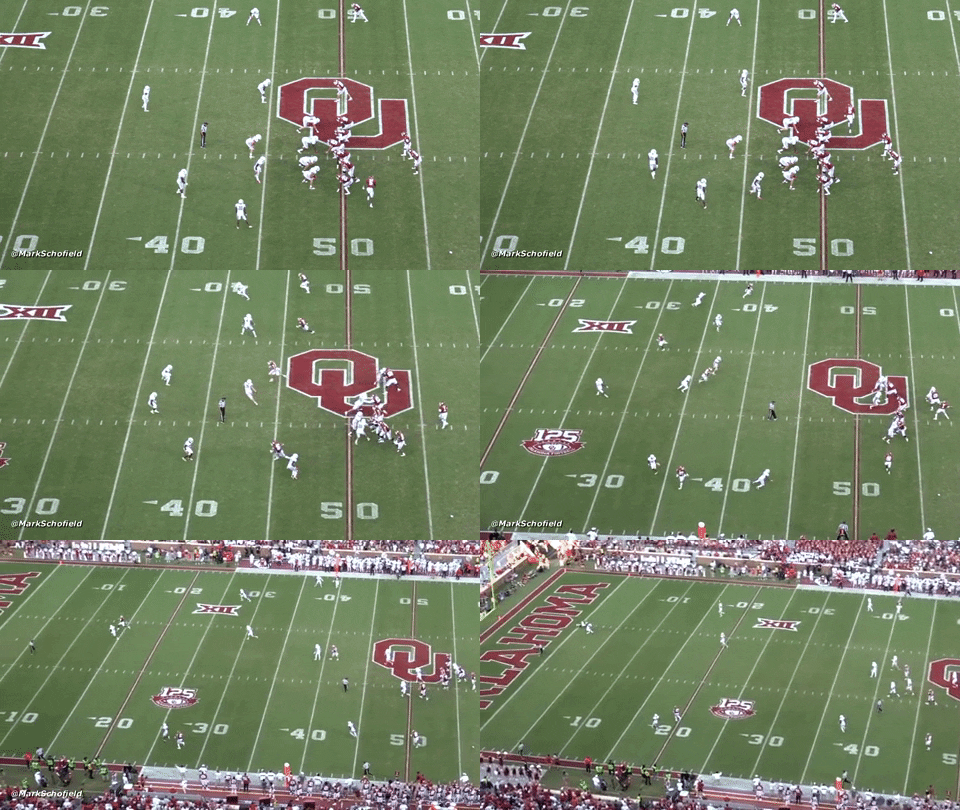
Look at how long Hurts waits to throw this seam route. Now perhaps he was fixated on holding the free safety in the middle of the field, but there is a window to throw this early for a huge play. But he waits, and by that time the distance the throw needs to carry invites the safety – who Hurts moved out of position – back into the route to make a play on the football.
Take this throw from the National Championship Game:
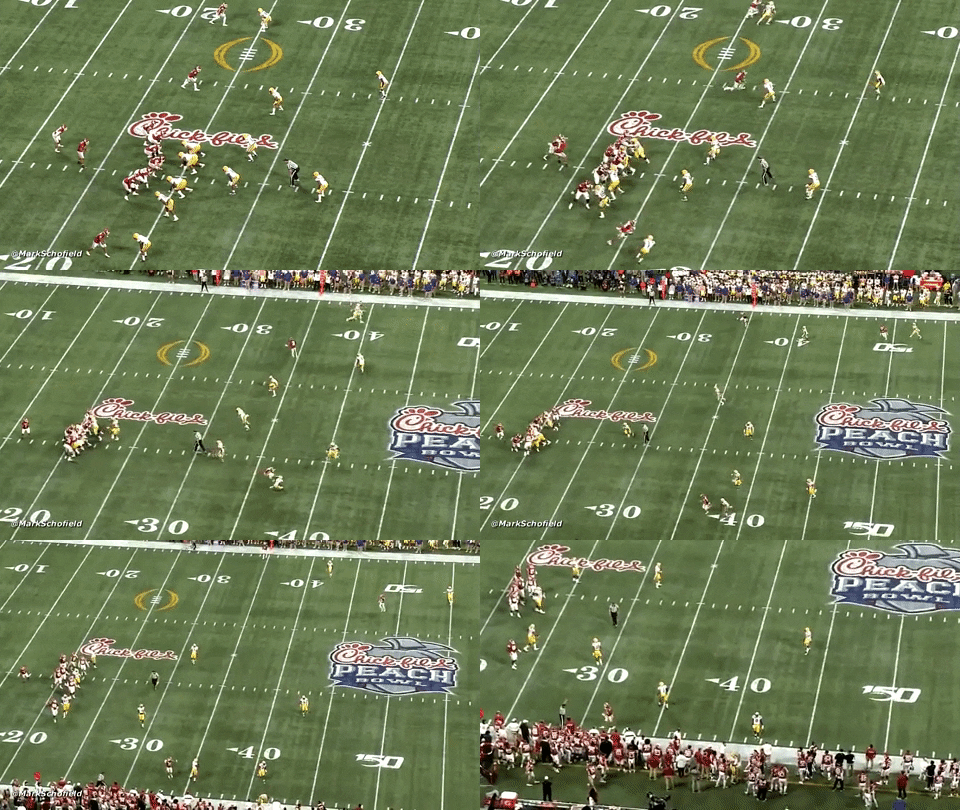
Hurts has an opportunity to make an anticipation throw here on this out route to the right sideline. If he pulls the trigger with the break, this is a first down. Heck, if he even throws it a bit late, it is a completion. But he stares it down, then double-clutches, and eventually makes it a much tougher throw. Which is nearly intercepted.
This is why the potential fit in Philadelphia’s offense is troublesome. The one-two punch of an elongated delivery and a “see it, throw it” mentality is not a fit for a West Coast offense predicated on quick throws, timing and rhythm, and yardage after the catch.
But we are not done with the analysis.
Projecting the Future

One of the most intriguing part of the NFL Draft, from where I sit, is that it gives us a window into how all 32 organizations view themselves, both in terms of the near- and the long-term. For example, the New England Patriots, in a post-Tom Brady world, seem to be loading up on defense and tight ends, perhaps envisioning a return to the start of Brady’s career. At that time they relied not on Brady slinging it 55 times a game, but a ball-control offense where the QB threw it more like 25 times a game, and a stifling defense. So they could win those 17-14 “rockfights,” as my friend Dave Archibald termed them.
Then there are the Green Bay Packers. Who, a year removed from the NFC Championship Game, drafted the following on the first two days of the draft: A potential quarterback of the future, a between-the-tackles running back who joins a crowded RB room, and a tight end that Matt LaFleur wants to uses as his version of Kyle Juszczyk.
(In case you are wondering, Aaron Rodgers is indeed healthy and ready for the start of the 2020 season).
So teams tell us through their picks what they want to be in the future. New England, and it seems Green Bay, are betting on football being truly cyclical, and the halcyon days of “three yards and a cloud of dust” returning to the sport. Perhaps a risky bet, but you go in on a bet against Bill Belichick…
Now let’s return to the potential fit in Philadelphia for quarterback Jalen Hurts.
Prior to the draft, Touchdown Wire explored the best fits for the top 11 passers in the class. Here is a snippet of the report on Hurts and where he fit best, in our mind:
I first had this idea of Hurts in an Arians offense down in Mobile during the Senior Bowl. This was my first exposure to the Oklahoma/Alabama passer in person, and I was entranced by his ability to put touch and accuracy on the deep ball. This was something that is noticeable on film but really stood out. Play after play of Hurts dropping throws in the bucket got my mind working.
One of the areas of his game that does need refinement is what he does in scramble drill situations. Hurts is perhaps at his best when he is forced to create in the pocket, and he does a very good job at keeping his eyes downfield to scan for targets, and in a vertical-based offense that ability would be maximized.
Also, Hurts is better at reading defenses than he might get credit for. For example, his first throw against Iowa State this season saw him take a deep shot on a post route. The defense showed him a Cover 3 (middle of the field closed) look pre-snap but rotated to a Tampa 2 (middle of the field open) look as the play began. Hurts read it perfectly and took the deep shot to split the safeties as you would expect.
[Bruce] Arians will love throws like that.
In such a downfield passing system, the flaws that might make Hurts a difficult fit for a West Coast offense (elongated mechanics, a “see it, throw it” mentality) are minimized. Timing, which still important, is not a critical component. If Hurts is a half-second late, throws can still be completed. If he waits on a route (although hopefully not as long as that deep ball against South Dakota) he can still hit on throws. Further, when you factor in his ability to drop in bucket throws, his fit in a more vertical system makes sense.
Now.
Let’s take a two-fold look at how the Eagles view their future, through the dual lens of their 2020 draft picks, and the words from Howie Roseman and Doug Pederson.
In the first round the Eagles selected Jalen Reagor, a receiver viewed as a true threat after the catch (making him a good fit for a West Coast system of course) but also someone who was a vertical threat. Reagor is almost deadly on double-moves, provided his quarterback gets him the ball:
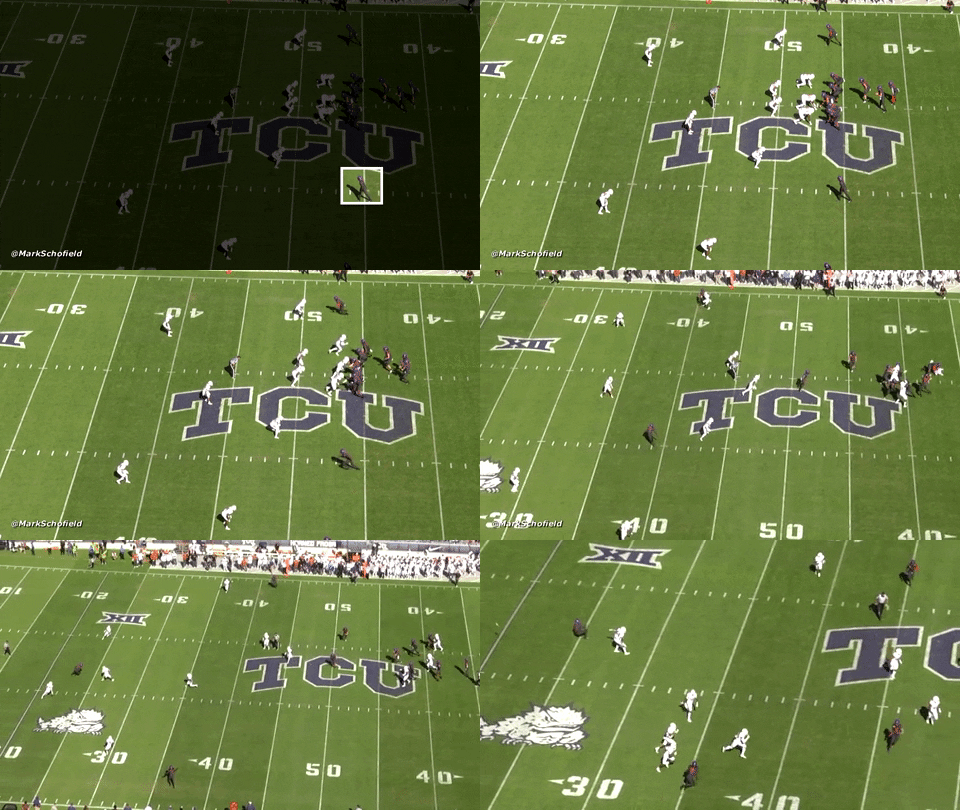
What else did they do this past weekend?
They added two more receivers in John Hightower from Boise State and Quez Watkins from Southern Mississippi. The Boise State WR was identified before the draft as one of our sleepers, and here is why. As we wrote “[t]he first box that he checks as a receiver, particularly a vertical threat, is speed. Hightower ran a 4.43 40-yard dash at the Combine in Indianapolis, with a 1.49 10-yard split, a split that placed him in the 98th percentile among wide receivers.”
It is speed you see on film:
Watkins? Well the Southern Mississippi WR is a pure burner. He was clocked at 4.35 in the 40-yard dash at the Combine, and was deadly in the vertical passing game. On throws of more than 20 yards, Watkins had 13 receptions for three touchdowns and a quarterback passer rating of 90.9, his best by distance.
Then consider what Roseman and Pederson have said over the past few days. When the team drafted Reagor, one of the things the Eagles’ general manager highlighted was his ability in the vertical game. “I think you see the separation on tape,” Roseman said. “You see the vertical separation as an outside receiver and those things are hard to find. When you look at this draft and guys who can just separate as an outside vertical receiver, there’s not a lot of those guys. They’re hard to find.” Pederson, after the Reagor pick was made, highlighted his speed, ability to stretch the field, and his vertical prowess.
Regarding the two later picks, Roseman illustrated after the draft that the organization really wanted both players:
I know when we drafted [Boise State WR and Eagles fifth-round draft pick John] Hightower we had a lot of conversation about Hightower versus [Southern Miss WR and Eagles sixth-round draft pick Quez] Watkins. And then when we moved back and picked up a bunch of picks, we had an opportunity to get Watkins, too. We sat there and we said, ‘Let’s get both of these guys. These are guys that we feel passionately about, and let’s add them to the team and let competition dictate what’s best for our football team.
Then there is a move the team made on the trade market the past weekend, when they acquired wide receiver Marquise Goodwin in a trade with the San Francisco 49ers. Of the veteran player, the Eagles’ general manager had this to say: “Marquise is one of the fastest men in the world. And I mean that when I say that. He’s one of the fastest men in the world. He is so fast.”
Putting the pieces together, you see the mindset behind these picks. As Roseman himself put it:
When we went back and looked at our team over the last year, we wanted to get more explosive, we wanted to get faster, and I told that to you guys after the season. It was important we stuck to that. I know a bunch of our scouts over the last couple days and certainly today when we talked about it, they kind of threw it back in our face. You know, they said, ‘Hey, if we are looking to get faster, this guy is still on the board.’
They are building a fast, vertical offense. A downfield offense. As Roseman told the media, “[w]e want to throw the ball down the field. We don’t want to be station-to-station football – that’s not what coach Pederson wants.”
That is where Hurts comes in.
Think back to a few years ago. A quarterback coming out of an Air Raid system in the Big 12 was drafted to a team running a West Coast offense. However, the coach of that offense realized that they needed to get more vertical in the passing game, to take advantage of the talent on the roster and the skill-set of their receivers and tight end options. So he drafted a quarterback built to run a newer version of his West Coast system, one you could now term West Coast on steroids.
This past February that coach and his new quarterback hoisted a Lombardi Trophy in Miami.
This is not to say that Hurts is the next Patrick Mahomes. Not at all. But the NFL is a copycat league. The Eagles, like every other team in the league, are looking at what works in the NFL. In today’s game, passing is king, and passing downfield is king. In terms of Expected Points Added per Play, provided the math is right, throws behind the line of scrimmage had an EPA/P of 0.006. Throws from 1-9 yards downfield had an EPA/P of .178. Throws in the 10-19 yard range had an EPA/P of .455, and throws more than 20 yards downfield had an EPA/P of .339. To score points – you know, the job of an offense – you gotta throw downfield more.
Perhaps cognizant of that fact – and the Eagles are a data-driven team – they are looking to get downfield in the passing game. That is where Hurts fits in. His strengths as a passer are in the downfield part of the field, and if they are getting more vertical as an offense, that is why he was the quarterback they targeted. Sure, the debates over whether Hurts is a threat to Wentz are fun, but the more fascinating part of this selection is the window into how the Eagles view their offense moving forward. They want to be vertical. Wentz himself has shown an ability to attack downfield. After the Reagor pick, Roseman himself said so. “Our QB likes to throw the ball down the field and make vertical throws.”
For years those of us who study quarterbacks and offenses have clamored for teams to build systems around what their passers do well, and not force quarterbacks into offenses they might not be tailored to run. If Wentz wants to be aggressive and throw vertically, then perhaps the Eagles are finally going to be an offense that is tailored to that approach. Perhaps they are going to build a system around him – with weapons around him – that are built for the vertical game.
In that kind of system, Hurts fits perfectly.
So in the end, they got the scheme fit right after all.

.jpg?w=600)