Gaming is essentially a sedentary pastime. Andrea Pirlo, for example, spent the hours before winning the 2006 World Cup final with Italy playing video games and sleeping. Is it possible, though, that the skills required to play video games might be useful for nurturing certain parts of footballers’ brains?
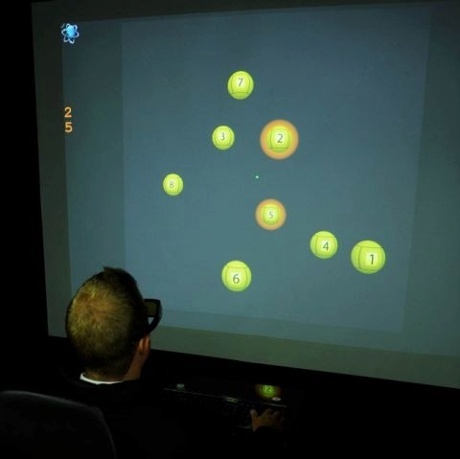
Professor Jocelyn Faubert, a psychophysicist at the University of Montreal, has devised a computer game, a type of graphical simulation machine, called a NeuroTracker. Players have to index a number of spheres floating in 3D space. It lasts about 15 minutes. He tested 51 English Premier League players against two other test groups – elite amateurs, including athletes from an Olympic training centre, and 33 university students who were not athletes.
Faubert discovered that a professional footballer can “hyper-focus” better than a typical undergraduate student (and top athletes).
“What really blew me away,” he says, “is that professional footballers learnt so much faster for this task that really had no specific sports element. There’s movement, but there’s movement in real life, too.”
The conclusion he draws from the NeuroTracker, which has been used as a training device by Manchester United, is that it can arguably improve players’ concentration during a game.
“We separated the soccer players into three groups. We did the NeuroTracker training and measured (pre and post) their ability to do passing and decision-making on the pitch and they improved while the other groups did not improve.”
Is it possible to train a footballer’s brain? Professor Ian Robertson is a neuroscientist at Trinity College Dublin. He makes the point that the brain is like a muscle. Use it or lose it.
“I know,” he says, “that if you play games like Medal of Honor, for instance, your capacity for spatial thinking improves. We know, for instance, that surgeons who play a lot of video games, which make demands on their perceptual motor system, perform better and have better accuracy; they show slightly better surgical technique.”
Faubert says that a footballer’s working memory is used in the same manner for playing video games as it is for making decisions on a football pitch – the ability to focus intensely, to track multiple elements, to anticipate things that are out of sight but remain in play, to make calculations and predictions. That innate ability of football’s finest playmakers like Pirlo to read a game, to end up in the right place at the right time, is a function of good visual memory.
David G Kirschen, an optometrist and a colleague, Daniel M Laby, studied US Olympians from the 2008 Beijing Games. They found that soccer players, who track flying objects at a distance, scored well on contrast sensitivity, which is the ability to pick a target out of a background and is a feature of action-based video games such as Call of Duty. “If you have poor vision, your contrast sensitivity goes down,” says Kirschen.
It is not that top athletes have superior reaction times to the rest of us, it’s that they have better eyesight. Good vision helps them to pick up on visual clues so they can make better decisions, such as picking the right moment to pinch a ball from the feet of a winger.
It could be that video games – apart from being a way to unwind before a World Cup final – become an integral part of footballers’ training-and-fitness regime; another counterintuitive way to get an edge, such as doing yoga or ballet, one which appeals to their obsessive, competitive nature and draws on keen eyesight, spatial awareness and a greater ability to “hyper-focus” than average undergrads.
Richard Fitzpatrick is the author of El Clásico: Barcelona v Real Madrid, Football’s Greatest Rivalry (Bloomsbury 2012)
JUST A GAME
NEYMAR JR
The Brazilian star says he adopted moves from football video games and assimilated them into his play with a teammate, Ganso, at Santos.
BAFETIMBI GOMIS
The Swansea City striker tinkered with Football Manager as a research tool before joining the club this summer from France. He used the game to bone up on his future teammates’ attributes.
ZLATAN IBRAHIMOVIC
When the Swedish star played for Inter Milan he could go 10 hours at a stretch playing football video games. He has since replaced the hobby with hunting.
FERNANDO TORRES
During his time at Liverpool, Fernando Torres spent £35,000 converting three rooms in his house – one on each floor – into gaming suites.