Weeds and patches are the two things that can blight a perfect sward, and I have both in my lawn.
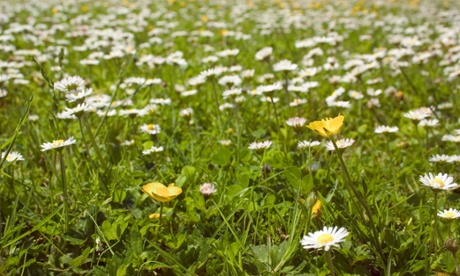
If you have in mind a typical lawn of fine and even green grass, then both patches and weeds are going to mess with that vision, but I have to admit I feel very differently about each. A bare patch annoys me, and I am very likely to get out and have a go at remedying it. But lawn weeds are different, mainly because they can be pretty in the way a patch of mud cannot. With lawn weeds I am really very tolerant: I like the odd buttercup prettying the place up, and I can even put up with dotted dandelions. As for daisies, I have positively encouraged them, and the one clump in my lawn has grown slowly and steadily over the years, alas not spreading naturally to the rest of the lawn. Perhaps I should lift it and split it and replant all over. Speedwell is a lawn weed I may also seek out, its tiny blue flowers weave so prettily through grass.
But I have been a little too lenient with the weeds, and in one corner of my little lawn the buttercups have been spreading. I noticed it a while ago and tutted at them indulgently, but now it has reached the point where they cover around a quarter of the surface of the lawn (it really isn’t very big). And in spreading so far they have lost their charm. When woven among grass they weren’t a problem, but buttercups, it turns out, don’t cut well. Each time I mow, I am left with a horrible bare patch until they grow back. It is time to sort them out.
The trick is to physically dig out the roots and then survey the bare patch that remains. Of course this also works with smaller weed problems: even individual weeds can be needled out with the help of something pointy to get to the root (if you are looking to buy then it is a grubber you are after, which is forked at the end for more effective hoiking out).
I am also attending to the other bare patches around my lawn, because from here on in, the treatment is the same. Naturally occurring bare patches, and bare patches created by digging out offending weeds, both need resowing with grass seed, and tending until the grass fills the space instead of mud or weeds.
For this, you need to create a fine tilth, which means a crumbly surface into which germinating seedlings can easily sink their roots. So work over your bare patches as well as you can within the confines of the surrounding lawn, and when the surface is nicely scratched up, sow your seed into it, scratch with a rake so that some are covered, and water well.
If you have a lively bird population, it is a good idea to pin a piece of mesh across to prevent them from moving in and eating all the seed within the first couple of hours. This can be removed immediately upon germination, or left to see off cats that may likewise take an annoying fancy to your bare patches. With luck soon your entire lawn will be green - with little dots of yellow, white and blue of course.