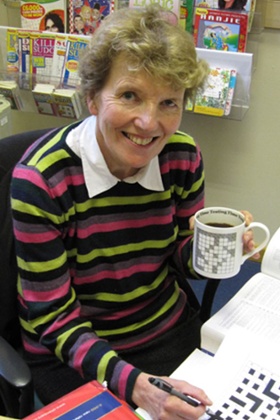
Words, seen through Sue Purcell’s eyes, are acrobatic things. For an instant a label spotted in a Sainsburys vegetable aisle will read “mange tout” but then it morphs into “Man get out”. “Whenever I see Britney Spears I think of Presbyterian,” she says, “and ‘bedroom’ is an anagram of ‘boredom’, which makes it a good source of clues.”
It’s this linguistic agility that has equipped 60-year-old Purcell for a career compiling crosswords and brain teasers. She is unusual – most professional compilers produce their puzzles in their spare time at the end of a more lucrative day job, or use them to expand their intellect – and their pensions – in retirement. She, on the other hand, has a full-time job compiling and editing puzzles for Puzzler, the UK’s most prolific provider of puzzles and puzzle magazines. “No one’s in it for the money, but for the love,” says Purcell who speaks four languages and writes French and German grammar books on the side. “We all want to find a clue that no one’s ever come up with before or a new way of interpreting a much used word. If you’ve got that kind of mind you can never stop – I sit on buses reading the adverts and start making anagrams out of the slogans.”
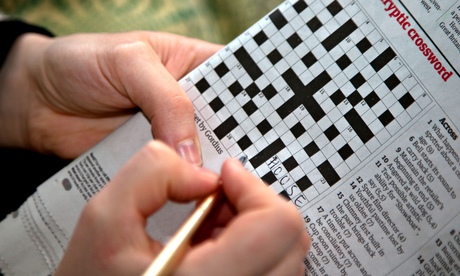
The clues to a cryptic crossword may be fiendish to ordinary minds, but the mental dexterity that lies behind them is more incredible than some might realise. Deft clues to unlock clever words are not enough to create a good puzzle: a compiler needs a mathematical precision to navigate the grids and a mastery of current fashions and affairs to anticipate their readers’ responses. Spellings of common words, for instance can alter over time and part of Purcell’s job is to compile a house style to ensure that compilers are consistent and that tricky words are interlocked with other words on the grid to give readers a steer. “The T of ‘tsar’ would have to be interlocked to make it clear we weren’t looking for ‘czar’,” she says. “And the ‘s’ or ‘z’ in words like ‘organise’ should never be interlocked so people can spell it either way.”
Purcell graduated in foreign languages and worked as a teacher until she became a mother and wanted a part-time job. She answered an advertisement for a proof reader and editor at Puzzler where her linguistic skills were swiftly noticed and she was offered a full-time position. “It’s one of those jobs you don’t realise exists,” she says. “Some compilers might be a surgeon or an accountant by day – the typical one is a retired school teacher and clergy are disproportionately represented.”
Although there are unexpectedly few grid designs in circulation, many trillions of different word combinations can be inserted into them so, even though the same clues can be redeployed from Puzzler’s archive, no crossword ends up the same. “The experts start at the bottom right hand corner; rookies begin at the top left and find they’re left having to fill the last corner with a word ending in a ‘v’ or worse,” says Purcell. “You start with a word using less common letters like a J or a Z and feed other words round it, otherwise you’ll end up with a congestion of common letters and nowhere to fit the harder ones in. You get fed up with words like ‘emu’ or ‘elk’ because there are so few alternatives with those letters and the challenge is to find a new clue for them.”
A good compiler must, like a chess champion, always be a few steps ahead and one of Purcell’s roles is to anticipate when a clue might wrong foot a reader. “If the clue were ‘a tropical yellow fruit’ and there were three ‘a’s in the grid the answer could be either ‘banana’ or ‘papaya’ so I would make sure the word was interlocked with another to make it clear,” she says. “Puzzles are meant to be entertaining, not an exam. I also ensure that there’s nothing offensive hidden in them.” To that end she is obliged to keep an eye on news headlines. “Our magazine crosswords are written several weeks before publication and if there’s a clue about a celebrity who has since died or been jailed it could be an embarrassment so I have to keep my eye on scurrilous gossip and Twitter trends,” she says. “It was midnight when I heard that Michael Jackson had died and I turned on my computer and looked to see what puzzles were coming out that referred to him and changed all the relevant clues.”
Persistence, she says, is the key to becoming a published compiler and many launch their careers on the coat tails of established professionals whom they’ve approached for advice. “Crosswords have personalities and most fans have a favourite compiler so send your work to them – or the publication they appear in – and ask for feedback. If you’re good they might take you under their wing,” she says. Crucial, though, is to realise that crossword styles vary according to publication. “You have to understand the readership you are compiling for so that you get the tone right,” says Purcell. “The Guardian’s audience, for instance, tends to be intelligent and broadminded so you could get away with some things that would not find favour in a different paper.”