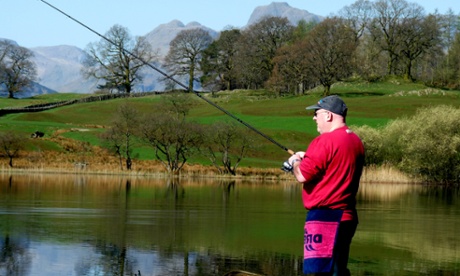
On Loughrigg Tarn, a broad-chested angler charged his catapult with maggots and released a shot over the glistening water, hoping to attract the curiosity of any roach out there.
“Any luck today?” called a walker on the shore footpath as the bait pattered on the surface.
Keswickian Bob Youdale, 57, raised his eyes to Langdale Pikes and shook his head. “Nothing doing,” he said “apart from seeing two ducks, two frogs and six toads.”
“Tough,” said another rambler “roach were biting yesterday.”
“Aye, the roach,” Bob told me later, “it’s my favourite coarse fish, along with the rudd. They’re closely related, the roach feeding off the bottom of the tarn, while the rudd is a top feeder, with a protruding bottom jaw.” Other fish living on Loughrigg Tarn, he says, include perch, tench, trout and pike – the only coarse fish that bites. Oh, and eels too.
In summer water lilies float on the surface, their bamboo-green leaves much beloved of visitors. “The lilies are a great holding area for tench, another bottom-feeding fish that rummages in the silt on the tarn bed,” Bob said. “I wouldn’t fish among the lilies, but next to them. I would also use my strongest rod and line, as tench can weigh 8lb and they fight hard.”
As one of the north of England’s best match fishermen, Bob is unusual among his peers in also angling in the high tarns. His interest was triggered at the age of six by adventures with Keswick Cub Scouts when they climbed fells such as Cat Bells and Latrigg. He started angling on the shore of Derwentwater with local lads, using a borrowed fly rod. Today he sells fishing permits with all the tackle from his newsagent’s shop in Keswick.
Bob has his own theory about how fish come to be found in the tarns among Lakeland’s crags and screes where you usually find climbers with ropes. “Fish have sticky eggs and frog spawn is sticky. I think they get stuck on a duck’s feathers and when ducks fly into the high tarns the eggs are transferred with them.”