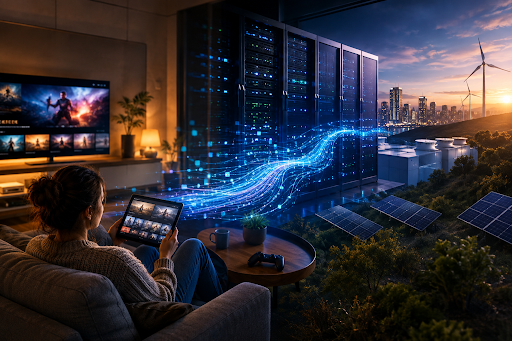
An Australian can stream a film on the train, download a 100GB game overnight, and listen to music for hours without receiving a single physical product. Entertainment that once depended on discs, plastic cases, printed packaging, and delivery vehicles now arrives almost instantly through an internet connection.
That transformation has obvious environmental advantages. Digital distribution can eliminate much of the manufacturing, packaging, warehousing, and transportation associated with physical media. But the environmental cost has not disappeared. It has largely moved into infrastructure that consumers rarely see: data centres, telecommunications networks, cloud systems, and the electronic devices used to access them.
Digital entertainment is therefore not a zero-impact activity, but neither is it automatically an environmental burden. The more useful question is how efficiently Australia can build and operate the infrastructure required to support its growing digital habits.
Streaming, Cloud Gaming, and Network Loads: Where the Power Goes
Streaming is one of the simplest examples of the shift from physical to digital entertainment. A film no longer needs to be manufactured onto a disc and transported to a retailer. Instead, content is stored on remote servers and delivered through communication networks to a television, computer, or smartphone.
The energy involved is spread across that entire journey.
Data centres consume electricity to operate servers and storage systems and to keep equipment within safe operating temperatures. Telecommunications networks consume electricity while transferring information. At the household level, the television, computer, or mobile device also requires power.
Importantly, video streaming and cloud gaming place different technical demands on this infrastructure.
Video streaming is primarily a data-delivery process. A programme has already been produced and encoded, and the service sends the resulting video to the viewer. Higher resolutions and bitrates can increase the amount of data being transmitted, although greater data traffic does not translate directly into a proportional increase in electricity consumption because networks and data centres have become significantly more efficient.
Cloud gaming is more computationally intensive. Services such as Xbox Cloud Gaming and GeForce NOW require remote servers to perform game processing and rendering in real time before the resulting video is encoded and sent to the player. A downloaded game, by contrast, transfers the software once and then relies largely on the user's own hardware for subsequent gameplay.
That distinction is important when discussing the environmental cost of digital entertainment. Not every digital activity places the same demand on the cloud.
The same infrastructure shift extends beyond video streaming and gaming. Music platforms, social media, and online pokies in Australia are among the many entertainment services now delivered through cloud infrastructure, digital networks, and online payment systems rather than physical distribution.
The individual electricity demand associated with any one online activity can be relatively small, but the aggregate effect becomes more significant as billions of digital interactions take place across increasingly connected economies.
The International Energy Agency has also cautioned against simplistic claims about the carbon footprint of streaming. Its analysis found that the viewing device itself can account for a substantial share of streaming energy use, while efficiency improvements across data centres and networks have reduced the energy intensity of data transmission over time.
Australia’s Data Infrastructure: Powering the Cloud Shift
The invisible infrastructure behind digital entertainment is becoming an increasingly important part of Australia's electricity system.
Australia has more than 160 operational data centres, according to AEMO's 2026 Integrated System Plan. AEMO estimates that data centres currently account for around 2% of grid-supplied electricity use. Under its long-term outlook, demand from data centres is expected to grow substantially as cloud computing, artificial intelligence, and other digital services expand. The 2026 ISP projects that data-centre electricity demand could reach almost 10% of NEM underlying demand by 2050.
AEMO's 2025 Inputs, Assumptions and Scenarios Report provides a useful near-term benchmark. Under its Step Change scenario, data-centre electricity consumption was projected to increase to around 12 terawatt-hours by 2029–30, representing approximately 6% of NEM grid-supplied electricity.
The distinction between those figures matters. The 2% figure describes current demand, the 6% figure is a 2029–30 Step Change scenario from AEMO's 2025 forecasting work, and the almost 10% figure is the longer-term 2050 projection in the 2026 ISP.
Much of Australia's data-centre capacity is concentrated around major population and business hubs, particularly Sydney and Melbourne. Operators such as NEXTDC, AirTrunk, and Equinix are expanding facilities as demand for cloud and digital services grows.
The environmental implications depend not only on how much electricity these facilities use, but also on where that electricity comes from. As Australia's electricity system incorporates more renewable generation, the emissions associated with each additional unit of electricity can decline.
Efficiency is another major consideration. Power Usage Effectiveness (PUE) measures how efficiently a data centre converts electricity into useful computing activity, with lower values indicating less overhead energy use. Australia's NABERS data-centre rating system uses operational performance data to assess energy efficiency and encourage improvement.
That makes data-centre growth an infrastructure-planning issue as much as an environmental one. The question is not simply whether Australia should consume less digital entertainment, but whether the electricity generation, transmission, storage, and computing infrastructure supporting that demand can expand efficiently.
The Visible vs. Invisible Impact: Physical vs. Digital Consumption
The environmental differences between physical and digital entertainment are easiest to understand when the two supply chains are placed side by side.
A physical DVD involves material extraction, plastic manufacturing, packaging, printing, transportation, warehousing, and retail distribution. A consumer then needs a compatible device to play it.
Digital delivery removes many of these physical steps. A stream or download does not require another plastic disc to be manufactured for every customer, nor does it need to be individually transported from a factory to a shop and then from a shop to a home.
That is a meaningful efficiency.
But digital entertainment replaces visible material flows with an infrastructure network that is mostly invisible to the consumer. Servers operate continuously. Networks move enormous quantities of data. Cooling systems consume energy. Devices require electricity at the point of use.
The result is better described as a shift in environmental footprint rather than its disappearance.
This distinction also explains why simplistic comparisons can be misleading. Watching one film online is not necessarily environmentally equivalent to manufacturing and transporting one physical disc, but neither can every additional hour of streaming be treated as environmentally insignificant.
The actual outcome depends on factors such as how long content is watched, the quality of the stream, the efficiency of the device, the energy mix of the electricity system, and the infrastructure supporting the service.
For Australia, the transition to renewable electricity makes this particularly important. Cleaner generation can reduce the emissions associated with growing digital demand without requiring consumers to abandon digital entertainment altogether.
The E-Waste Paradox: Hardware Obsolescence in a Digital World
Digital entertainment may reduce physical media waste while leaving another environmental problem largely intact: electronic hardware.
The continued growth of cloud services requires servers, storage systems, networking equipment, and other infrastructure. At home, consumers increasingly rely on smart televisions, gaming consoles, computers, smartphones, routers, and other connected devices.
Those products have environmental impacts before they are ever switched on.
Raw-material extraction, manufacturing, component production, and international transportation all contribute to the embodied emissions of electronic products. These impacts are commonly captured within Scope 3 emissions when considered as part of an organisation's wider value chain.
The precise balance varies between products, usage patterns, and electricity sources, so it would be misleading to claim that replacing every television or console after a fixed number of years always produces more emissions than its entire operational lifetime. However, manufacturing can represent a substantial part of an electronic product's lifecycle footprint.
That makes premature upgrades environmentally costly.
Keeping a television, phone, or game console in use for longer can reduce the need for new manufacturing and the associated extraction of raw materials. Repair, resale, and refurbishment can extend that benefit further.
Australia also has established e-waste collection systems. The National Television and Computer Recycling Scheme provides households and small businesses with access to industry-funded recycling services for televisions and computers.
For mobile devices, MobileMuster provides recycling services and supports the recovery of materials from unwanted mobile phones and accessories.
The digital economy therefore creates a paradox: the entertainment product may become intangible, but the hardware needed to deliver it remains very real.
The Balanced Verdict: Is Digital Entertainment Actually Greener?
There is no universal answer for every form of entertainment, but digital distribution often has a structural advantage because it eliminates many of the physical steps required to manufacture and distribute individual copies.
|
Factor |
Physical Media (DVDs, Discs, Retail) |
Digital Streaming & Cloud Services |
|
Upfront Footprint |
Higher material, packaging, and distribution requirements |
Lower physical-material requirements at the point of delivery |
|
Ongoing Carbon Cost |
Playback still requires electricity, but there is no continuing data transfer |
Continuous demand from data centres, networks and consumer devices |
|
Scalability Impact |
More physical sales generally require more physical production |
Demand can scale rapidly and require significant additional digital infrastructure |
|
End-of-Life Waste |
Discs, packaging and other physical materials |
Electronic waste remains a concern because digital services depend on hardware |
The important conclusion is not that digital entertainment is environmentally perfect.
It is that digital delivery can be more efficient without being impact-free.
Replacing a physical supply chain with digital infrastructure can reduce material use and transport requirements, while cleaner electricity and more efficient data centres can further reduce the environmental cost of digital services.
At the same time, frequent hardware replacement can offset some of those benefits.
Digital entertainment is therefore best understood as an evolving infrastructure system rather than an inherently green or environmentally damaging category.
The Path Forward: Green Clouds and Conscious Consumption
The biggest environmental gains are likely to come from infrastructure rather than guilt.
For data-centre operators, improving cooling efficiency, server utilisation, power management, and PUE can reduce the amount of electricity required for useful computing. Increasing the use of renewable electricity can reduce the emissions associated with the remaining demand.
For Australia's energy planners, the challenge is to accommodate growing digital loads alongside other forms of electrification while expanding renewable generation, transmission, and storage.
AEMO's 2026 ISP makes clear that data-centre growth is becoming an increasingly important factor in the NEM's long-term demand outlook. The response therefore needs to involve coordinated infrastructure planning rather than simply asking individual consumers to reduce their screen time.
Consumers can still make sensible choices. Watching background content at a lower resolution can avoid unnecessary data use. Keeping televisions, consoles, computers, and phones for longer reduces pressure on manufacturing and raw-material supply chains. Power-saving settings can also reduce avoidable household electricity consumption.
And when devices do finally reach the end of their useful lives, using recognised recycling services can help recover valuable materials rather than sending electronic waste to landfill.
The broader lesson is that digitalisation has changed where entertainment's environmental cost occurs.
It is no longer mainly visible in plastic cases, delivery trucks, and retail shelves. Increasingly, it sits inside data centres, communications networks, electricity systems, and electronic devices.
That does not make digital entertainment a step backwards. In many cases, it remains a more efficient way to distribute entertainment than manufacturing and shipping physical products.
The challenge for Australia is to make the invisible infrastructure behind that convenience cleaner, more efficient, and more circular as digital demand continues to grow.
Frequently Asked Questions
Is streaming video worse for the environment than buying a DVD?
Answer: Streaming generally avoids the manufacturing, packaging, and physical transportation associated with DVDs, although it still requires electricity for data centres, networks, and consumer devices. The overall impact depends on viewing time, device type, video quality, and the electricity mix.
How much electricity do data centres use in Australia?
Answer: AEMO estimates that data centres currently account for around 2% of Australia's grid-supplied electricity use. Its 2025 Step Change scenario projects this could reach around 6% by 2029–30, while the 2026 Integrated System Plan projects data-centre demand could reach almost 10% of NEM underlying demand by 2050.
Does cloud gaming use more energy than downloading a game?
Answer: Generally, yes. Downloading a game mainly involves transferring and storing data, while cloud gaming requires continuous server-side computing and real-time rendering alongside live video delivery.
Is digital entertainment more environmentally friendly than physical media?
Answer: It can be. Digital distribution can avoid much of the manufacturing, packaging, and transportation associated with physical media. Its environmental advantage becomes stronger when digital infrastructure uses cleaner electricity efficiently, and consumers keep electronic devices in use for longer.





.png?w=600)