With latest ONS figures showing more than 132,000 jobs were lost from the public sector last year and councils grappling with unprecedented budget cuts, green issues are in danger of slipping down the priority list. But in my view, it would be an economic error for local authorities to take their eyes off the environmental ball now.
The Stern report made it clear that environmental and economic sustainability go hand in hand. And, at a time of cuts in jobs and services, the expanding market for low emissions goods and services, predicted to swell to £4 trillion worldwide by 2015, presents a rare opportunity for councils to set a positive agenda.
In its bid to meet targets to cut greenhouse gas emissions, the government is offering financial incentives of up to £400m for generation of renewable energy. This energy can be sold to the National Grid as well as being used to cut councils' own fuel bills.
Given the intense pressure on resources, local authorities will be understandably reluctant to undertake capital investment. But our research shows how renewable energy not only pays for itself but can create a 'revolving fund' to reinvest in further energy saving measures – meaning a virtuous financial circle is set in motion.
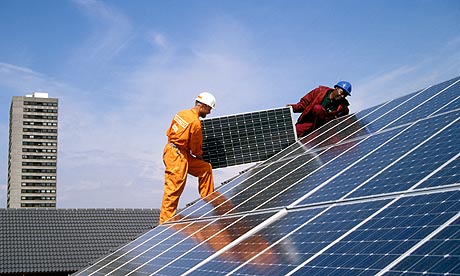
The model we have developed uses solar photovoltaic (PV) panels as an example, but it could be applied to any other form of renewable energy. Local authorities have everything they need to develop PV schemes: buildings to convert, staff to undertake the work and the capacity to borrow money at low interest rates through prudential borrowing.
A number of valuable lessons have emerged from our study.
The first is that our number-crunching proves investment to save does pay. Creating a revolving fund to pay for substantial works may involve borrowing, but this expenditure has a guaranteed income stream, so it is ultimately self-funding.
Secondly, this is an opportunity to put the business case for the green agenda within the council and to local residents. In many ways, the local authority's own benefits – free energy, cost savings and income generation – can be taken as a given. It is the wider benefits that will make such a scheme more attractive. These include community leadership, carbon reduction, security of energy supply in an insecure market and, importantly, economic development.
By far the most important lesson we found is that doing it yourself is the most financially rewarding route. The DIY local government green energy model set out in our report means in-house staff can be recruited and redeployed, local supply chains stimulated and skills developed to benefit local economies far into the future.
With misery pervading local government, councils and communities need the positive impact a well-run green scheme can bring. That impact is economic as well as environmental.
Paul O'Brien is chief executive of Association for Public Service Excellence, APSE
This content is brought to you by Guardian Professional. Join the local government network to receive more like this direct to your inbox.