
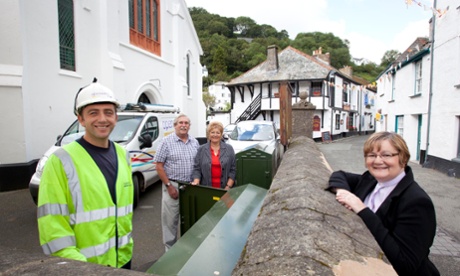
Over the last five years there’s been a quiet but determined revolution going on in the south west of England. During that time Cornwall has transformed itself into one of the best connected rural areas in Europe.
The force behind this radical renovation is the Superfast Cornwall project, a partnership between the EU, BT and Cornwall Council. Superfast Cornwall is responsible for rolling out the region’s pioneering fibre broadband network - a network that now reaches 95% of Cornish homes and businesses.
Research carried out by Plymouth University shows that the fast and reliable fibre connections have been great for the local economy. Already they’ve led to the creation and preservation of 4,500 jobs and contributed more than £186m in economic benefits.
But the good news doesn’t end there. The Superfast Cornwall project is delivering some astonishingly positive environmental plus points for the region too.
Reducing Cornwall’s carbon footprint
By 2020, superfast broadband will have reduced Cornwall’s carbon footprint by half a million tonnes. That’s around one tonne of CO2 saved per superfast connection per year - equivalent to an impressive 10% reduction per person.
These findings follow environmental monitoring work carried out by a team from the project. Using robust methodology the team looked closely at the specific environmental impacts and carbon abatement potential of Cornwall’s superfast fibre network.
In particular, the researchers quantified the amount of carbon and energy consumption that was involved in rolling out and running the network.
Studying the full carbon impact
This includes everything involved - from building the infrastructure and deploying fibre cabinets to calculating the amount of electricity needed to power the network, as well as the fuel burned by BT vans, trucks and other vehicles.
The team also took into consideration the carbon footprints of engineers visiting fibre broadband customers, cabinets and exchanges.
They then contrasted the net total of those calculations against a quantification of the positive carbon and energy-saving “connectivity” impacts of the network on end-users and the societies in which they live.
Substantial ICT savings made possible by faster fibre
The researchers evaluated all the diminished carbon footprints of people able to work from home instead of commuting (in Cornwall the average commute is an energy-sapping 24 miles) or using videoconferencing instead of travelling to meetings.
Similarly, they took into consideration the carbon-diminishing results of ordering goods online rather than making journeys to the shops, or buying digital products like books and movies rather than physical ones.
They also considered savings and efficiencies made by businesses able to invest in more efficient and cost-effective cloud-based technology because of their high-speed connections.
Innovative tools make carbon abatement calculations possible
To help calculate these numbers, the researchers used innovative tools like the purpose-built Green Gauge calculator to capture carbon footprints of a sample of fibre broadband users.
A smartphone app, Carbon Diem, was also developed and given to sample users for the survey. The app provided an easy way of collecting travel-related carbon emission data and could be integrated into the Green Gauge calculator.
Overall the findings give valuable insight into how fibre broadband technology can play a significant role in helping rural communities cut carbon and save energy.
Data gathered by the research team shows that the Superfast Cornwall programme could have a net positive impact saving an estimated 581,146 tonnes of CO2 over the nine year study period (2011 - 2020) - equivalent to a staggering 25 times the carbon emissions associated with the network.
Abatement research echoes SMARTer2030 report findings
The results of the Superfast Cornwall work underpins previous formal studies such as the GeSI SMARTer2030 reports that have all forecast that the ICT sector as a whole has the potential to reduce carbon emissions from other sectors.
Ranulf Scarbrough, director of the project, is in no doubt about the significance of these findings:
“This is a study that those involved with other high-speed fibre deployment projects around the world should read with enthusiasm.”
“Not only is the Superfast Cornwall network helping Cornwall to flourish economically and socially, it’s going to help us stay clean and green for many years to come. Our network will save us 25 times the carbon it generates. 25 times. That is an incredible story.”
Superfast fibre means less pollution, less packaging and less waste
Continues Scarbrough: “Thanks to superfast broadband there will be less traffic, less pollution, and less packaging and waste.”
“But the benefits delivered by the Superfast Cornwall programme go way beyond carbon reduction figures.”
“We’ve helped hundreds of thousands of people to get online for the first time. We’ve connected remote communities from the Scilly Isles to Saltash and enabled people to access all sorts of essential online services from the NHS, schools, colleges and more. It’s a magnificent illustration of how the power of communications can make a better world.”
Content on this page is paid for and provided by BT, sponsor of the technology and innovation hub.













