WASHINGTON _ When Jordan Lawson went to see Democratic presidential candidate Beto O'Rourke, he didn't hesitate when a reporter asked his top concern: climate change.
"That's pretty much the deciding factor in terms of the future of the planet," said Lawson, 22, a Penn State graduate student who saw O'Rourke speak at State College in March.
Young people like Lawson have helped drive climate change from a piece of the Democratic discussion to the top tier of issues driving the 2020 presidential primary, with nearly every candidate trying to show they are taking the issue seriously and one, Washington Gov. Jay Inslee, basing his entire campaign around it.
For many on the left the environment has become a litmus test, with vocal factions urging candidates to embrace the Green New Deal, a sweeping statement of goals to combat climate change and tackle other liberal priorities, though it lacks details about how to achieve them.
"The Democratic Party's future and also its current electoral prospects hinge in large part on turnout of millennials and Gen Z, and its become very clear that climate is a top issue for young people," said Julian Brave NoiseCat, director of Green New Deal strategy at the liberal think tank Data for Progress. "If you want to get their votes, I think at this point you have to show that you really are taking climate change seriously."
The issue has been building for years, said Patrick Murray, director of the Monmouth University Polling Institute.
"It moved from a secondary issue, an add-on, if you were _ 'Oh, by the way, what's your position on the environment?' _ to becoming one of the primary ways that Democratic voters are using to sort out the candidates," Murray said. "It's an influence of younger voters, but it has spread throughout the party."
Environmental advocates point to several factors. Young people looking decades ahead worry about the consequences for them and their families. Meanwhile, the increasing frequency and intensity of wildfires, hurricanes and other extreme events have turned the debate from abstract warnings to something everyday people see and feel.
"The longer you're planning to be here, the more you stand to lose if we fail to tackle climate change," said South Bend, Ind. Mayor Pete Buttigieg, the 37-year old presidential candidate. "This is no longer a theoretical issue that's happening in some other place like the arctic, or some other time like the distant future. It's happening here, it's happening around us."
At a campaign stop in Marshalltown, Iowa, in April, Buttigieg took a question on the environment from 17-year-old Nathan Wegner, a member of Kids for Boundary Waters, which aims to protect the environmental treasure on Minnesota's northern border.
"It's going to be our world in the future, so all if all of this climate change keeps going, we won't have this world that we have today," Wegner, of Omaha, Neb., said in an interview.
The Sunrise Movement, a group made up of young activists, has forcefully pushed Democrats to support the Green New Deal, and in March, more than 1 million students in more than 100 countries skipped school in a "climate strike" to demand action.
Activists also said the media focus has been sharpened by a 2018 United Nations report that warned of drastic consequences, including for crops, coral reefs and coastal populations, unless carbon emissions are dramatically reduced, fast.
"For a very long time there was a very sterile way of communicating about climate change that never really brought home to people the threat, the scale of the threat that we're facing," NoiseCat said.
Yet the urge to take drastic action may also run up against efforts to reach swing voters in industry-reliant parts of the Midwest, including Western Pennsylvania and Michigan, where some people are wary of environmental restrictions that might affect their livelihoods.
"The Green New Deal is an issue," said Darrin Kelly, president of the Allegheny County Labor Council, an umbrella group for more than 130 unions in the Pittsburgh area. "We can't just abandon hundreds of thousands of middle-class workers that work in the energy industry."
The resolution, a non-binding statement without specific policies or costs attached, calls for reducing net carbon emissions in the U.S. to zero within a decade. It urges an overhaul of the economy, with massive investments in renewable energy, a revamp of transportation systems to focus on rail and electric vehicles and guarantees of good-paying jobs and health care, and would likely cost trillions of dollars.
It has been co-sponsored by many of the top Democratic candidates for president, including Sens. Bernie Sanders, Cory Booker, Kamala Harris and Elizabeth Warren, though some say it is an aspiration, not policy.
The plan has also been embraced by the GOP, as a punching bag. Republicans have pilloried it as part of a "socialist" agenda of government intrusion.
President Donald Trump has cast doubt on climate change and the science behind it, even saying that noise from wind turbines causes cancer. In Central Pennsylvania Monday he railed against Democratic efforts to rejoin the international Paris Climate Accord, which aimed to reduce greenhouse gases, and which he pulled out of.
"Every Democrat running for president wants to reopen the economic assault on Pennsylvania by crippling the coal and shale industries and by crippling your now, once again, great steel industry," Trump said. "If you want American energy, you have to go Republican."
Some Democrats see political risks in going too far. House Speaker Nancy Pelosi, D-Calif., has dismissively referred to the Green New Deal as "the green dream, or whatever they call it." Instead, she has advanced ideas with broader support, such as keeping the U.S. in the Paris agreement.
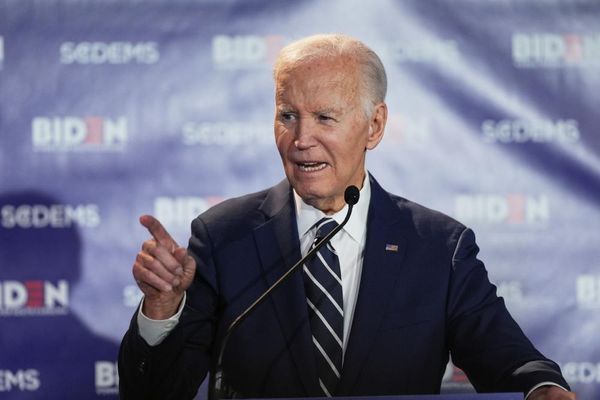
Joe Biden has called for a "green energy revolution," but has faced attacks from his rivals and some liberal groups for not going far enough. He has pledged to lay out his climate plans soon, but at a rally in Philadelphia Saturday argued that nothing can happen to address the environment unless Democrats win.
"The first and most important plan in my climate proposal is: Beat Trump," Biden said.
NoiseCat argued that Republicans have more to fear politically, saying their dismissive stance gives Democrats an "unprecedented opportunity" to be "the party that takes climate change seriously."
Ryan Costello, a former Republican congressman from Chester County, Pa., doubted that Democrats will pay much of a political price for a proposal that hasn't been enacted, but said the Green New Deal could be part of GOP attacks on a "laundry list" of big-government priorities.
At the same time, Costello, who now works with a group urging a carbon tax to address emissions, said Republicans risk losing more ground with suburban voters if they refuse to address the issue.
"More people are being educated about climate change as they feel the impacts, and as the topic gets more media attention," he said. "There's a visceral human experience."