In these challenging times, where funding is tight, it is more important than ever for charities to demonstrate their effectiveness to funders and stakeholders.
Charities that are able to show how their work achieves outcomes, changes lives and prevents costly public interventions later down the line are more attractive in bids for contracts and to prospective partner organisations. This can lead to greater diversity of funding and better links with other organisations in the same field – thereby relieving pressures around capacity and sustainability.
However, impact and value are not straightforward things to measure, especially for charities whose work is about helping people, changing – and even saving – lives. It is simpler to measure the direct financial impact of the Citizens Advice service helping someone get a debt repayment plan than, for example, measuring how advising renters on their rights can help keep a roof over their heads and prevent homelessness. To address this we required a new approach.
Getting started
Over the past few years, we have invested in building our small team of impact researchers, drawing together expertise in evaluation, social research and measuring outcomes. They have worked, with resources from the Inspiring Impact programme and voluntary sector thought-leaders like New Philanthropy Capital, to meet the challenge.
Last year the team published Citizens Advice’s first impact report, Making the Case, which considered the outcomes we achieve for our beneficiaries. However, we wanted to go further and show how our advice not only solves problems but also boosts health and finances by demonstrating how our service contributes to savings for taxpayers. This involved strengthening our evidence in two important ways.
First we surveyed a large, representative sample of our service users. We conducted telephone interviews with over 2,700 people, asking them detailed questions about their issues prior before and after engaging with Citizens Advice. We also asked about their experiences of our organisation and what happened three to five months after they received our help. From speaking to advisers we knew we helped many people but the survey enabled us to quantify this for the first time. Results showed that Citizens Adivce helped solve two in every three people’s problems.
That led us to the second important step, putting a value on our service. Using the cost benefit tool that New Economy has made freely available, we have, in a report published this week, been able to show the financial value of the Citizens Advice service. We found that for every £1 invested in our service, we save the government £1.50 and bring wider economic benefits worth almost £9.
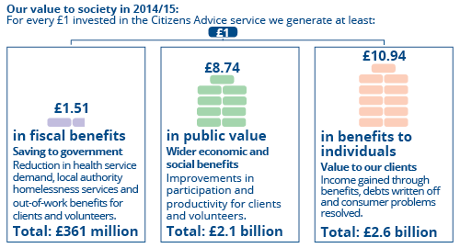
The tool enables us to work out how much we save various government departments. For example, we can assess how much our employment advice is helping people stay in work, which in turn avoids the costs of benefit payments or how us helping people sort out their money worries can reduce health problems, thereby taking some pressure off GP surgeries and the NHS.
Our findings that show the impact we have on people’s health, and their mental health in particular, are especially significant. We’re now able to demonstrate not only the benefits our service brings for local authorities and the Department for Work and Pensions, but also to the Department of Health and local commissioners of health services. We want to work more with GPs so they can prescribe advice as well as medical care.
Lessons learnt
It’s no easy task for a charity to demonstrate its value, but in the course of this work we came upon some broad principles that other organisations might find useful when considering these same problems.
This is a long-term process. Organisations need to consider what evidence they have available and how they might fill the gaps with new research. Our impact research and financial modelling is the product of many years work – implementing standardised impact measurements across the Citizens Advice service and building up quality evidence over time. This involved a clear strategy and the commitment of our staff and volunteers who diligently record client data on a daily basis.
Standardised measurements of results are necessary to make sure the evidence is strong. These metrics should be continually reviewed and formally updated each year, where necessary, to ensure the outcomes are recorded and evaluated consistently.
Charities must think carefully about what arguments they want to put across and how they represent their service. It can be tempting to go for things that are easy to prove but that might not be the most important benefit provided by the service. Charities should start by deciding on their long-term goals and the difference they are seeking to make. Then it’s crucial to look at what difference their work currently makes before looking to build evidence on this.
Figures are not everything – for most charities, there will be aspects that cannot be defined in financial terms. That is why we have published a full impact report, including case studies of personal stories. We have been transparent about what we’ve included in our financial modelling and what we haven’t.
These are tough times for charities and the sector is under a lot of scrutiny. Demonstrating the impact and value of what we in the third sector do requires investment. But it is worth it, not just to engage with funders and respond to external pressures, but ultimately to put ourselves in the best possible position to continue our work and support those who rely on us.
For more news, opinions and ideas about the voluntary sector, join our community – it’s free!