Chinese car brand BYD sold more vehicles globally than Ford for the first time in 2025, knocking the U.S. manufacturer off the list of the world's top six carmakers.
For many industry experts, the overtake of America's flagship car brand was a foregone conclusion as Chinese carmakers keep hitting new heights in what seems to be an unstoppable global ascent.
One of the keys to BYD's performance has been its expansion in Latin America, with the region accounting for over a quarter of its sales outside of China in 2025.
In major markets like Mexico and Brazil, as well as emerging ones like Colombia, BYD and other Chinese firms are taking on established competitors from the U.S, Europe, and other Asian countries.
But with rising regulatory barriers and competitors quickly adapting, BYD still faces an uphill battle in staking its claim over the Latin American market.
Chinese carmakers on the rise in Latin America
Chinese firms have rapidly gained ground across Latin America in recent years.
In Brazil, the region's largest market, BYD rose from 10th to 7th place in market share in 2025, with the country's National Federation of Automotive Vehicle Distribution recording a 46.2% increase in new vehicle registrations for the brand.
In comparison, market leader Volkswagen posted an 8.9% increase in registrations, while U.S. carmaker General Motors (GM), which clawed onto its third place standing, saw a 13.7% reduction in new car registrations as it lost ground to BYD.
Other Chinese car brands like Chery and Great Wall Motors also outpaced rivals, posting a 17.2% and 42.1% increase in registrations, respectively.
The story is similar in Mexico, the second-largest market for Chinese EVs, where firms have also expanded rapidly.
"In recent years, Chinese brands have gone from being a minor player to becoming one of the key features of the Mexican automotive market," said Jaime Pedraza, an automobile industry consultant in Mexico.
While BYD does not publish its sales figures, Pedraza estimated that the company sold 75,000 units last year, marking an 18.6% rise year-on-year and putting it in 8th place for market share.
Meanwhile, GM and Volkswagen – ranked second and third, respectively – saw a decline in new vehicle registrations the same year.
In emerging markets like Colombia, BYD has also posted astronomic growth, increasing its sales by 137.2% in 2025, according to the country's National Federation of Merchants (Fenalco).
Why are Chinese brands growing so quickly?
Industry experts say the success of BYD and others lies primarily in their ability to offer a better product at a cheaper price.
"In a market where buyers are sensitive to value for money, that... has proved very effective," explained Pedraza.
Chinese firms offer better value-for-money, with features like high-tech cockpits, infotainment, and driver assistance – usually reserved for premium lines in European and American brands – available in their most basic models.
Firms like BYD also have a fundamentally different business approach to traditional brands, says Bill Russo, founder and CEO of Automobility Limited, a Shanghai-based consultancy focused on the future of mobility.
"[Chinese firms are] highly pragmatic—entering markets with the right mix of pricing, financing, and distribution partnerships rather than relying on brand heritage," Russo told International Business Times.
He added that Chinese car companies have carved out a competitive advantage in the Electric Vehicle (EV) space, something that traditional brands have been slow to adopt.
"Chinese automakers are optimized for speed, cost, and integration of software and electrification, whereas many legacy players are still managing the transition," explained Russo.
In countries like Colombia, BYD is not only capturing the EV market – it is creating it. Last year, the South America nation saw a 115% increase in electric vehicle registrations, the majority of which were sold by BYD.
"Chinese brands have played a particularly significant role in boosting the supply of electric and hybrid vehicles," Eduardo Visbal, Vice-President for Foreign Trade and the Automotive Sector at Fenalco, told International Business Times.
The situation in Mexico is similar, where EV sales grew 56% in 2025, with BYD boasting a 56% market share for Battery Electric Vehicles (BEVs) and 74% for Plug-in Hybrid Electric Vehicles (PHEVs).
"BYD and other Chinese brands arrived at just the right time: when electrification was starting to gain traction but the range of options was still limited and expensive compared to traditional alternatives," explained Pedraza.
Putting the brakes on BYD
As BYD and other Chinese carmakers continue their Latin American expansion, rival firms are scrambling to adapt.
"Competition from China has forced them to offer more technology for the same price or to better justify their prices through quality, brand reputation and service networks," explained Pedraza.
He said that European, American, and Asian car firms have begun to shift towards a more localized commercial strategy, focusing on improving entry-level models and offering value-for-money.
But Russo suggested that these firms are still lagging behind Chinese carmakers: "European and U.S. players remain constrained by higher cost structures and slower decision-making cycles, while Japanese and Korean firms are more competitive but still cautious in their EV rollout."
BYD is also facing increasing regulatory hurdles as national governments face political pressure to reign in Chinese firms.
In January, Mexico introduced a 50% tariff on finished car imports from countries with which it does not have a Free Trade Agreement, a move widely seen as targeting Chinese brands.
"The official aim is to protect local industry and jobs, as well as to address concerns about undervaluation and unfair competition," said Pedraza. But he also noted that the move comes "against a backdrop of external political and commercial pressure, particularly from the United States."
Meanwhile, in Brazil – where automotive bodies have accused Chinese carmakers of "dumping" by selling cars for too cheap – authorities have begun to tighten the screws on BYD.
In January, the government allowed a tax exemption on "knocked-down" kits to expire, effectively removing the zero tariff rate for Chinese manufacturers importing partially disassembled cars.
But Chinese firms have proven their agility in adapting to these regulatory headwinds.
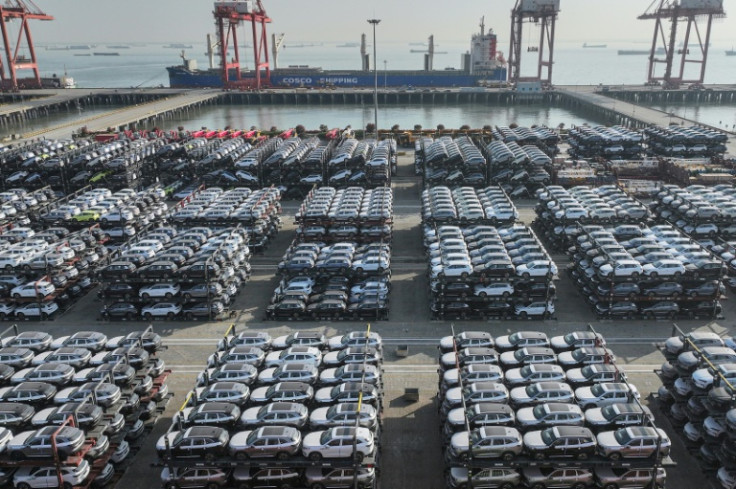
In the last quarter of 2025, BYD and others ramped up vehicle imports in Mexico, bolstering their reserves of cars before having to pay heightened duties from January onwards.
BYD has also invested in local manufacturing to avoid import taxes.
In October, BYD inaugurated a vast factory in Camacari, Brazil, on the site of the shuttered Ford plant, with the American firm closing up shop in the country. It is also among the finalists to buy a Nissan–Mercedes-Benz car plant in Mexico.