CHICAGO _ Outside a West Side medical clinic late last summer, a fed-up Tyler Lumar told Chicago police he'd had enough.
Officers were called to the East Garfield Park clinic after Lumar, a 22-year-old with asthma there for a first visit after his longtime doctor died, yelled and allegedly threatened a physician who refused to refill his cough medicine prescription, then tossed papers on the floor and said he would come back and shoot the place up, according to a police report.
"I'm so tired of racism, bro," Lumar said outside the clinic, according to a Chicago police squad car dashcam recording of the encounter, alleging the incident began when the doctor accused Lumar, who has no criminal record, of reselling his prescription drugs. "That's racial profiling. I don't gangbang, I went to Oak Park and River Forest (High School). I played baseball."
Police let Lumar go without charges, but moments later the same officers stopped him as he walked down Madison Street, records show. They arrested him because a western Illinois county had issued a warrant over an overdue $25 payment in a misdemeanor traffic case but had failed to remove the warrant when Lumar paid up.
Less than 24 hours later, the father of one attempted to hang himself in a Harrison District police holding cell, police said. As a result, he's suffered massive brain injuries and can no longer move or speak; he's spent the past year on life support, racking up medical bills of about $2 million.
Meantime, his family has tried to determine why he was kept locked up overnight on a low-level warrant even though he had the cash, according to an arrest report, to bail himself out. They have filed a federal lawsuit alleging Lumar was wrongfully detained and that Chicago police failed to check on him every 15 minutes in his cell _ even falsifying the inspection logs, a record-keeping breach the lawsuit says is a common police practice in Chicago.
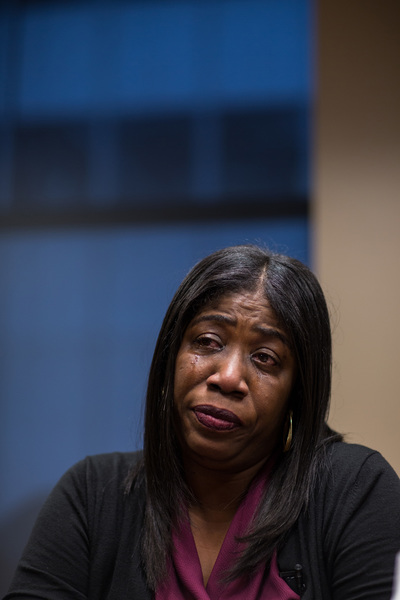
"My son never should've been there (in a police lockup)," his mother, Lisa Alcorn, a Verizon Wireless training manager from River Forest, said in an interview as tears streamed down her face.
The case is not only another example of the city's and county's alleged failure to keep nonviolent offenders from languishing in jails _ an issue experts say disproportionately affects the poor and minorities _ but also highlights the tightrope that defendants walk even in misdemeanor cases, where a slightly late payment can land someone in jail.
Lumar's longtime girlfriend, Casey Tecate, 23, who once thought of becoming a cop herself, said "it definitely is scary; it goes to show it could literally happen to anybody. I feel like they, meaning the police, just don't ... look at certain people as people. They're just like 'Oh (this is) some person from the West Side of Chicago.' They weren't looking at him as Tyler Lumar: a dad, a brother, a son."
She spends part of most days in a Des Plaines rehab hospital with the now 23-year-old man she had planned to marry. Sometimes Tecate brings their daughter, Savannah, now 4.
Alcorn, who visits her son after work, said she hopes the lawsuit will not only help the family pay for Lumar's medical care but change how Chicago police treat those they arrest. "In Chicago, you should be scared for your son," she said.
Her lawsuit alleges Chicago police wrongfully detained Lumar, concealed from Lumar the fact that he could have bonded himself out and were "deliberately indifferent" to his medical needs by failing to check on him every 15 minutes as required. The city is responsible, too, the lawsuit alleges, because it ignored the widespread police practice of falsifying cell inspection records.
The Cook County sheriff's office, which briefly housed Lumar in the county jail, is also being sued.
Attorneys for the city and its police officers say they did nothing wrong and have asked a judge to dismiss the case. "Plaintiff has failed to plead that Lumar's suicide attempt was a constitutional deprivation instead of just a tragic decision by Lumar himself," the police officers' attorneys wrote in a recent court filing.
In response to Chicago Tribune inquiries, Chicago police did not say why Lumar remained locked up despite having the cash in his pocket to bond out.