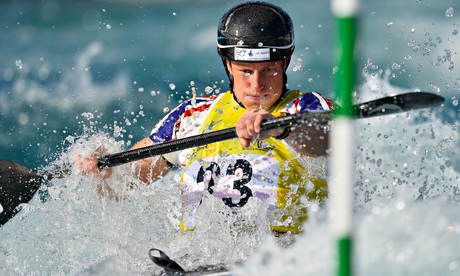
If ever you require an example of the cruelty that resides within elite competition, it is worth turning to Fiona Pennie. The Scottish canoeist knows all about crushing disappointments and heartbreak having missed out on the London Olympics despite being the strongest Briton in the K1 slalom category. The scars were deep, the memories remain vivid.
The qualification process was ruthless and even reflecting on it now brings a certain pain. Instead of awarding the solitary Team GB spot to the most consistent performer over a prolonged spell, the paddlers faced off against each other in three races across a weekend four months before the Games.
In a winner-takes-all scenario, one mistake in the space of a few minutes and all the work that went before could go up in smoke. Being the favourite and most successful in the run-up meant nothing.
Pennie was beaten at Lee Valley by Lizzie Neave, a friend as much as a rival. There is a striking image from the immediate aftermath when a jubilant Neave partakes in various media duties while Pennie passes by in the background with an inconsolable look etched across her face. All that work, those endless hours on the water and in the gym, did not produce the desired result. “It didn’t go very well for me,” she concedes now, pausing for reflection. “I made crucial errors but let’s just say it wasn’t my weekend. It was hard to take at the time but I bounced back … eventually.”
Her use of “eventually” implies a lengthy postmortem, a spell of deep introspection and an attempt to understand where it all went wrong. Not quite. “Three weeks after missing out I was third in the Euros, so that helped me get the disappointment out of my system,” she says. “And I won the Europeans the following year, so I’ve a history of bouncing back. I tend to use those disappointments as a motivational tool.”
Pennie has eight medals from world and European championships and her tale has not yet been fully told. The happy ending may still arrive. She knows how to recover and this summer, as the cycle comes full circle, she will attempt to qualify for next year’s Olympics.
The 32-year-old may have missed out on the chance of being a host participant but Rio gives her a shot at redemption. How sweet it will taste if she can qualify at the end of a season which also includes the European championships this weekend and the world championships in September.
There is, however, a twist in the qualification process. Starting with a medal in Germany this weekend, where Pennie will take to the water on Friday afternoon, would be a big help. “If you medal at the European championships and also at the world championships, and nobody else within your team comes in the top 10, you automatically get the place,” she explains. “If that doesn’t select one person, we will have those three selection races at the end of October. Your best two races count and whoever wins gets the qualification space.”
It is difficult to think of another sport where you spend so much time being team-mates but when it comes to reaching the greatest stage those who you train, eat and often share a room with are the opposition. “It’s an odd environment,” Pennie admits. “We’re team-mates for the rest of the cycle. You’re working alongside each other but against each other at the same time. You want to do well for your team but also for yourself.
“We all get on but there’s a rivalry, too,” she adds. “You have to gel as a team. You’re always pushing each other and it’s a natural competition but at the same time we get the same funding; we’re using the same services and information in the exact same way. It’s very different to a lot of sports. We don’t work as individuals but it is, essentially, an individual sport.”
There remains a purity to Pennie’s approach despite the disappointments. Even after the heartache, her enthusiasm shows no sign of waning but as one of the leading names in her sport in Britain does she not sometimes crave more attention? For the vast majority, after all, canoeing is perceived as a niche pursuit which you might catch a glimpse of every four years – even if participation numbers have increased since London.
“I don’t do it for a profile,” Pennie says. “If you ask anybody at the top of their sport – even those with high profiles – they’ll say they’re only doing it for the love of it. If you don’t enjoy it, it’d be a very difficult job to do every day. Obviously, it would be nice to be out there a bit more but I go canoeing, I enjoy my sport and that’s all that matters.” That, plus a successful campaign.
National Go Canoeing Week is taking place across England until 31 May. To find activities taking place at a club near you, visit gocanoeingweek.org.uk