Youth suicide (see below) is not declining. The Yomiuri Shimbun has published a number of stories featuring the circumstances of young people under pressure and their backgrounds. We asked three experts about what efforts and attitudes are necessary to reduce youth suicides. The following are excerpts from the interviews.
(From The Yomiuri Shimbun, June 6, 2018)
Create places of belonging where they are not alone
The perception that suicide is a "personal choice" is mistaken. In the majority of cases, there are a myriad of social factors behind it, such as isolation, poverty and overwork, so we ought to think of it as a social problem. First of all, we need to recognize that anyone can be driven to suicide.
Since 1998, the suicide rate, which once exceeded 30,000 per year, has been declining against a backdrop of economic recovery and measures to address multiple debts and unemployment. However, suicides among young people alone have not fallen. The main targets for conventional measures were middle-aged and elderly people facing economic hardship. One cannot help but say that sufficient support was not extended to young people.
In fact, the causes of youth suicide are not well understood. This is because roughly 70 percent of adults leave a suicide note, while for people under 20, nearly half take their own lives without leaving a note. However, one conceivable cause might be that their family, school or peer group becomes their entire world.
Perhaps a friend said mean things to them, or their significant other broke up with them, or they gave up on their dream school. From the perspective of an adult living through the vicissitudes of society they may seem like trivial events, but for young people living in a narrow world, there is a tendency to see them as problems serious enough to lead to suicide.
Another possible cause is difficulty in talking to the adults close to them. In most cases, adolescents talk about their problems with a close friend rather than their parents or teachers. There have even been cases in which the friend also lacked a trusted adult to talk to and gradually came to feel the same way, resulting in the two taking their lives together.
What is important is being able to say "Let's talk to someone" instead of "Let's die together." I hope that "SOS education (see below)," which has already been implemented at schools in Adachi Ward, Tokyo, will spread across the nation. Young people who lack a connection with school, such as truants, dropouts and shut-ins, also have a tendency to experience greater isolation. We need to make active efforts to create accessible places where they can belong, whether it's privately operated children's cafeterias or academic tutoring schools.
I got involved with prevention measures in Akita Prefecture starting in 2001, which had the worst suicide rate at that time. We provided private health counseling for people with a high risk of depression in a model community and distributed educational pamphlets to every home that resulted in a 50 percent drop in the suicide rate in the target community.
Public-private cooperation is crucial for these kinds of efforts, but looking at the situation nationwide, the level of enthusiasm seems to vary widely between local governments. Compared to actual suicides, there are said to be 10 times as many people who find it hard to go on living, including those who attempt suicide. We ought to start by reappraising the provision of support to these people as part of the role of local governments and their elected leaders.
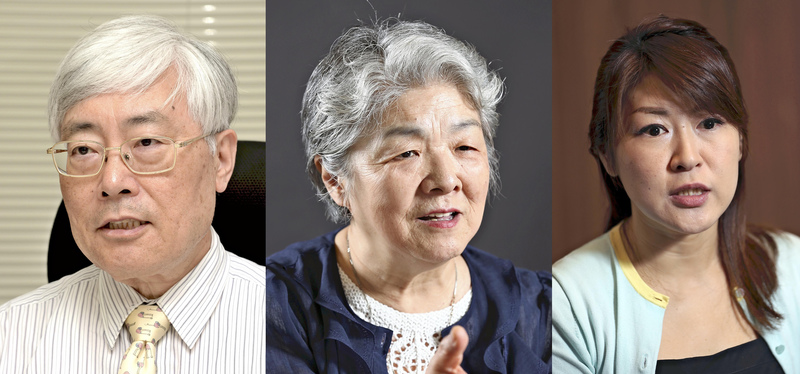
--Yutaka Motohashi
Director of the Japan Support Center for Suicide Countermeasures
Motohashi is an expert in public health. After serving as a professor at Akita University's Faculty of Medicine, among other posts, he became the inaugural director of the Japan Support Center for Suicide Countermeasures, launched in April 2016 as a core organization for the advancement of the government's suicide prevention measures. Publications include "Jisatsu ga Hetta Machi: Akita-ken no Chosen" (The town where suicides went down: Akita Prefecture's challenge.) He is 63.
--This interview was conducted by Yomiuri Shimbun Staff Writer Yuri Ishihama.
Adults need to be on the lookout for signs of distress
"My child would never take their own life." Whenever I listen to the parents of a troubled child, they all seem convinced of this.
Until my eldest son, a police officer, took his own life in 2005 at the age of 34, even when I saw him looking worried or worn out, I never believed he would die. It was only after I lost him that I was filled with regrets about what I should have done. The adults in a child's life may not see their problems as being serious at the time, but the key to suicide prevention is whether they can keep in mind that it might end in death, and treat it seriously.
There is also the approach of urging young people to "send out an SOS." However, I wonder if in many cases children are not already sending an SOS by appealing directly to parents and teachers or by falling ill. More important is adults' sensitivity and readiness to lend a keen ear to the SOS. Having an adult listen seriously to their problems will likely be a source of moral support when they run into obstacles later in life as well.
When you cannot clearly determine why your child committed suicide, as it was in my case, the bereaved parents cannot help but blame themselves. There are even cases in which parents blame each other, with one saying, "You were wrong to say such and such." No one else can understand the pain inside them.
In that sense, support groups for surviving families are extremely important. Because they have all lost a loved one, it is all right to feel sadness, or even to laugh sometimes. In support groups, the surviving family members themselves set up and run the meetings, including arranging the desks and chairs. Even if the sadness never goes away, they should be able to "feel needed by someone" and go on living.
Our support group network receives about 10,000 requests for counselling annually from surviving family members and those surrounding them. Many young people who took their own lives had lost self-confidence due to worries such as their studies, bullying, physical punishment or unrequited love, and then could not accept themselves for who they were.
It seems that schools and parents are too demanding that they grow up in a one specific manner. As a result, young people, driven into a corner within the framework, fall into a situation in which they are forced to end up feeling they have no choice but to commit suicide.
Having lost my son, I want parents to constantly communicate their love to their children. Even if they do not fit in at their school or society, tell them out loud, "If nothing else, I accept you." To get children to feel that they are happy to be alive, it starts with those closest to them.
To reduce suicides even a little, the cooperation of surviving families is needed. I would like a research organization to be set up that will listen to and analyze the experiences of surviving families, and use them to create preventive measures. There are certainly more than a few people who would cooperate out of a desire to see that no one else has to bear the same sadness.
--Sachiko Tanaka
Representative Director of Zenkoku Jishi Izoku Renraku-kai
Founded Ai no Kai, a support group for family members of suicide victims, in Sendai in 2006. About 40 groups participate in Zenkoku Jishi Izoku Renraku-kai, a nationwide network for suicide survivors' groups, which was founded in 2008. Started the Miyagi no Hagi Network, also in Sendai, in 2015 to offer counseling services to prevent suicide. Resides in Sendai. She is 69.
--This interview was conducted by Yomiuri Shimbun Staff Writer Ryo Fujii.
Communicating desire to die is simply a cry for help
I have been offering counseling for teens experiencing difficulties in their lives via the LINE social networking service since 2012.
After listening to the troubles of roughly 5,000 people, what I feel is that while young people may say, "I want to die" or "I want to disappear," they are really crying out, "I want to live." I feel strongly that it is important for us to first understand and take seriously their internal feelings that "I actually want to live, but my current reality is so bad that I want to die."
When I listen closely to young people who say they want to die, in the majority of cases, problems at home are at the root cause. In about 30 percent of cases, they are clearly suffering abuse from parents, but the most common problems are not wanting to be at home because of discord between their parents, and excessively high expectations from parents that many people might find difficult to think of as being directly linked to suicide.
One high school girl told me, "I get bullied and I want to die." However, when I listened more closely to her story, I learned that her parents only finished high school and had an inferiority complex about academic achievement, so they had strong expectations that their daughter would go to a good university. While being unable to live up to her parents' expectations and feeling pressured, she also suffered bullying. And she brooded that she would be better off dead.
Compared to the period of high economic growth, it seems like there is a greater sense of hopelessness in adult society these days. Instead of unilaterally imposing their unfulfilled dreams on their children, it is necessary for parents to solve the problems they have to confront themselves.
Home is supposed to be a place where one can feel at ease. However, if they do not have sense of belonging at home, young people will look to the internet for emotional support. Their place of belonging becomes a space where people listen when they tweet "I want to die" on Twitter. The serial murders that claimed nine lives in Zama, Kanagawa Prefecture, epitomize how this can be used for malevolent purposes.
We need places to deal with the feelings of young people. I grew up lonely and attempted suicide myself when I was young. I started LINE counseling because I wished that someone had listened to me. As we found out from The Yomiuri Shimbun's survey, counseling through social media is spreading among local governments little by little. The increase in counseling is welcome.
However, I feel that there are some young people who will hesitate to talk with local governments for fear that their problems might become known to their school or be reported to the police. To lower the hurdles, a system where one can see the faces of the counselors should be set up and it must be ensured there are enough people available during evening hours. Finally, the most important thing is to acknowledge the way these young people have been living and to accept who they are, rather than flatly denying their feelings or lecturing them.
--Saori Okada
Director of a nonprofit organization Teenagers' Mental Support Association
Mental health counselor. Began counseling on the Line social network service as a personal project, and established a nonprofit organization in 2015. In addition to publishing personal experiences of her parents' divorce, bullying and domestic violence on her blog, she also appears on a weekly radio program for young people dealing with problems. She is 45.
--This interview was conducted by Yomiuri Shimbun Staff Writer Asako Ishizaka.
--Youth suicide
According to government statistics, there were 21,321 suicides last year, the eighth straight year of decline. Youth suicides were the only exception, increasing over the previous year to 567. A survey by The Yomiuri Shimbun in April found that 31 local governments will begin offering suicide counseling this fiscal year or later via social media familiar to young people, such as LINE, accounting for 30 percent of prefectures, designated cities and prefectural capitals.
--SOS education
An educational program to teach young students coping methods for various difficulties and stress, such as talking with adults close to them, it was incorporated into the government's comprehensive measures to prevent suicide that were revised last year. The Adachi Ward office in Tokyo started a special class called "Jibun o taisetsu ni shiyo (Care for Yourself)" in December 2009, and public health nurses make visits to the ward's elementary, junior high, and high schools.
Read more from The Japan News at https://japannews.yomiuri.co.jp/