Debates over the government's policies for housing and development – the Green Deal, planning reform and the localism bill – have largely ignored a key question for the housing sector: how the design of our homes will have to change.
As I never tire of pointing out, affordable and sustainable housing is not just related to the purchase price, though that is important; it must also relate to the running costs of the home, local employment and transport links for drivers and non-drivers alike.
If we encourage our developers to build new homes on cheap land around our towns and cities, they will happily build rabbit hutches with tiny rooms and tiny gardens that only just comply with design regulations. Some will be marketed as "affordable", mainly because they are small, even though their running costs will quickly become unaffordable as fuel prices soar.
If we wish to avoid plunging ourselves into fuel poverty in the very near future, our house-building criteria will have to change. For some of us, our total energy bills are now more than our mortgage payments; energy efficiency is fast becoming our number-one consideration.
What also influences our home lives is space. When the excellent Parker Morris space standards for social housing were abandoned in 1980, floor areas gradually shrank and housebuilders had to have small furniture specially made to showcase their properties.
Thankfully, moves are now afoot to reinstate a modern version of the Parker Morris standards so that the British will no longer have to live in the smallest homes in Europe. When you are designing a highly insulated, energy-efficient building, the proportion between the total internal floor area and the accumulated areas of the ground floor, external walls and roof has a profound effect on energy efficiency, which is compromised by irregular plan shapes and small floor areas.
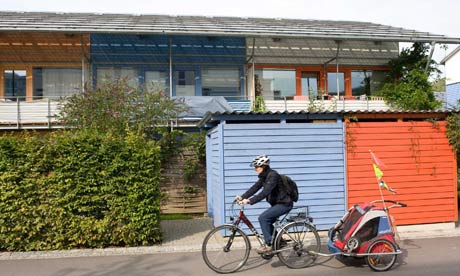
While we can look forward to larger rooms in our new houses, we will have to get used to simple rectangular plans and smaller, triple-glazed windows and doors. Higher levels of insulation will mean thicker external walls and higher levels of air-tightness. These compromises, if the house is well constructed to our Passivhaus standards, will result in a cut in demand for energy, huge improvements to internal air quality, comfort all year round in every room and no need for a conventional central-heating system.
Our government still aspires to build only zero-carbon new homes from 2016 onwards, and this will require at least an 80% improvement in energy efficiency over the leaky boxes that the current regulations permit developers to build today. Accurate, up-to-date information is hard to come by, but I would estimate that an average three-bedroomed house on mains gas costs around £1,400 a year in fuel for heating and hot water. Built to Passivhaus standards, this home costs about 15% extra to build – mainly for the extra insulation and triple-glazed windows – but it will cost less than £70 a year for fuel at current prices, and that is without the addition of renewable technologies. This is not zero-carbon housing, but it is at least 75% nearer to the target.
We have also allowed decades of misguided planning policies to socially engineer patterns of new development. We must embrace a more enlightened policy to ensure new development in our smaller towns and villages where people want to live and work. If the government wishes to encourage more "affordable and sustainable" housing to be built, we must build to high architectural standards.
In the short term, new policies will mean slightly higher build costs for new homes – both for land and construction – but in the long term it should reduce some of the local nimby resistance to well-designed village developments, while providing a much-needed supply of real affordable homes.
Philip Newbold is director of New Bold Design and a Passivhaus consultant
This content is brought to you by Guardian Professional. Join the housing network for more comment and analysis direct to your inbox