
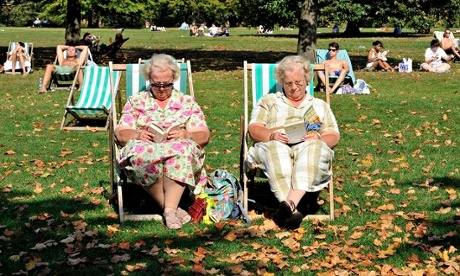
Society is failing to value and harness older people’s skills, knowledge and experience, a Guardian survey has revealed. Some 92% of the 1,250 respondents to the ageing population research believe that older adults’ contribution to society is not recognised.
One said: “On the whole the public view older people as a drain on society instead of an asset.” Another added: “Older people are mostly seen as a bundle of problems and service-needs. Their strengths, skills and knowledge are not harnessed or appreciated in a society infatuated by the cult of youth.”
In fact, older people in the UK contribute an estimated £61bn to the economy through employment, volunteering and caring. And, according to Ros Altmann, the UK government’s champion for older workers, being 50, 60 or 70 in the 21st century is no longer a predictor of physical or mental abilities. It certainly does not signify that someone has failing health and will soon be unfit to work, or no longer able to learn new skills.
Meanwhile, with numbers of people aged 75 and over expected to double by 2040 and the proportion of older people in the UK due to rise from 23% to 28% of the population by 2030, it is vital to plan for the necessary services to support our ageing society.
How can we create a society where people aren’t so worried about getting old, where there’s less stereotyping of older people, more inter-generational contact, and more opportunities to see older people as assets? What are the issues around financing retirement and how do we make sure older adults are not excluded because they don’t have enough money?
We will be discussing these questions and more on Wednesday 25 March from noon till 2pm.
The live chat is not video or audio-enabled but will take place in the comments section (below). Get in touch via sarah.johnson@theguardian.com or @GdnHealthcare on Twitter.
The panel so far ...
Simon Bottery, director of policy and external relations, Independent Age
Jonathan Morgan, senior service manager, Red Cross Independent living services in London
Helen Creighton and George Holley-Moore, International Longevity Centre
Roger Newman, older person, LGBT activist and writer on ageing
Anna McEwen, director of support and development, Shared Lives Plus
Andrew Williams, deputy honorary secretary, British Geriatrics Society
Anthea Tinker, professor of social gerontology, King’s College London
Gillian Connor, head of external affairs, Hanover
Gemma Heath, PA Consulting Group
The panellists started off discussing the main worries of people as they grow older:
 Guardian contributor
 My concerns are the usual things like, health, mortality, money etc, but having a feeling of significance is also important.
Guardian contributor From my experience of working with a number of older people, some of the main worries include stigmatisation and discrimination from the workplace. Some of the earlier comments I have read suggested that we need to better understand how we can ensure we value the skills and experience of older people in the UK which I absolutely agree with. Other major worries include social isolation and the inability to live independently within their own homes - something which we feel at the British Red Cross is a basic right and something we work tirelessly to advocate for.
They talked about the stereotypes around older people:
Guardian contributor There are certainly stereotypes surrounding the 'baby boomers' - well off retirees who maybe took early retirement, own a couple of properties, takes frequent holidays. Whilst we have made significant strides in reducing pensioner poverty in the last 20 years (previously to be old meant most likely you would be poor), there is still a significant number of older people living in poverty today. And with wealth inequality comes health inequality, as the Marmot report of 2010 pointed out.
Guardian contributor One of the common stereotypes of growing old is that older people don't contribute to society.
We need to give more recognition and pride to the contributions that older generations have already made and highlight the achievements that people are making now.
How is the environment geared towards (or against) older people taking part in their communities?
 Guardian contributor
 There are so many simple things that could be improved. For example, most people over 65 walk more slowly than the 1.2 metres per second that is assumed at pedestrian crossings. The result is older people rushing to get across a road as the lights turn to green and the traffic begins to move. As our society ages, and there are more of us over 65, it will become more and more necessary to fix basic problems like this.
Guardian contributor Agree with that Simon. In Singapore the elderly have smart cards that they can swipe at road crossings and thus slow down the speed that traffic lights change.
Guardian contributor A well designed outside environment can make the world of difference to community involvement for some older people. Small things, like well-placed benches for people to rest if they can't walk so well, public toilet provision and thoughtful use of lighting and colour to aid those with dementia can be the difference between being active and housebound. Such improvements can benefit us all ultimately. Some areas, like Manchester (who strive to be an age-friendly city) are doing better than others.
We shouldn't underestimate the role of understanding in the community too. The Dementia Friends campaign is a fantastic example of how to grow greater everyday awareness of a condition that affects many in our communities.
Guardian contributor Making active transport (walking, cycling) more accessible for older people is important. We can learn a lot from our European neighbours here. In the UK, cycling remains a disproportionately young (and male) mode of transport. In the Netherlands and Germany, for example, it is far more common for older people to cycle. Improving cycle routes to make them safer is a start. In Scandinavia, planning laws encourage mixed-use development, making journeys from the home to shops and services a lot shorter, and more accessible for older people. This has obvious health benefits, but also can reduce isolation in our older population.
What employment opportunities are there for older people? How can we value their skills in the workplace?
Guardian contributor I chair a local Medical Centre Patient Participation Group and we have a number of older members who are using their skills in the workplace. However working in later life needs to acknowledge our need for flexibility especially when our staying power might be reduced. Job sharing and part time work can be ideal for us.
Guardian contributor At the British Red Cross we actively encourage older people to volunteer for our services. We often find that there is a lack of confidence or an assumption that they won't be considered due to the stigma and stereotypes and volunteering often helps build confidence within a modern working environment. There are a number of opportunities to increase work opportunities for older people, someone mentioned previously that the 3rd sector has notoriously low numbers of older people as employees despite having the most experience of advocating for them as a group. It's a cultural shift that's needed so that young people growing up are understanding the value of older people and the many benefits they can bring to the workplace.
Guardian contributor The short answer Sarah is not enough! There is evidence of age discrimination in the workplace as the recent government report ' A New Vision for Older Workers: Retain, Retrain recruit' shows.
Interestingly more older people are becoming self employed.









Older people have different expectations these days, and that will continue to change. What might have been good enough for previous generations will not cut it in the future, and what we have is not sustainable anyway. I certainly don’t want to end up in a care home, nor do I want to have to make the decision for my parents to go into one. My fiercely independent grandmother who died aged 94 lived at home until the last few weeks of her life when she became too unwell, she is not a rare breed, I’ve worked with many many older people over the years who have just wanted to stay in their own homes. It’s about choice, having the services in place to support people to make choices about how they want to live, and be supported when necessary in later life.