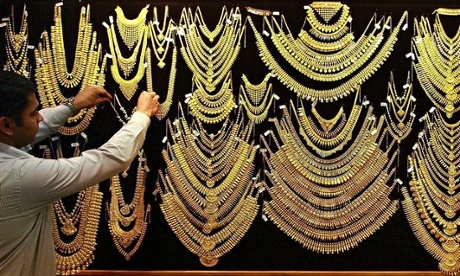
Seen as a luxury and carrying a high price tag, gold is one of the most desired commodities in the world, with 50% of the world’s consumption of new gold going towards jewellery. But unlike with food or clothes, when purchasing a product made from this special metal many consumers don’t think about where it has come from.
Gold is linked to human rights abuses, environmental degradation and exploitation, while illicit trading has helped fund armed conflict in countries such as the DRC. Although the price of gold is high, the artisanal and small-scale miners who make up 90% of the labour force can earn as little as $1-2 per day, and work in dangerous and poor conditions.
Despite new international guidelines requiring refineries to demonstrate that they have sourced gold responsibly, a Guardian investigation carried out in February 2014 found that one of the world’s biggest gold refineries was caught breaching the standards by accepting billions of pounds of gold with no paperwork.
However, some steps have been made to clean up the murky waters that surround gold. In 2010, Alliance for Responsible Mining (ARM) and Fairtrade Labelling Organisations International (FLO) launched the first Fair Trade certification for gold, guaranteeing that certified miners receive a minimum price for their gold and a premium that can be invested back into their communities. Alongside this, in 2012 The World Gold Council set up its Conflict-Free Gold Standard, which enables gold producers to provide assurance that their operations do not support unlawful armed conflict.
With many initiatives voluntary rather than mandatory, and a lack of consumer demand for responsibly-sourced gold, progress is slow and the gold industry remains 30 years behind the fresh produce industry in its supply chain management, according to Alan Frampton, managing director of ethical jewellery brand Cred.
So why is the industry lagging so far behind others in ethical practice and what does business need to do to change this? We’ll be tackling this topic with a panel of experts in our live chat on Thursday 15 January. Some of the key points to be discussed include:
- Why is the jewellery industry so far behind other sectors in terms of sustainability?
- What will drive business to be more transparent about their supply chains?
- How can we learn from reform in other sectors such as food?
- What will change consumer behaviour and drive awareness around the social and environmental issues associated with metals such as gold?
- Could ethical labelling make a difference?
Get involved
Join us on Thursday January 15 12 - 1.30pm GMT to explore why the jewellery sector is lagging on supply chain transparency and where the solutions lie. To submit a question in advance, fill in the form below, tweet us @GuardianSustBiz or email tess.riley@theguardian.com
Panel
Alan Frampton is managing director at Cred Jewellery
Gavin Hilson is programme director, MSc extractive industries, the environment and sustainability at the University of Surrey
Vivien Johnston is founder and designer at Fifi Bijoux
Estelle Levin is an artisanal mining and responsible sourcing specialist.
Amy Ross is project manager, fairtrade gold and precious metals at Fairtrade Foundation
Lina Villa is director at the Alliance for Responsible Mining
The supply chain hub is sponsored by the Fairtrade Foundation. All content is editorially independent except for pieces labelled “brought to you by”. Find out more here.
Join the community of sustainability professionals and experts. Become a GSB member to get more stories like this direct to your inbox