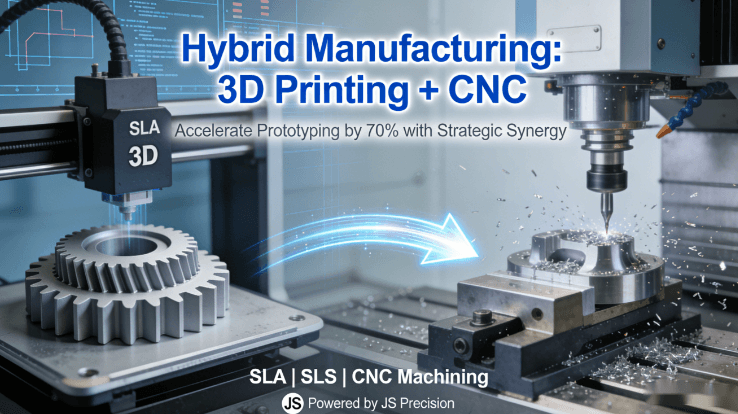
Figure 1: Strategic integration of 3D printing and CNC machining reduces prototyping cycles by leveraging the speed of additive manufacturing and the precision of subtractive processes.
Introduction
With the increasing level of competition occurring in the global environment, product iteration speed has emerged as the lifeblood for enterprises. The problem arises when conventional prototyping techniques, such as strictly using Prototype CNC Machining, turn out to be bottlenecks for innovation because of high preparation times and costs, especially when working with complex geometries or requiring frequent design iterations .
In this article, how additive manufacturing (3D printing), specifically SLA Rapid Prototyping Services, could reshape the product development process by integrating with traditional processes like CNC will be explored. Therefore, how enterprises could strategically leverage these technologies to achieve breakthroughs will be addressed below.
Why Do Global Manufacturing Leaders Include 3D Printing Prototypes at the Heart of Innovation Strategies?
As reported by McKinsey & Company's analysis of global Industry 4.0 trends, leading enterprises that integrate digital technologies such as 3d printing prototype gain a significant competitive advantage, accelerating product time-to-market by up to 30% . The strategic value of a 3d printing prototype extends far beyond simply 'making a model.' It serves as a critical tool for concept validation, real-world market testing, and enhancing internal communication, ensuring alignment across departments from engineering to marketing .
Crucially, rapid iteration through 3D printing allows companies to identify and rectify design flaws early in the development cycle. This proactive approach avoids exponentially higher modification costs at later stages, such as during tooling or production, thereby optimizing the overall rapid prototyping cost. This leads to a pivotal question: with various technologies available, how does one make an informed choice?
SLA vs. SLS: How to Make an Informed Choice Between Precision and Strength?
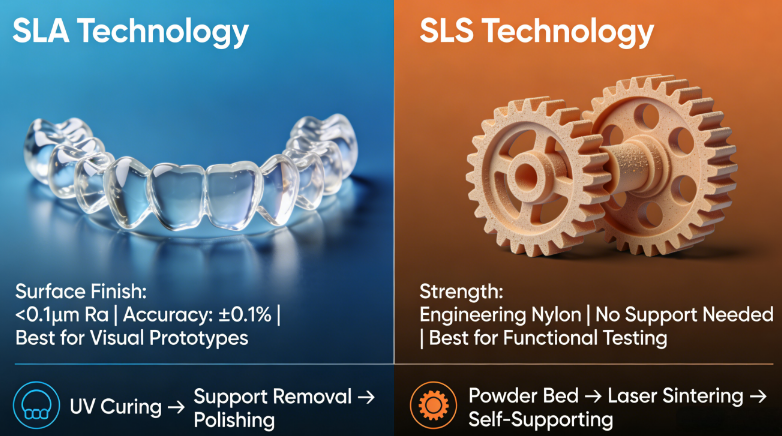
Figure 2: SLA excels in high-detail visual prototypes, while SLS is ideal for complex functional parts without support structures, as shown in this technical comparison.
When selecting a rapid prototyping technology, understanding the fundamental differences between Stereolithography (SLA) and Selective Laser Sintering (SLS) is essential. The decision often centers on the trade-off between surface quality and functional durability.
The following table provides a clear comparison:
|
Feature |
SLA (Stereolithography) |
SLS (Selective Laser Sintering) |
|---|---|---|
|
Surface Finish |
Excellent, smooth, high detail |
Moderate, porous, granular texture |
|
Dimensional Accuracy |
Very High |
High |
|
Mechanical Properties |
Good, can be brittle |
Excellent, strong and durable |
|
Build Materials |
Photopolymer resins |
Engineering thermoplastics (e.g., Nylon) |
|
Support Structures |
Required, must be removed |
Not required; powder supports the part |
|
Ideal For |
Visual models, high-detail parts, master patterns |
Functional testing, complex assemblies, ducts |
SLA is typically chosen for applications requiring high accuracy and smooth surface finishes, such as detailed appearance models or prototypes for fit and assembly checks .
In contrast, SLS is preferred for functional prototypes that need to withstand stress, heat, or possess complex geometries without the need for support structures . A proficient rapid prototype design company provides invaluable consultation at this stage, guiding the selection process. For instance, for components demanding exceptional detail, they might recommend a service specializing in Precision SLA Prototyping . This raises another consideration: is 3D printing always the answer? When should traditional methods like CNC machining be employed?
In What Circumstances Must 3D Printing be Abandoned and CNC Machining Considered for Functional Prototype Development?
Despite the versatility of 3D printing, Prototype CNC Machining remains indispensable for specific scenarios. Recognizing these situations is key to achieving prototype goals related to performance and compliance .
Scenarios Demanding Specific Material Properties
The most compelling reason to choose CNC machining is when the prototype must exhibit the exact material properties of the final production part. This is critical for performance testing .
- Fatigue Strength and Thermal Resistance:
3D printed materials, particularly resins, often cannot match the mechanical performance of wrought metals or specific engineering plastics. If a part will undergo cyclic loading, high temperatures, or chemical exposure, CNC machining from the identical material (e.g., 6061 aluminum, PEEK, or certified medical-grade stainless steel) is the only reliable method - Regulatory Compliance:
For industries like medical devices or food processing, prototypes may need to be made from materials with specific certifications (e.g., USP Class VI, FDA compliance). CNC machining allows for the use of these certified, often non-printable, materials.
Requirements for Extreme Tolerances and Surface Finishes
CNC machining excels in achieving unparalleled dimensional stability and surface quality .
- Achieving Tight Tolerances
For components that must mate perfectly with existing parts or meet extremely tight geometric tolerances (e.g., IT7 grade or better), CNC machining offers superior accuracy and repeatability compared to most 3D printing processes . - Achieving Specific Surface Finishes
Certain functionalities depend on a specific surface texture. As explained in resources on Surface Finish, the texture imparted by a CNC toolpath can be precisely controlled to achieve desired properties like low friction, sealing capability, or specific optical characteristics . CNC can consistently achieve very low surface roughness values (e.g., Ra < 0.8μm), which is essential for hydraulic components, bearing surfaces, or optical mounts .
The guiding principle is "horses for courses." A hybrid approach, leveraging the strengths of both 3D printing and CNC, often yields the most efficient and effective development process. This strategic combination directly influences the rapid prototyping cost.
How to Optimize Rapid Prototyping Costs by 30% by Means of In-depth Cost Analysis?
Effective management of rapid prototyping cost requires a holistic view beyond the unit price. A deep cost analysis from a Business & Industry perspective should consider the total cost of ownership, including materials, machine time, post-processing, and the potential costs of design iterations . Partnering with experienced prototype manufacturing companies and implementing the following strategies can lead to significant savings .
Implement Design for Manufacturability (DFM) Early
Engaging with manufacturing experts during the design phase is the most impactful way to reduce costs. A DFM analysis can identify features that drive up expenses, such as excessive support structures for 3D printing or difficult-to-machine internal corners for CNC. Simple design tweaks can drastically reduce build time and material usage .
Optimize Material and Process Selection
Choosing the most suitable material and process for the prototype's purpose is crucial. One should not default to the highest-grade material. For non-critical visual models, a standard resin or plastic may suffice. Furthermore, for small batches, processes like vacuum casting using a 3D printed master may be more economical than machining multiple individual parts .
Leverage Strategic Partnering with Manufacturers
Building a strong relationship with a full-service manufacturer is key to cost control .
- The Value of Early Consultation
Involving a manufacturer early allows for expert guidance on the most cost-effective approach from the start, avoiding costly redesigns later . - The Benefit of a Single-Source Supplier
Using a supplier that offers a comprehensive Rapid prototyping manufacturing service enables easy comparison of different technologies (3D printing, CNC, urethane casting) to find the most balanced solution for both cost and lead time . - Importance of Quality Certifications
Selecting a partner with international certifications like ISO 9001 (quality management) and AS9100D (aerospace) ensures standardized processes. This reduces the risk of errors, delays, and associated costs, ensuring the project stays on budget and schedule .
Other Than Price, What Essential Factors Are to Be Considered While Selecting a Rapid Prototyping Company?
Selecting the right partner from among many prototype manufacturing companies requires an In-Depth Analysis of several critical dimensions beyond the initial quotation. Price is just one factor; these other aspects determine the long-term success and reliability of the partnership .
- Technical Capability and Quality Systems:
It is essential to review the manufacturer's equipment portfolio to ensure it meets the project's needs. More importantly, a robust quality assurance system, potentially including certifications like IATF 16949 for the automotive industry, is a testament to a commitment to consistency and traceability - Intellectual Property Protection and Sustainability:
A clear and robust confidentiality agreement is non-negotiable. Furthermore, a commitment to sustainability, demonstrated by certifications like ISO 14001 (Environmental Management), aligns with modern corporate social responsibility goals and indicates a forward-thinking partner . In summary, a reliable partner acts as an extension of the engineering team, ensuring project success.
Conclusion
In the competitive landscape of Technology & Innovation, a strategic approach that intelligently blends the speed of 3D printing with the precision of CNC machining can dramatically accelerate product development. By conducting thorough technical and cost analyses and selecting a manufacturing partner based on rigorous multi-dimensional criteria, companies can enhance their innovation agility and maintain a competitive edge .
Is your next innovation project ready? Contact today to receive expert manufacturing solution consulting and an instant quote, transforming your ideas into reality with speed and precision.
Author Biography
This article was composed by seasoned experts in CNC and additive manufacturing, backed by the precision engineering team at JS Precision. The company holds multiple international certifications, including ISO 9001, IATF 16949, AS9100D, and ISO 14001, and is dedicated to providing global clients with comprehensive one-stop solutions from rapid prototyping to low-volume production.
FAQs
Q: What is the typical lead time for an SLA rapid prototyping project?
A: The standard lead time, from file confirmation to shipment, is typically 3-5 business days. The exact duration depends on part size, complexity, and post-processing requirements. Expedited services are available, reducing the lead time to 24-48 hours .
Q: For a small batch (50-100 pieces) of prototypes, which process is more economical?
A: The answer depends on the part geometry. For simple parts, CNC machining may be more cost-effective. For complex parts, SLS 3D printing is often more economical due to its ability to nest multiple parts in a single build without tooling .
Q: How can you ensure the received prototype matches the 3D model dimensions exactly?
A: Using industrial-grade equipment and conducting inspections with precision measuring tools like Coordinate Measuring Machines (CMM) on critical dimensions ensures accuracy. First-article inspection reports are available upon request .
Q: How is the security and confidentiality of design files guaranteed?
A: Reputable manufacturers sign Non-Disclosure Agreements (NDAs) with clients. Design files are stored on secure servers with encrypted transmission and strict access controls. Files can be purged after project completion as required .
Q: If a design modification is needed after prototype testing, how is the cost for re-manufacturing calculated?
A: A new quotation is provided based on the revised 3D file. If the modification is minor and does not alter the core manufacturing process, the cost for re-manufacturing is typically lower than the initial cost to support iterative design .