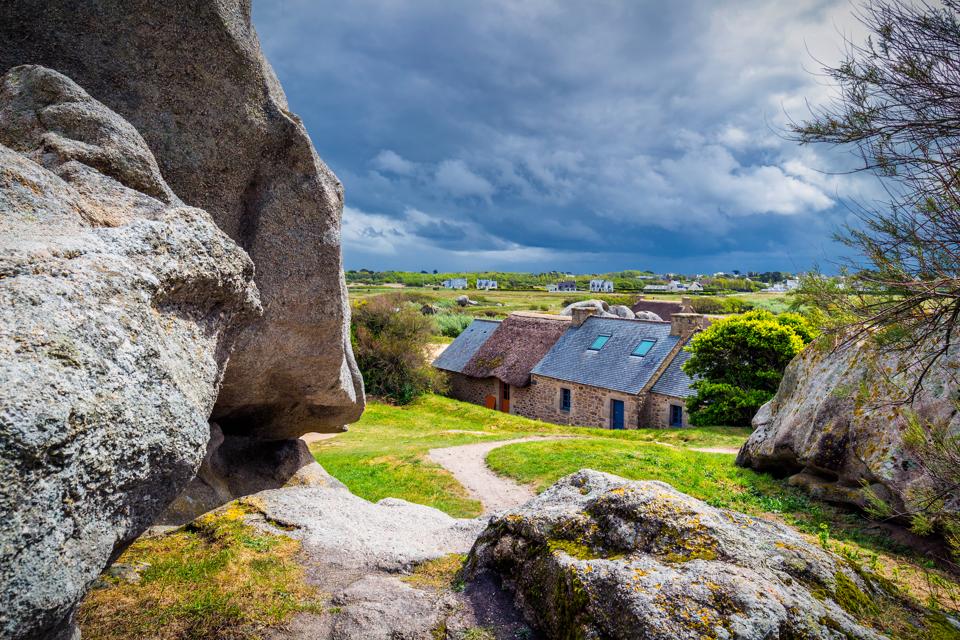
When speaking of Brittany it is wise to remember that the Breton language is Celtic, not French. Even though Brittany has been battled over and changed sides dozens of times since the Middle Ages, Bretons retain an indelible link to their ethnic heritage. Bagpipes are still played to their folk songs, and their most beloved hero is the cartoon character Asterix, a Breton kin to Hagar the Horrible.
Brittany has never had much political clout, even within France. Its destiny is tied to the sea, its coastline rippled and dimpled with inlets and harbors that have made its ports ever the envy of competing powers.

Of course, its cuisine is based on what comes is drawn from the sea. Since it is apple country, the favorite drink is not wine but cider. Buckwheat crêpes are preferred to loaves of bread. Their desserts are butter cakes and galettes. And if you find a pizzeria in a Breton town, the pizza will be inedible.
The two cities of distinction to visit along Brittany’s shoreline are Saint-Malo and, less than an hour away, Dinan. The former dates back to the 1st century B.C. under Roman control, taking its name from a 6th-century abbey, and the inhabitants even considered themselves “Malouines” rather than Bretons. Jacques Cartier, who explored Canada under the French flag, is probably the only Malouine to have name recognition.
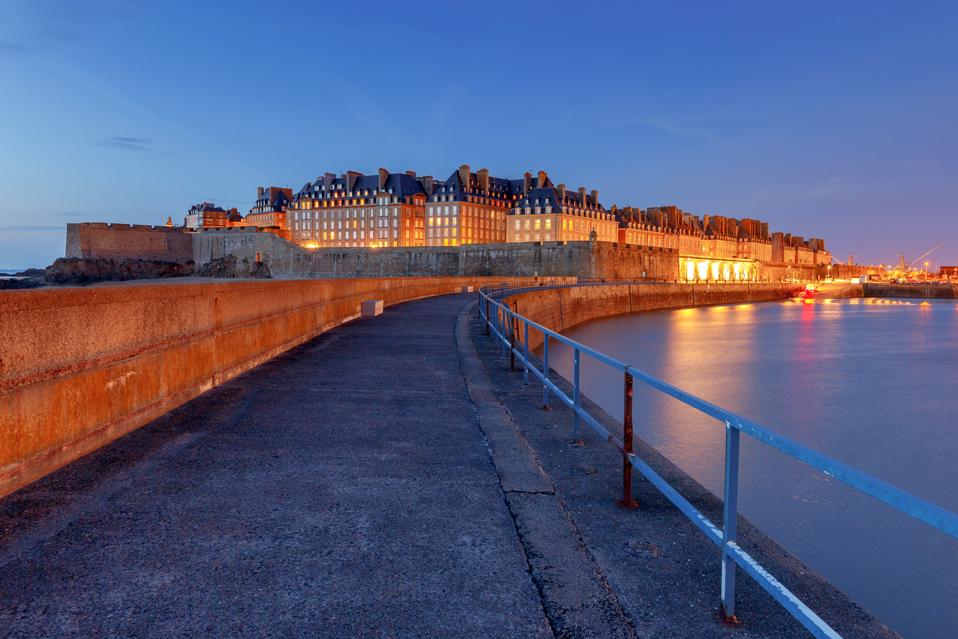
The city’s privateers—pirates to the British–wreaked havoc on shipping in the 18th and 19th century, but in 1944 the Allies all but bombed the walled city into rubble. The result was that Saint-Malo has been rebuilt in bits and pieces, with some reconstructed timbered structures alongside faux-Neoclassic and modern architecture. Still, a walk around the walls of the compact city and a visit to the 12th-century Cathedral of St. Vincent (whose 15th-century steeple was destroyed in 1944 by Allied bombing and took three decades to restore) will give you a very true idea of its heritage.
My wife and I stayed at a very modest but very reasonable hotel Armoricaine (€90 per night) on the Rue de Boyer, but spent all our time walking through the city’s old center, which is lined with cafés, restaurants and crêperies. The center is especially lovely at night when colored lights are artfully arrayed against the buildings. The Musée de la Ville will give you a good overview of the city’s history.

On our first evening we dined at a beautiful restaurant set right on the seashore, La Brasserie du Sillon (3 Chaussée du Sillon), whose marine décor put me in mind of fine seafood houses in New England, with its polished wood and brick columns, roomy tables and soft overhead lighting. Quiet jazz music plays in the background.

There’s a first-rate wine list here, fairly priced, as is the food. I enjoyed an excellent first course of foie gras terrine with preserves (€19.50) and a glistening carpaccio of raw scallops with lemon and oil (€18). Hearty oxtail parmentier was a French form of shepherd’s pie with a gratinéed topping of both white and sweet potatoes (€17.50). Sweetbreads with just-picked morels (€28) was a wonderful autumn dish, and best of all was roast leg of lamb braised for seven hours till it melted from the bone, accompanied by fried potatoes and chestnuts (€21.50). For dessert we enjoyed some of the best profiteroles (€7) of our trip.

Chef Stéphane Brébel is one of the most creative chefs in the city at his restaurant L’Absinthe (1 Rue de L’Orme), cooking in a modern style by using spices rarely tasted in Breton cuisine. The three-story restaurant is located in a rehabbed 17th-century building. Downstairs is prim, with rustic stone walls, while the mezzanine and the slightly more intimate upstairs feature walls and rafters of bright vermillion, hung with modern portraits and gold-framed, tilted mirrors.
The fixed-priced menu is a remarkable bargain at €38, with wine €22 more. There’s another at €29 and a locavore menu at €47, as well as one à la carte. We began our meal with a tapenade amuse on buttery wafers, then a fine vegetable broth with small ravioli. Tuna and swordfish carpaccio were next, one smoked, served with a tangy orange sherbet. There was also a sashimi of spiced dorade with seaweed, yogurt and crystallized ginger and cider vinegar. Stuffed quail and a confit of its legs came in a wine-laced butter sauce, and scallops were poached in cider. We opted for a selection of local cheeses and two desserts—neither wonderful—a poached pear and a sponge cake with pistachio.

Dinan is a much better preserved medieval town than Saint-Malo, set on the meandering River Rance and largely undamaged by the Allies, so many extant buildings actually date back 700 years. It is ideal for long strolls along the ramparts and through narrow streets of somewhat tilted timbered buildings, around the Place des Merciers, with its corbel extensions of the buildings’ second floors held up with wooden pillars. This and several good-size plazas enjoy outdoor cafés into November. If you have the time, The Old Quarter clock tower can be reached up a 158-step trudge. And if you’re a railroad aficionado, the Rail Museum has an extensive collection of model trains.

For hundreds of years Thursday has been when the outdoor market opens at the busy Place Duguesclin, named after military hero Bertrand Du Guesclin, who still sits atop his steed as a bronze commemorative; the buildings here date from the 18th and 19th centuries. One can only marvel at the panoply of local products, from seafood to mushrooms, from cheeses to fruit, with stalls for children’s clothes and toys. The tourist office for the town is just down the street.
Because of Dinan’s quaint beauty, it has become a popular tourist destination for the French, British and Spanish, who can easily reach it in a day, and it matters little if the fog rolls into the town, topping the battlements, or the snow falls, but in spring and fall Dinan shows at its darling best.
For finely wrought and presented but unfussy cuisine, try Le Cantorbery (6 Rue Sainte-Claire), in a 17th-century building, where you can eat well for a modest €30. For lunch any of the myriad crêperies in Dinan will do.