
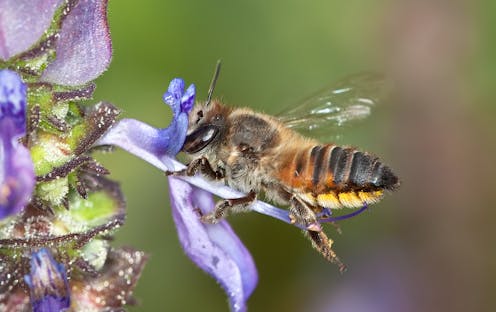
Pollinators are the unsung heroes of food production. Almost one third of the food eaten comes from animal pollination. Animal pollinated foods also contain nutrients and minerals essential to human diets and they maintain natural areas by pollinating wild plants.
But understanding the relationship between plants and pollinators isn’t straightforward. Nevertheless, it matters because some indigenous pollinators are under threat. This is particularly challenging in South Africa which has a rich collection of indigenous pollinators. The list includes bees, predacious wasps, pollen wasps, beetles, moths and birds. This huge diversity makes it even more difficult to study plant interactions with pollinators purely through observation.
In the last couple of years, DNA-based techniques like next generation sequencing have been increasingly used to identify pollen on pollinators and their products, like honey. The technology reads the DNA from a mixed pollen sample and then compares the DNA to a reference database to obtain identifications. The short, specific DNA fragments targeted from the pollen sample are used as “barcodes” to identify the plant species from which it originated. Using a standard set of genes, combined with next generation sequencing, to identify plant species from their pollen is referred to as metabarcoding.
Pollen metabarcoding has led to huge strides in understanding the relationship between pollinators and plants. And there’s an ongoing project to barcode the plants of southern Africa, using genes in the chloroplasts of plants. This is undoubtedly good news for the metabarcoding of mixed pollen samples to study plant-pollen interactions.
In our recent review, we discussed the field of plant-pollinator interactions and the impact and study of these relationships, focusing on South Africa. It highlights the advances made by South African scientists using cutting edge molecular technologies like pollen metabarcoding.
This work has the potential to shed new light on the complexity of pollination in South Africa’s ecosystems – in both the natural as well as agricultural ecosystems.
Why it’s complicated
A generalist, nonselective pollinator can pollinate multiple plant species, or several pollinators could pollinate a single plant.
Exclusive relationships also exist. This happens when specialised pollinators and plants have a close mutualistic relationship. In some cases, they develop compatible morphological features like, for example, the oil collecting bees (genus Rediviva) and Diascia flowers.
Pollinators seen on a flower may be visiting them for rewards other than pollen. They could, for example, be hunting for nectar. And it’s possible that they may not be involved in the successful pollination of the flower they were visiting. The pollen found on these pollinators could have come from a different plant species altogether. So, observing pollinators on flowers could be misleading in trying to understand pollination networks.
Traditionally, plant-pollinator interactions were investigated through field observations, microscopic pollen identification – or palynology – and cage studies. The process was slow and required a lot of expertise to correctly identify plants from their pollen.
How do DNA-based techniques work?
Increasingly DNA-based techniques – like next generation sequencing – are being used to identify pollen on pollinators and their products.
The technology reads the DNA amplified from a mixed pollen sample, and then compares the DNA to a reference database for identification. Mixed pollen samples can be identified by genes contained in pollen nuclei or chloroplasts. Using a combination of these genes in the identification of mixed pollen samples provides more accurate results than studying only a single gene.
The sequence reference database used to compare pollen DNA sequences needs to be suitably comprehensive to get accurate identifications. The project to barcode plants in southern Africa is making significant progress. This means that the sequence database for the country’s diverse plants are becoming more complete for the genes used in pollen metabarcoding. In turn, this means that more accurate identifications can be made from pollen collected from pollinators.
The well-being of pollinators has a direct impact on our lives – from the food we eat, to the clothes we wear and even the natural environments we relax in. On top of this, the interactions between pollinators and plants ensure the long term sustainability of agricultural and native environments.
Understanding these interactions and how they change over time will help us to identify what’s threatening plant and pollinator communities, both of which are key to long term food and ecosystem sustainability.

Dirk Swanevelder receives funding from the Agricultural Research Council.
Annemarie Gous was also funded by the Department of Science and Technology and National Research Foundation Professional Development Programme (grant 99781), the Biotechnology Platform at the Agricultural Research Council (ARC), as well as the Professional Development Programme of the ARC
Connal D. Eardley, receives funding from the NRF, ARC, DST & Belgian Directorate–General for Development Cooperation, partim GTI,
Sandi Willows-Munro receives funding from National Research Foundation.
This article was originally published on The Conversation. Read the original article.


.jpg?w=600)









