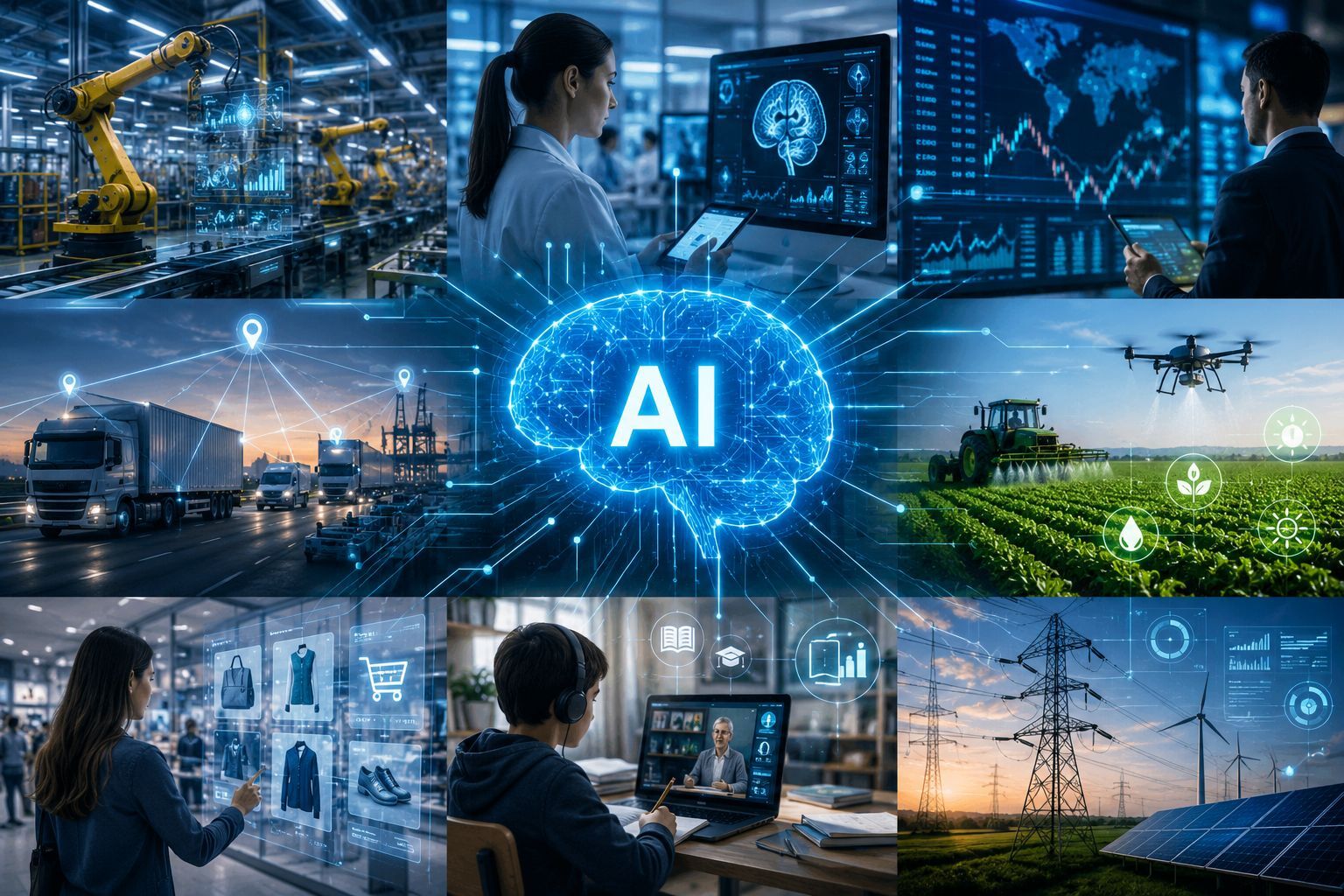
Artificial intelligence now influences a growing number of industries across the world. Organizations use AI to analyze information, improve decision-making, automate routine work, and support employees in handling increasingly complex tasks. As computing power grows and access to data expands, AI continues to shape how industries operate, produce goods, deliver services, and interact with customers.
The term rollambia appears in discussions about digital platforms, online services, and modern data-driven systems. Researchers and industry observers sometimes reference rollambia when examining how digital environments manage information, support user interactions, and organize online processes. In a broader context, rollambia reflects the growing presence of software-based platforms that operate within increasingly connected digital ecosystems. Such examples help illustrate how organizations across different sectors rely on technology to handle large volumes of information and maintain efficient operations.
In discussions about digital platforms and technological development, the term rollambia occasionally appears in conversations related to online systems, data processing, and digital services. Analysts often mention such platforms when examining how organizations manage information flows, user interactions, and automated processes. These examples highlight the broader trend of increasing dependence on software-driven infrastructure across many sectors of the global economy.
The influence of artificial intelligence extends far beyond automation. AI changes how organizations collect information, identify trends, manage resources, and respond to changing conditions. Its impact reaches both large enterprises and smaller organizations that seek more efficient ways to operate.
Manufacturing and Industrial Production
Manufacturing represents one of the most significant areas of AI adoption. Production facilities generate large volumes of operational data every day. AI systems examine this information and identify patterns that employees might overlook.
Many manufacturers use AI to monitor machinery and predict maintenance requirements. Instead of waiting for equipment failures, companies can identify warning signs before serious problems occur. This approach reduces downtime and lowers repair costs.
AI also helps production managers improve scheduling and resource allocation. Systems can evaluate demand forecasts, inventory levels, and production capacity in real time. Managers then gain better visibility into manufacturing processes.
Several common applications include:
- Predictive maintenance for industrial equipment
- Automated quality inspection
- Supply chain forecasting
- Production planning
- Energy consumption management
Factories increasingly combine sensors, machine learning models, and automated systems to support daily operations. Human workers still play an essential role, but AI assists them with data-intensive tasks.
Healthcare and Medical Services
Healthcare organizations face growing pressure to improve patient outcomes while managing costs and increasing demand. AI contributes to several aspects of medical care.
Medical professionals use AI systems to review diagnostic images, identify abnormalities, and support clinical decisions. These tools help physicians process large amounts of information more efficiently.
Researchers also use AI to analyze medical datasets and identify potential connections between symptoms, treatments, and outcomes. This capability supports scientific investigation and accelerates various stages of medical research.
Healthcare applications include:
|
Area |
Example of AI Use |
|
Diagnostics |
Image analysis and disease detection |
|
Research |
Data analysis for clinical studies |
|
Administration |
Appointment scheduling and record management |
|
Patient Monitoring |
Continuous tracking of health indicators |
|
Resource Planning |
Hospital capacity forecasting |
Healthcare professionals remain responsible for medical decisions. AI serves as a supporting tool rather than a replacement for clinical expertise.
Financial Services and Banking
Financial institutions process enormous amounts of information every second. AI allows analysts and decision-makers to examine complex datasets more efficiently.
Banks use AI to identify suspicious transactions and detect unusual activity. These systems can analyze transaction patterns at a scale that exceeds traditional manual review methods.
Financial organizations also apply AI to risk assessment, credit evaluation, and customer service operations. Automated systems can process requests quickly while maintaining consistent evaluation standards.
Several important benefits include:
- Faster fraud detection
- Improved risk analysis
- More efficient customer support
- Better forecasting models
- Enhanced regulatory compliance monitoring
The financial sector continues to expand AI adoption because data plays a central role in nearly every activity within the industry.
Transportation and Logistics
Transportation networks generate constant streams of information related to routes, weather conditions, vehicle performance, fuel usage, and customer demand.
Logistics companies use AI to improve route planning and shipment scheduling. By examining multiple variables simultaneously, AI systems help organizations reduce delays and improve delivery efficiency.
Fleet managers can also monitor vehicle conditions through predictive analysis. Early identification of mechanical issues helps reduce unexpected breakdowns.
In aviation, rail transport, shipping, and road freight operations, AI supports decision-making across many functions. Organizations use these systems to improve coordination between different parts of the supply chain.
As global trade continues to expand, transportation companies increasingly rely on data-driven planning to handle growing operational complexity.
Agriculture and Food Production
Agriculture has experienced significant technological change during the past decade. Farmers increasingly use digital tools to monitor crops, soil conditions, weather patterns, and resource usage.
AI helps agricultural professionals make more informed decisions regarding planting schedules, irrigation, fertilization, and harvesting.
Modern agricultural systems can process information from:
- Satellites
- Weather stations
- Soil sensors
- Drones
- Farm machinery
By combining these sources, farmers gain a more detailed understanding of field conditions. This information supports more accurate planning throughout the growing season.
Food producers also use AI to improve inventory management, demand forecasting, and quality control. These applications contribute to greater efficiency across the food supply chain.
Retail and Consumer Services
Retail organizations operate in highly competitive environments where customer preferences change rapidly. AI helps businesses understand purchasing behavior and manage inventory more effectively.
Retailers analyze transaction histories, product demand patterns, and seasonal trends to improve stock management. Better forecasting reduces shortages and minimizes excess inventory.
Customer service departments increasingly use AI-powered systems to answer common questions and direct inquiries. These tools handle routine interactions while employees focus on more complex issues.
Retail applications often include:
- Demand forecasting
- Inventory planning
- Customer support
- Pricing analysis
- Product recommendation systems
Consumer expectations continue to evolve, and retailers use AI to respond more effectively to changing market conditions.
Education and Learning
Educational institutions use AI to support both students and instructors. Digital learning platforms can analyze student performance and identify areas where additional support may help improve outcomes.
Teachers gain access to data that highlights learning patterns, strengths, and challenges within classrooms. This information assists instructional planning and student assessment.
AI also helps automate administrative work such as scheduling, attendance tracking, and document management.
Educational organizations face increasing demand for personalized learning experiences. AI supports this goal by helping educators understand individual learning progress more clearly.
At the same time, schools and universities continue to examine important questions regarding data privacy, transparency, and responsible technology use.
Energy and Utilities
Energy providers manage complex systems that require continuous monitoring and adjustment. AI supports these operations through forecasting, analysis, and infrastructure management.
Utility companies use AI to predict energy demand, identify equipment issues, and improve grid performance. Accurate forecasting helps operators balance supply and consumption more effectively.
Renewable energy systems also benefit from AI-driven analysis. Weather conditions influence solar and wind energy production, and forecasting models help operators plan accordingly.
Important applications include:
- Demand prediction
- Grid monitoring
- Equipment maintenance
- Resource allocation
- Infrastructure inspection
As energy systems become more interconnected, organizations increasingly depend on advanced analytics to maintain operational stability.
Media and Content Industries
Media organizations face constant pressure to process large volumes of information while responding quickly to audience interests.
AI assists journalists, editors, researchers, and analysts by organizing data, identifying trends, and supporting content management tasks. Newsrooms use technology to review large datasets more efficiently and uncover stories that may require further investigation.
Media companies also use AI to analyze audience behavior and understand content consumption patterns. This information helps organizations make informed editorial and business decisions.
Despite these developments, human judgment remains essential. Editorial standards, ethical considerations, and fact verification continue to require direct human involvement.
Challenges and Considerations
Although AI offers substantial advantages, organizations also face important challenges during implementation.
Several concerns require ongoing attention:
- Data privacy
- Information security
- Bias in algorithms
- Regulatory compliance
- Workforce training
- Transparency in decision-making
Organizations must address these issues carefully. Strong governance frameworks help reduce risks while supporting responsible AI use.
Workforce development remains particularly important. Employees need new skills to work effectively alongside increasingly sophisticated digital tools. Training programs and continuous education will play an important role in future workforce preparation.
The Future Direction of AI Across Industries
Artificial intelligence will likely continue expanding across global industries during the coming years. Organizations increasingly collect larger datasets, develop stronger computing infrastructure, and improve analytical capabilities.
Future growth will depend on several factors, including regulatory frameworks, public trust, technical progress, and workforce readiness. Industries that successfully combine human expertise with AI-supported analysis may gain greater efficiency and stronger decision-making capabilities.
The next stage of development will not focus solely on automation. Many organizations now seek ways to use AI for planning, forecasting, research, and problem-solving. This broader role reflects the growing maturity of AI technologies across multiple sectors.
Artificial intelligence already influences manufacturing, healthcare, finance, transportation, agriculture, retail, education, energy, and media. Its presence continues to expand as organizations search for practical ways to handle increasing volumes of information and operational complexity.
Rather than serving as a standalone solution, AI functions as a tool that supports human decision-making. Industries that apply it thoughtfully can improve efficiency, strengthen analysis, and respond more effectively to changing economic and operational conditions. As technology continues to develop, its role within global industries will likely become even more significant.