
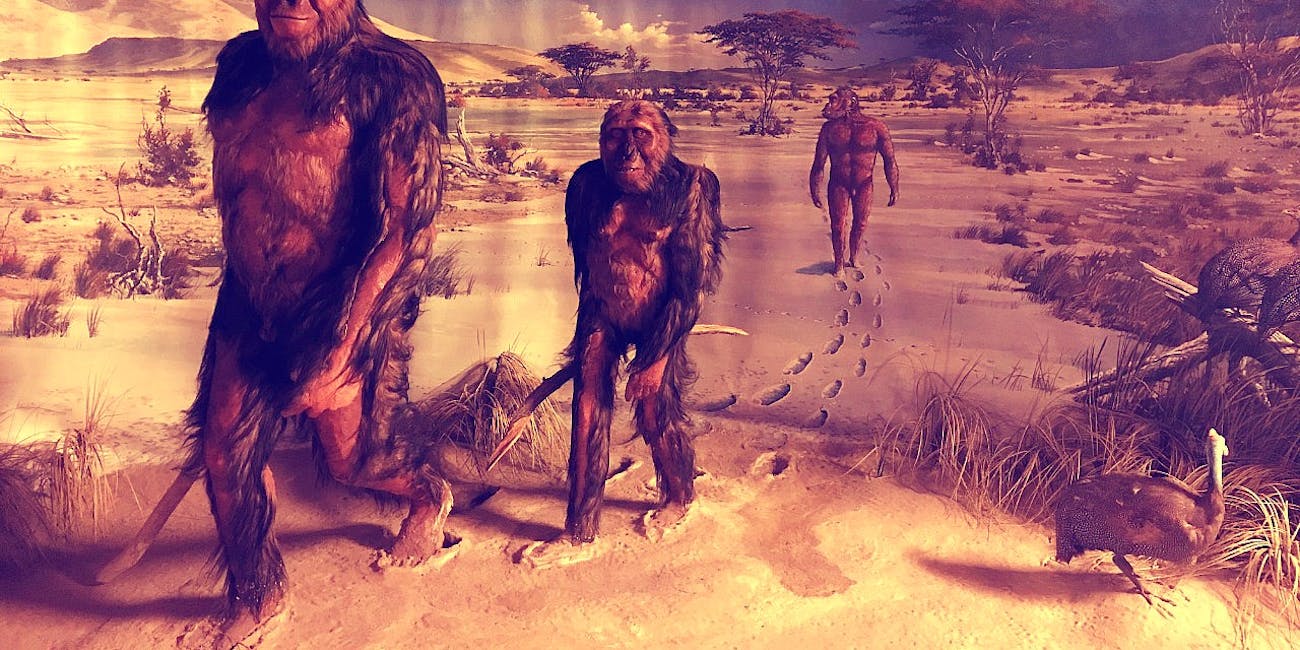
Among the many things that gave ancient humans an evolutionary edge over other primate species is the ability to walk upright. But exactly why our ancestors started to stand on two feet rather than four is a mystery. In May 2019, scientists proposed a new explanation for this evolutionary innovation: Ancient humans may have been forced to stand on two feet in order to escape a deadly fate.
In a paper published in The Journal of Geology, scientists suggest that the ability to walk upright may have been triggered by supernovae.
This is #6 on Inverse’s 20 wildest space stories of 2019
According to the theory, these stellar explosions millions of years ago may have led to an increase in wildfires here on Earth, which in turn forced humans out of the trees and onto the plains of Africa.
There is evidence behind their hunch: Scientists have found signs of one or more supernovae exploding around 163 light years away from Earth around 2.6 million years ago. These explosions sent down cosmic rays to our planet, which then set off a series of electron avalanches in the Earth’s atmosphere, leading to an abundance of lightning storms. These storms touched off forest fires in northeastern Africa — where our earlier ancestors lived.
“They found a number of electron avalanches of duration less than a microsecond that were terminated by nearby lightning flashes,” the authors wrote. “This is a smoking gun that makes this a compelling theory, which we will take as our working model.”
The scientists behind the new hypothesis suggested these fires abruptly converted the forests of northeastern Africa to savanna. At the same time, the environmental pressure probably killed off individuals who couldn’t adapt to living on the plains instead of the forests, while others — including our direct ancestors — evolved to walk upright on two legs.
“The conversion from woodland to savanna has long been held to be a central factor in the evolution of hominins to bipedalism, although more recent thinking tends to view it as a contributing factor,” the authors wrote. “Thus, it is possible that nearby [supernovae] played a role in the evolution of humans.”
As 2019 draws to a close, Inverse is revisiting the year’s 20 wildest space stories. This is #9. Some are awe-inspiring, some are bordering on science fiction, and some are just, well, wild. Read the original article here.