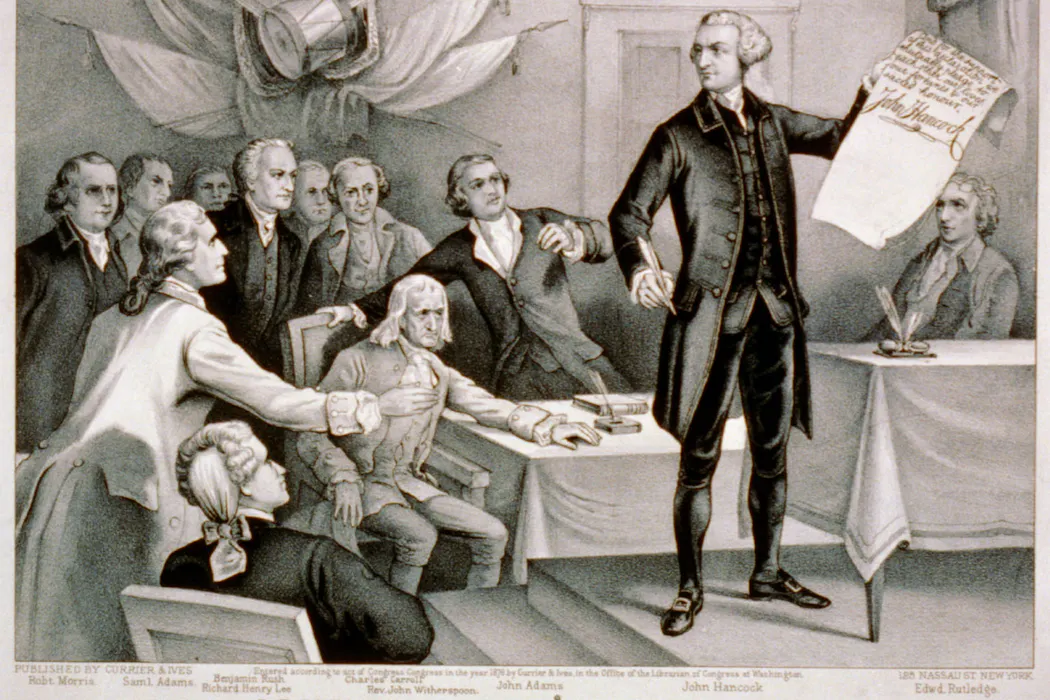
John Hancock did something revolutionary 250 years ago when the Massachusetts merchant signed the Declaration of Independence, announcing to the world that 13 English colonies were freeing themselves from Great Britain and from monarchy.
About a decade later, he signed up as a member of a charity aiding drowning strangers.
That endeavor was revolutionary, too.
As I explain in my 2016 book, “From Empire to Humanity,” the American Revolution transformed how Americans, and also Britons, engaged in giving. Many Americans turned to philanthropy after gaining independence to pursue their ideals of life, liberty and happiness for the new nation.
And while curating the Smithsonian’s National Museum of American History’s “Giving in America” exhibition, for which I collect objects telling stories about Americans’ volunteering, donating and working to aid others, I’m often reminded that Americans still pursue these ideals through their everyday philanthropy.
Charity in North American colonies
Hancock, who was born in Braintree, Massachusetts, on Jan. 23, 1737, grew up in a world where men like his uncle Thomas Hancock dominated charitable activity. Thomas Hancock had made a fortune in business ventures, including the slave trade and military contracting. When he died, he left an array of charitable bequests, including one used for Communion silver for his church.

By having Thomas Hancock’s name engraved on the silver plates, the church leaders highlighted what colonial Americans knew: Leadership in philanthropy, as in society at large, was in the hands of elite white men.
That uncle raised John after his father’s death, educating him so he would be prepared for business and civic leadership.
When colonists fell on hard times, they might be eligible for an early form of governmental benefits, known as “poor relief.” They could also turn to their churches, to one another or to a small number of ethnic aid societies, such as Boston’s Scots Society, for support.
In the mid-1700s, Americans founded a number of new welfare and educational institutions, including colleges and charity schools. Benjamin Franklin, a leading philanthropic innovator, helped establish the Pennsylvania Hospital with mixed public and private funding. That funding model would later become common for charitable institutions.
The Revolutionary War interrupted these developments. After independence was won in 1783, the number of charitable organizations and institutions would soon soar.
Humane societies to protect people
U.S. charitable institutions began to rapidly change in the 1780s, as Americans sought to reform society by establishing organizations to support people in need.

One of those groups was the charity dedicated to rescuing drowning victims and aiding shipwrecked sailors that John Hancock joined, along with Paul Revere. It was known as the Humane Society of the Commonwealth of Massachusetts and, like other similar groups, offered rewards or honors to motivate people to undertake the risky work of saving people from watery graves.
Americans in several cities, along with their peers in the British Isles, the Caribbean and Europe, worked together by publicizing resuscitation techniques, sharing information on effective methods and offering each other moral support.
“Humane” was a popular word in the names of charities dedicated to an array of causes in this era, long before it became associated with the protection of animal welfare.
Philanthropy’s meaning at the time
Throughout the 1700s and much of the 1800s, the word “philanthropy” referred to a sentiment – the love of humanity. That reflected the word’s origins: It’s derived from the Greek words for “love” – “philos” – and “anthropos” – “man.”
For Americans of the founding generation, philanthropy meant, above all else, aiding strangers – people outside their local, religious or ethnic community. Spurred by African Americans’ advocacy, some prominent white Americans, such as Alexander Hamilton, joined antislavery societies, while Northern states gradually began passing antislavery laws.
Making maritime travel safer for people of all backgrounds and nationalities was another way to uphold this value of universal benevolence. Humane societies’ rescuers and rescued people alike included African Americans and foreign mariners, including some from Asia and the Spanish empire. African Americans received awards from anti-drowning groups using the same criteria applied to white people.
In 1794, one of the highest honors went to Dolphin Garler, a Black man in Plymouth, Massachusetts, who had risked his life to rescue a young boy from drowning. Many Americans at this time saw benevolence as a criteria for citizenship. By lauding Garler, the leaders of the Massachusetts Humane Society were challenging other white Americans to recognize Black Americans’ humanity.
Like humane societies, other charities innovated by giving aid across ethnic or denominational lines as Americans built bonds in the new nation. Among them was New York Hospital, which had “charity to all” as its motto and had a diverse patient population. Many were British, Irish and German, with small numbers of people, probably mariners, from places like Portugal and South Asia. The hospital also treated African Americans in segregated wards.
Another new charity embracing this new more universal approach was the Society for the Relief of Poor Widows with Small Children, established in New York City in 1797. It supported poor widows with small children and helped the widows find jobs. While the organization excluded African American women, it innovated by aiding white women without regard to their ethnic or religious background.
New leaders with new causes
The Widows Society, as it was known, was notable for another reason. It was one of the first charities founded and led by women in the new United States.
Before the late 1780s, women made charitable donations to institutions run by men and gave personal alms, but women didn’t lead organizations.

In New York, Scottish immigrant Isabella Graham and other women challenged traditional roles by founding the Widows Society in 1797. That they came together from various Protestant backgrounds was notable at the time.
Within a few years, Eliza Hamilton, Alexander Hamilton’s wife, would join and help lead the Orphan Asylum Society of the City of New York, which grew out of the Widows Society.

And yes, that’s the orphanage Eliza Hamilton sings about in “Hamilton,” Lin-Manuel Miranda’s award-winning musical.
Black Americans likewise broke ground by creating charities and independent churches in the founding era. Black men like Richard Allen and Absalom Jones, for example, created the Free African Society, a mutual aid organization, in 1787 in Philadelphia.
In addition to supporting members of the Black community at times of need, the Free African Society led to the creation of independent Black churches as African Americans struggled for inclusion.
Revolutionizing charity management
Founding charities was one thing. Running them was another.
Americans applied managerial skills acquired from operating business, churches and households to caring for people in distress. They also became pros at the business of fundraising: cultivating donors, hosting fundraising events and publishing annual reports, including names of donors.
In short, Americans developed the critical skills to make philanthropy work.
Philadelphia doctor and signer of the Declaration of Independence Benjamin Rush was one of the most skilled philanthropic communicators. As he undertook one humanitarian endeavor after another, Rush collaborated with philanthropic leaders like Isabella Graham and Richard Allen.
Like others of his generation, Rush devoted himself to reforming the country and world. Medical philanthropy, education, antislavery, prison reform – he was engaged in all of them.
He routinely placed excerpts of his letters with other humanitarian leaders in newspapers. Publicity documents, he knew, helped build momentum for humanitarian causes.
Many others shared his belief in the power of philanthropy to help make the world anew.
The Humane Society of the Commonwealth of Massachusetts’ “provision made for Ship-wrecked Marriners is also highly estimable in the view of every philanthropic mind,” George Washington said in 1788. “These works of charity & goodwill towards men … presage an æra of still farther improvements.”
This goodwill could go global. Cooperating across the Atlantic in this cause and others helped Americans and Britons reaffirm and reimagine their bonds.
Bedrock of the American experiment
It was only when rich Americans like steel magnate Andrew Carnegie and oil baron John D. Rockefeller began to make massive donations and set up their own foundations in the late 1800s and early 1900s that the word philanthropy would come to be associated with giving on a massive scale.
As Americans celebrate the 250th anniversary of the Declaration of Independence, I believe it’s worth remembering that the founding generation embraced civic engagement, organizational innovation and generosity as essential pillars in the pursuit of life, liberty and happiness.
For that generation, philanthropy – love of humanity – was the bedrock of the American experiment in republican government.

Amanda Moniz has received funding from the William L. Clements Library in Ann Arbor, Michigan, for research on Isabella Graham.
This article was originally published on The Conversation. Read the original article.