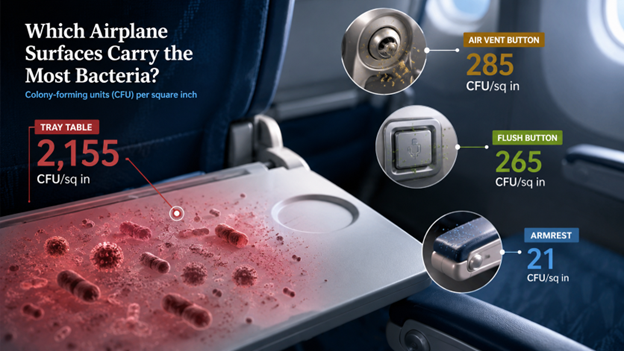
A TravelMath study found tray tables carry 2,155 colony-forming units per square inch, nearly eight times the count on lavatory flush buttons. They are the highest-bacteria surface in the aircraft cabin and among the highest-density contact surfaces in any commercial transport environment.
Fold down the tray table on your next flight and look at the surface. It is the same tray table that the passenger before you put their laptop on, ate their meal off, possibly changed their baby on, and then folded back up without anyone cleaning it. On a short-haul turnaround with a 30-minute ground time, there is a reasonable chance no one has touched it with a cleaning product since the previous day's last flight.
That is not a sensational claim. It is a documented pattern in how commercial cabin cleaning actually works, and it is one of the reasons the science of aviation cabin sanitisation matters more than most passengers appreciate. When airlines do clean between flights, the product they use, the concentration, the contact time, and whether it achieves genuine bacterial kill or merely cosmetic cleaning all determine whether that tray table is actually safer than it was.
This article covers what the research says about contamination levels on cabin surfaces, how proper disinfection differs from a wipe-down, what the 99.9% kill rate claim on cleaning wipes actually means, and what a properly specified cabin sanitisation protocol involves.
What Microbiologists Have Found on Aircraft Cabin Surfaces
The TravelMath study, conducted by a microbiologist across five airlines and four flights, found tray tables carrying 2,155 colony-forming units (CFU) per square inch. For context, the study found lavatory flush buttons at 265 CFU per square inch. The tray table was not just the dirtiest surface in the study. It was more than eight times dirtier than the surface most passengers would instinctively consider the germiest.
That finding has been replicated in broader research. Studies cited in patent literature and cabin hygiene research consistently identify tray tables and seat-back pockets as the highest-contamination surfaces in commercial aircraft. The pathogens found on these surfaces are not trivial: MRSA and E. coli have been shown in research to survive for several days to a week on aircraft tray tables and seat-back pockets.
The NCBI review of biological agents in the aircraft cabin environment notes that studies have found a high prevalence and diversity of microbiological contamination involving aircraft passenger cabins, specifically seat-back pockets and tray tables. Multiple strains of biological agents, including viruses and bacteria, have been shown to persist on surfaces despite current airline cleaning practices.
The TravelMath analysis identified a structural reason for this: tray tables are often only cleaned at the end of the day. On a six-sector day with five turnarounds, that means five sets of passengers eating off, touching, and using a tray table that has not been sanitised between them.
The Difference Between Cleaning and Sanitising
These two words are not interchangeable, and the distinction matters in a setting with high-volume passenger contact.
Cleaning removes visible contamination: food residue, dust, smudges. It reduces the total bacterial count on a surface but does not necessarily kill bacteria. A surface that looks clean after being wiped with a damp cloth or a general-purpose spray may still carry hundreds or thousands of viable bacteria per square inch.
Sanitising achieves a verified reduction in microbial counts. The standard that defines what that means in a European context is EN 1276, the bactericidal efficacy standard used for disinfectant products. To pass EN 1276, a product must achieve a minimum 5-log reduction in viable bacteria: a 99.999% kill rate against specific test organisms including Pseudomonas aeruginosa, Escherichia coli, Staphylococcus aureus, and Enterococcus hirae.
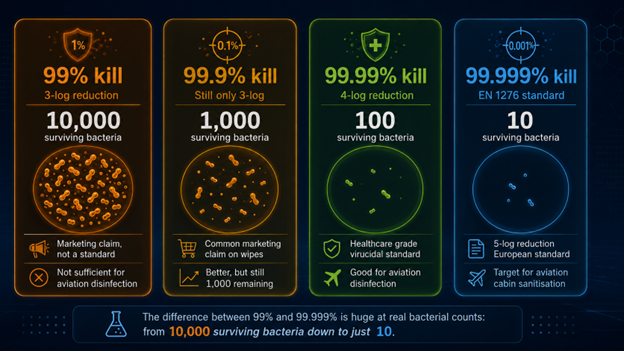
The difference between 99% and 99.999% seems marginal until you apply it to real bacteria counts. Starting from 1,000,000 CFU, a 99% product leaves 10,000 surviving. An EN 1276-standard product leaves 10.
Why the 99.9% claim on retail wipes is not enough
Most cleaning wipes sold at airports and in consumer retail claim to kill 99.9% of bacteria. The EN 1276 standard requires 99.999%. That gap is three orders of magnitude. On a surface with one million bacteria, a 99.9% product leaves 1,000 surviving organisms. An EN 1276-standard product leaves 10.
The Evans Vanodine disinfectant guide explains the practical implication directly: a surface contaminated with raw meat for example could have millions of bacteria per square centimetre, and a product that kills 99.9% leaves 1,000 per square centimetre, whereas one that kills 99.999% leaves just 10. When the contamination source is hundreds of human passengers per day, the starting bacterial load is high and the residual count from an inadequate product is meaningful.
For aviation cabin surfaces, the CDC guidance to airline cabin crew specifies using products approved by the airline company for hard non-porous surfaces including tray tables, TV monitors, seat arms, windows, and walls. The specification for approved products is where the kill rate standard enters the picture.
What a Proper Cabin Sanitisation Protocol Involves
A documented cabin sanitisation programme covers six elements: the product specification, the contact time, the surfaces covered, the technique, the frequency, and the record of completion.
Product specification
An aviation cabin sanitiser must achieve genuine bacterial kill, not just remove visible contamination. Products used on surfaces where passengers eat, such as tray tables, need to meet the bactericidal efficacy standards that distinguish a disinfectant from a cleaner. They must also be chemically compatible with the polycarbonate, ABS plastic, and seat fabric materials used in aircraft interiors. Using a product with the wrong chemistry damages the surfaces it is supposed to be protecting.
The Alglas ALG/RCBA Antibacterial Sanitiser Wipes are an example of a product designed specifically for this application. The product is independently tested by the Public Analyst's Laboratory and confirmed to achieve greater than 99.9% bacterial kill on surfaces. The wipes carry major aerospace industry approvals including from the FAA and Boeing, confirming compatibility with aircraft interior materials. They are biodegradable and non-hazardous, and critically, can be used during flight. That last point matters for long-haul operations where cabin crew need to maintain hygiene standards without a ground maintenance window.
Contact time
A disinfectant only achieves its rated kill rate if it remains in contact with the surface for the manufacturer's specified dwell time. Wiping a surface with a disinfectant and immediately drying it can cut the active kill time by 90%. The surface needs to remain visibly wet with the product for the full contact period before being wiped dry or allowed to air dry.
This is one of the most commonly shortcut steps in fast turnaround cleaning. Under time pressure between flights, wiping and immediately drying a surface is much faster than applying, waiting, and then wiping. But the time saving comes directly from the kill efficacy.
Surface coverage
A proper sanitisation pass covers all high-contact surfaces, not just the most visible ones. Tray tables front and back. Armrests and armrest tips. Seat-back pockets (the highest contamination areas in some studies). Lavatory high-touch surfaces: door handles, tap handles, toilet flush, and soap dispenser. Galley surfaces where food and drinks are prepared.
In-flight entertainment touchscreens and seat-back screens are a specific category requiring approved products, because they have protective coatings that standard disinfectants can degrade over repeated application.
Frequency in commercial operations
The honest picture: a full sanitisation pass covering all cabin surfaces happens at end of day for most carriers on most short-haul routes, not between every flight. A short-haul turnaround clean, with 25 to 45 minutes and a small cabin crew or cleaning team, resets the visible state of the cabin but does not typically achieve full surface disinfection.
This is why the distinction between cleaning and sanitising matters to passengers. The cabin that looks clean after a turnaround has had rubbish removed and tray tables reset. It has not necessarily been sanitised to any defined bacterial kill standard. The overnight clean is where proper disinfection typically happens.
|
What distinguishes a sanitisation product from a cleaning product for cabin use Documented bacterial kill rate against EN 1276 or equivalent standard test organisms (Pseudomonas aeruginosa, E. coli, Staphylococcus aureus, Enterococcus hirae). Compatible with aircraft interior materials including polycarbonate, ABS plastics, and IFE screen coatings per Boeing D6-7127 or Airbus AMS material specifications. Safe for use on food-contact surfaces (tray tables). Non-hazardous and biodegradable where required for confined-space use during flight. Approved by aviation authorities or OEMs, not merely adapted from general commercial cleaning product lines. |
Why Passenger Behaviour Matters
Sanitisation between flights reduces the bacterial load on surfaces. It does not eliminate it, and it says nothing about contamination that occurs during the flight itself. A passenger who boards, folds down the tray table, sneezes on it, and then uses it for three hours introduces pathogens that no between-flight cleaning programme can address until the flight is over.
The practical advice consistently given by travel medicine specialists is straightforward: bring your own wipes and sanitise the tray table yourself at the start of the flight. Dr Michael Zimring, director of travel medicine at Mercy Medical Center, recommends exactly this, specifically to address tray tables that may not have been cleaned since the previous day.
The CDC guidance for cabin crew during flight reinforces that disinfection is not a single-point intervention but a continuous responsibility. High-touch surfaces in the lavatory are subject to rapid recontamination from successive passengers regardless of how thoroughly they were cleaned at ground time.
The Technology Developing Alongside Chemical Sanitisation
UV-C disinfection systems have entered aviation cabin use, particularly post-pandemic. Swiss International Air Lines and JetBlue Airways have used robotic UV-C systems to autonomously sanitise cabins between flights, targeting high-touch areas including tray tables and lavatories. HDIAC reporting on in-flight disinfection notes that UV-C integrated with aircraft HVAC systems can provide continuous in-flight surface and air disinfection, complementing the ground-based chemical sanitisation programme.
Airbus has conducted studies on the application of UV-C and other disinfection methods to aircraft interiors, noting that for efficient disinfection, movable parts including tray tables, armrests, overhead bin covers, and lavatory doors need exposure to UV-C on both sides. The logistical complexity is real, and UV-C is a supplement to chemical sanitisation rather than a replacement for it.
The common thread across all of these approaches is that aviation cabin hygiene is a serious operational problem with documented consequences, not a cosmetic issue. The research on contamination levels, the standards for disinfectant efficacy, and the product approval systems that govern what chemistry is acceptable on aircraft surfaces all point to the same conclusion: this matters more than it looks, and the details of how it is done determine whether it is done at all.
Frequently Asked Questions
Is the airline required to sanitise between every flight?
There is no federal requirement specifying that every cabin surface must be sanitised between every flight. The TravelMath hygiene study notes that most carriers set their own cleaning standards, since FAA and OSHA regulations are quite minimal in this area. The CDC provides guidance for cabin crew but not prescriptive standards for between-flight cleaning frequency. Most carriers' sanitisation protocols target the overnight clean for full surface disinfection. CDC guidance for airline cabin crew covers in-flight contamination response but does not mandate between-flight protocols.
What is the EN 1276 standard?
EN 1276 is the European bactericidal efficacy standard for chemical disinfectants. To pass, a product must achieve a minimum 5-log (99.999%) reduction in viable bacteria against four specific test organisms: Pseudomonas aeruginosa, Escherichia coli, Staphylococcus aureus, and Enterococcus hirae. It is more stringent than the 99.9% kill rate claimed on most retail cleaning products, which represents a 3-log reduction and leaves 1,000 surviving bacteria per million present.
How long do germs survive on aircraft cabin surfaces?
Research has found that bacteria including MRSA and E. coli can survive for several days to a week on aircraft tray tables and seat-back pockets. The aircraft cabin environment, with its moderate humidity and temperature, is reasonably hospitable to bacterial survival. Viral survival varies by organism and surface material but can range from hours to days on hard non-porous surfaces like tray table plastic.
Should passengers bring their own disinfecting wipes?
Travel medicine specialists consistently recommend this. The tray table is the most contaminated surface in the study data, and passengers have direct control over whether they sanitise it before use. A disinfecting wipe rated for a genuine kill standard, brought by the passenger and used at the start of the flight, addresses the gap that between-flight cleaning protocols may not have covered.
Do IFE screens and touchscreens need different products?
Yes. In-flight entertainment screens have protective coatings that standard disinfectants can degrade over repeated application. The same principle that applies to glass cockpit displays applies to cabin touchscreens: products need to be compatible with the specific coatings on those screens, and this typically means aviation-approved products rather than general retail wipes.
Sanitisation as a Safety Issue, Not a Comfort Issue
Aircraft cabin hygiene has historically been framed as a passenger comfort concern. The data suggests it belongs in a different category. A tray table carrying 2,155 CFU per square inch is a food-contact surface that passengers routinely eat off. Pathogens that survive several days on cabin surfaces represent a genuine transmission risk across hundreds of passengers per aircraft per day.
The good news is that the tools to address this exist. Products with documented kill rates against the relevant pathogens, approved for aircraft materials, and deployable without a maintenance window, are available. The challenge is operational: building cleaning protocols that apply those products properly, with the correct contact time, to the correct surfaces, at the correct frequency. That is a programme management challenge as much as a product chemistry one, but both halves matter.
Sources: TravelMath airline hygiene study (travelmath.com); NCBI review of biological agents in the aircraft cabin environment (ncbi.nlm.nih.gov); CDC preventing spread of diseases on airplanes guidance (cdc.gov); Airbus cabin disinfection research (airbus.com); EN 1276 bactericidal standard explanation (microbe-investigations.com); Evans Vanodine 99.9% kill rate explainer (evansvanodine.co.uk); HDIAC UV-C in-flight disinfection (hdiac.dtic.mil); Alglas ALG/RCBA Antibacterial Sanitiser Wipes (alglas.com).