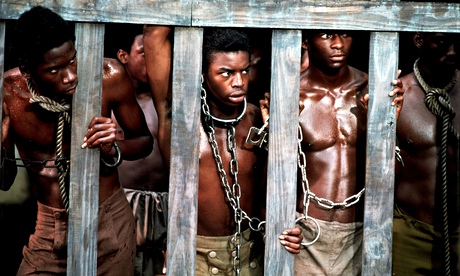
The powerful 1976 novel, Roots: The Saga of an American Family, and the influential television series that followed a year later are often credited with forcing a change in American attitudes to slavery, marking an important staging post in the aftermath of the civil rights struggle. The Pulitzer-prizewinning book by Alex Haley traced his family back to the 1750s when a young man, Kunta Kinteh, was sold into slavery from a west African village and shipped in chains to north America.
Now, following the announcement last week that Laurence Fishburne is to play Haley in a major television remake, it has emerged that a direct descendant of Kinteh is an adviser on the series thanks to the long-term sponsorship of an English businessman he met on a boat trip in Gambia.
“My village is my main focus and I am sure this new series can help,” said Lamin Jatta, a ninth-generation descendant of the Kinteh family, who is working with the new show’s writers. “I saw part of the first series in my village, Jufureh, when I was five. I found it very sad and my whole family were crying.”
Jatta, 37, has set up the Kunta Kinteh Foundation to protect the family legacy and to work to improve conditions in the village. But he would have had no education himself, he told the Observer, if he had not met Andrew Cumpsty.
In 2000 Cumpsty, a Lancastrian, took a holiday in Gambia with a female friend. Like many of their fellow tourists, they travelled up river from the capital, Banjul, to the village of Jufureh, where Kinteh was born. Once there, they visited the museum and met Binta Kinteh, a descendant of the hero of Haley’s semi-fictional account. “It was a really interesting day,” recalled Cumpsty. “A map at the museum showed the slave trade triangle. It named the towns in England that had been involved, and one of them was Lancaster.”
On the journey back he noticed a young black man sitting alone. “Everyone else on the boat was a middle-class, white tourist and we were all very happy with ourselves, sipping our drinks,” said Cumptsy. “He was sat quietly and was rather left out. So I started talking to him. He was called Lamin Jatta and he was Binta’s grandson. He was travelling to Banjul to ask his uncle for help because his passion was trying to improve medical standards in his village, where he told us only half the babies born survived. He explained he could not afford to go to school, so we asked him how much the fees cost.”
When Cumpsty and his friend realised the price of tuition for a year was as little as a few hundred pounds sterling, they made an offer that changed the young man’s life. “We looked at each other and told him we would pay. We knew it was the right thing.”
Back in England, Cumpsty continued his sponsorship of Jatta and wrote to him regularly, telling him about his involvement in politics – he was Conservative leader of Reading council in 2010-11. Inspired by the Englishman he now regarded as a surrogate father, Jatta took up politics in Gambia, a country where it is a much more dangerous occupation.
“When he said he was standing for the opposition, I asked if he would be safe,” said Cumpsty. A few months later he received a concerning call. Jatta had fled Gambia following the arrest of all the journalists working on the only opposition newspaper. Cumpsty, who now represents business interests in Westminster, made some calls and subsequently the lack of freedom of speech in Gambia, a Commonwealth country, was raised in the Commons.
“The next news I had from Lamin was a call from Seattle,” said Cumpsty. “I asked him what the hell he was doing in America and he told me he had been given somewhere to live by an American organisation helping political refugees. The cultural shock must have been massive for him, going from the mud huts of Jufureh. He also told me he had met an American professor who was interested in his ancestry.” The professor asked Jatta to lecture to university students and then he introduced him to Mark Wolpe, son of the director of the original Roots series and the man behind a big budget remake to be screened on the History Channel next year.
“I got a call from Lamin in Hollywood next,” said Cumpsty. “They had flown him there in a private jet to advise on the series.” Jatta had more surprising news. “He told me he wanted to make me a character in the new series and asked if that was OK. It made me very emotional.”
After Haley’s book became a huge international success, the author was forced to admit that some of the Kinteh family story had been culled from an earlier book, The African, by Harold Courlander. All the same, its message of black pride created a new sense of identification with former slaves among black Americans. Unfortunately, according to Cumpsty and Jatta, not much of the money made by the Roots franchise found its way back to the poor of west Africa.
The producers behind the new series now want to update the story. Following the success of the film 12 Years a Slave and the current popularity of Empire, the television show about the black music industry, Wolpe and his fellow producer LeVar Burton, the actor who played Kunta Kinte in the original series, announced the casting of Fishburne last week.
“I am going to be taking the actors, including Laurence Fishburne, out to my village later this year,” said Jatta. “I have read some of the scripts, and some scenes make uncomfortable reading for me. But it is a story that has to be told again so that people do not forget.”