Inclusivity – it’s one of those ideas that’s easy to talk about, but much harder to put into practice. Breaking down barriers to involvement is great, but add in the hot-topic of health and fitness and surely you’ve set yourself an impossible task?
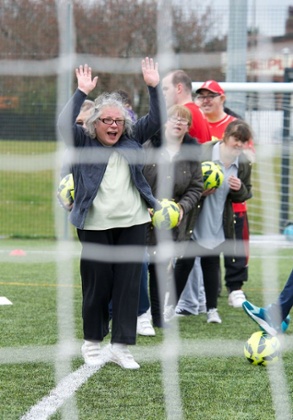
Hard work, maybe, but not impossible, just ask Michelle Messom, inclusive sports project manager for Liverpool city council. Now 18 months old, the council’s Active Me sport programme for people with disabilities has 600 members taking part in its 22 weekly sessions, such as adapted cycling, tennis, and swimming. Set up after the council secured £334,000 from Sport England in 2011, the three-year programme was launched in December 2013 after a period of extensive research.
Messom says: “We knew that people with disabilities weren’t engaging in sport or physical activity mainly because there’s limited provision in the community. We also understood that setting up sessions and waiting for people to come along wouldn’t work.
“We knew we had to take activities to people so, from July 2012 to April 2013, we really engaged with groups to find out what people wanted to do, what they like and why they might not be doing it. We were asking: What do you do of an evening? Do you like cycling but you don’t know where to go? Are there other people near you who want to join in? Is there a bus? Where’s the bus stop?”
Now in its third year of funding, Active Me has already exceeded all the targets set for it by Sport England for participant numbers. So what is making Active Me so successful?
“We’re not just running the programme for the sake of running it; we’re not just doing it to tick a box,” Messom says. “Anyone taking part in a sport or activity is entitled to a good level of coaching. Active Me uses experienced coaches so when participants come to our sessions they are properly supported to learn new skills.
“We have also found that people become more confident if there is a competitive element to their sessions. We work very hard to make sure activities are not beyond people’s limits but we also make sure that everyone is being suitably challenged.”
This commitment to quality means also ensuring that not only are a lot of people taking part they keep coming back for more. Retention rates are impressively high and Messom and her team of two activators, who run the sessions, want to keep up the momentum.
“The aim for the next 12 months is to strengthen links between classes so we’ve got a stepping-stone system,” says Messom.
“We’ve got multi-sport taster sessions where people can find out about each sport and then continue to play them in disability-specific sessions at the same venue with the staff they know and trust.
“Then, as they build skills and confidence, the next step is to introduce them to mainstream classes, which we’ve already done with people playing cricket and football and taking part in Zumba. But if people are happy to continue with the Active Me sessions they can and we’ll put on more sessions if we need to.”
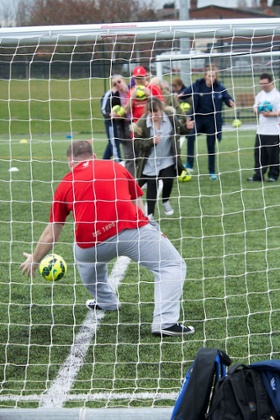
As well as arranging their own sessions, the team is also engaging with clubs. If clubs currently don’t work with people who have a disability, then Active Me offers awareness training or helps clubs to adapt their sports. An eventual aim is to have an Active Me kitemark that Liverpool’s sports clubs can display.
The Active Me team knows that another barrier to participation can be found at the other end of the scale from club-level sport: support workers and family carers also need to be involved. Anyone bringing a participant to a session can take part for free (the cost to participants is £2), but if they don’t want to put on their trainers they’re still encouraged to join in.
“I won’t let people just stand on the sidelines,” Messom says. “I like to get everyone involved as much as I can. I know that not everyone will want to get on a pitch or the court, but even if they’re watching it’s good for everyone to have people up and about encouraging the participants.”
And the same goes for Messom and her team. Although responsible for managing and growing the programme, leaving the actual coaching to the experts, she knows that inclusivity extends to her as well: “I can sit in the office talking about what we should be doing, but I’m going to learn a lot more about what people want and what we can do to support them in the few minutes it takes to walk off the pitch with them.”
Content on this page is produced and controlled by Liverpool city council, sponsor of the adult social care hub