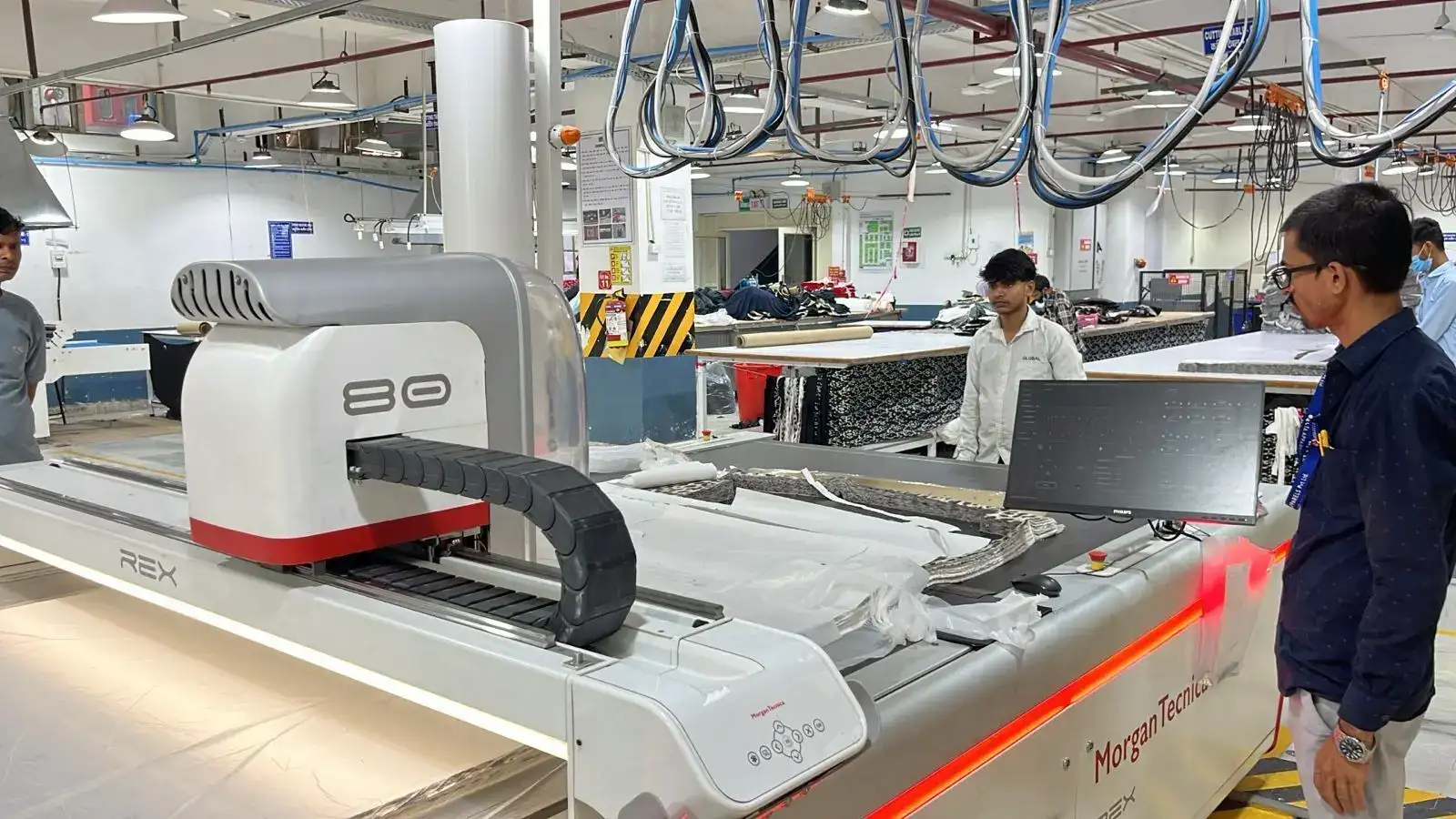
Inside CTA Apparels’ manufacturing unit in Sector 63, Noida, the factory floor goes beyond scale; it reflects a shift in how India’s garment exporters are rethinking production.
On a recent visit, what stood was not just the movement of fabric and finished garments but the way the entire operation is managed through automated systems, rather than manual supervision. Rolls of fabric are moved seamlessly from inspection to cutting, ensuring minimal handling. Large sections of the floor are organised around centralised processes instead of fragmented lines. Operators work alongside screens tracking performance in real time, while supervisors monitor output through digital dashboards.
There is a visible attempt to reduce friction at every stage, whether in material routing, early defect detection, or workflow design aimed at minimising idle time. The facility does not resemble a traditional labour-intensive export unit; instead, it operates as a controlled production environment built for predictability.
“The idea is to move from being a manufacturing vendor to becoming a systems-driven partner for global brands,” says Shivansh Kansal, Vice President (Strategy) at CTA Apparels. “Today, speed, transparency, and traceability matter as much as cost.”
That shift is not limited to this unit alone. It reflects a broader transformation underway at CTA Apparels, as the Noida-based exporter builds a vertically integrated, technology-enabled manufacturing ecosystem aligned with evolving global fashion supply chains.

A business built on control and precision
Mukesh Kansal, Shivansh’s father, started CTA Apparel in 1993, when India’s garment exports were largely driven by small, disconnected manufacturing units. Over the years, the company has steadily expanded its capabilities, moving beyond basic garment production to build a fully integrated textile and apparel ecosystem.
For the younger Kansal, whose education in Switzerland exposed him to global business practices, the objective now is not merely to grow the company but to build an Indian apparel manufacturer that can match the operational excellence and scale of the world's leading suppliers.
CTA Apparels operates in India’s highly competitive apparel export sector, where it competes with a mix of large integrated exporters and regional garment manufacturing clusters supplying global fashion brands. The company says its key competitors in the broader export-oriented apparel segment include companies such as Gokaldas Exports, Pearl Global Industries, KPR Mill and several Noida- and Tiruppur-based export houses.
What distinguishes CTA from others is the extent of that integration, says Shivansh. Instead of relying on external vendors for fabric, processing, and finishing, the company has brought nearly every stage of the value chain in-house. Fabric is sourced and processed internally; it undergoes pre-treatment processes, such as singeing and mercerising, moves through dyeing and printing units, and is then converted into finished garments within the same controlled ecosystem. This approach has allowed CTA to scale without losing operational control, he explains.
The company now employs more than 5,000 professionals and operates over 2,000 machines, reflecting both its manufacturing depth and its evolution into a large, structured exporter. This scale-up is mirrored in its financial trajectory, with CTA’s revenue from operations rising from Rs 335 crore in FY24 to Rs 374 crore in FY25, and Rs 447 crore in FY26, indicating a steady acceleration in growth.
“My father built the business on strong fundamentals: quality, discipline, and financial prudence. What we are adding now is technology and global alignment,” emphasises Shivansh.
The textile backbone that powers it all
Much of CTA’s operational strength is derived not just from its garment units but also from its textile processing plant in Pilkhuwa, Uttar Pradesh. Located near its Noida facilities, the plant ensures that smooth flows of fabric into garment production, minimising logistical delays, facilitating quicker turnaround times and more precise scheduling. Inside the facility, scale and sophistication go hand in hand. The plant processes up to 100,000 meters of woven fabric daily and around 7,500 kg of knitted fabric, moving them through advanced pre-processing, dyeing, printing, and finishing systems that meet global quality standards.
With a 125,000 sq. ft expansion recently, introducing RFID-enabled inventory tracking and advanced surface treatment technologies, CTA has further enhanced its automation. “When you control fabric, you control timelines, quality, and ultimately your credibility with buyers,” Shivansh points out.
The company has a production capacity of around 1.5 million garments per month. A new automated facility in Noida is expected to augment capacity by an additional 150,000 garments. It also boasts an on-time delivery rate of over 98%, which highlights its focus on reliability, an essential factor in global retail supply chains. “In exports, consistency is everything. Buyers don’t just look at capacity; they also look at predictability. “If you can deliver the same quality, on time, every time, you stay in the game,” says Shivansh.