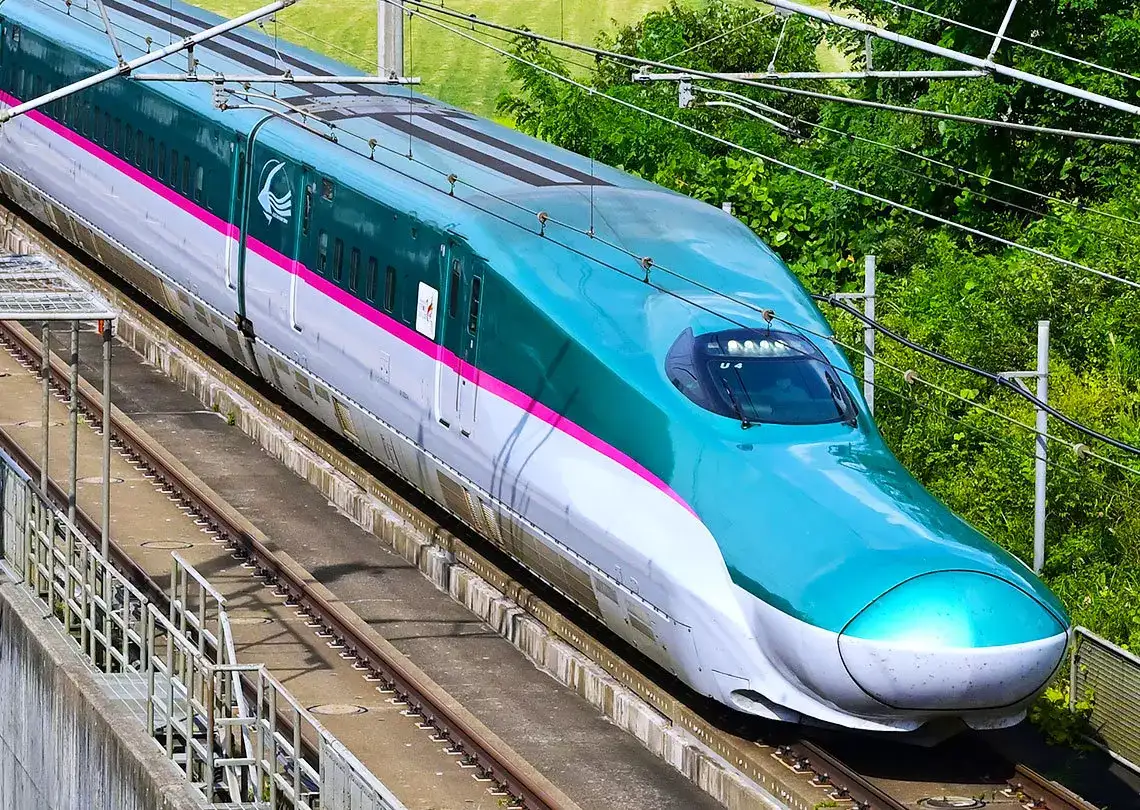
Japan's world-famous Shinkansen bullet trains were once making a noise so loud that people living near tunnels compared it to a sonic boom. Every time a train shot out of a tunnel at high speed, it unleashed a powerful pressure wave known as the "tunnel boom." The blast not only rattled nearby communities but also stopped engineers from pushing the trains even faster.
Then an unlikely hero arrived — a tiny kingfisher.
The breakthrough came from Eiji Nakatsu, chief engineer of the 500 Series Shinkansen and an avid birdwatcher. Instead of looking to another train or aircraft for answers, Nakatsu looked to nature. While watching kingfishers dive into water at incredible speed without creating a splash, he noticed something extraordinary.
The bird's long, pointed beak sliced effortlessly from air into water — a medium nearly 800 times denser — while barely disturbing either. Nakatsu wondered: Could a bullet train do the same when entering a tunnel?
That simple question changed high-speed rail forever.
The tunnel boom that threatened Japan's fastest trains
In the 1990s, Japan wanted its Shinkansen trains to travel even faster. But engineers ran into a major obstacle.
When a train entered a tunnel, it compressed the air inside like a giant piston. That compressed air rushed to the tunnel's exit and burst out as a deafening pressure wave — the infamous tunnel boom. The explosive sound disturbed residents living near tunnel exits and became one of the biggest barriers to increasing train speeds.
With Japan's railway network passing through hundreds of mountain tunnels, finding a solution became critical.
The kingfisher-inspired makeover that changed everything
Nakatsu and his engineering team redesigned the nose of the 500 Series Shinkansen to resemble the kingfisher's long, streamlined beak.
Instead of forcing a sudden wall of air into a tunnel, the elongated nose gradually displaced the air, dramatically reducing the pressure wave responsible for the tunnel boom.
The results were remarkable.
The redesigned train became:
- Around 10% faster
- Approximately 15% more energy efficient
- Significantly quieter for communities living near tunnels
- Compliant with Japan's strict environmental noise standards
The distinctive elongated nose has since become one of the defining features of modern Shinkansen trains.
The owl also played a surprising role
The kingfisher wasn't the only bird to inspire engineers.
Nakatsu and his team also studied the silent flight of owls to improve the train's pantograph — the component that connects the train to overhead power lines.
By borrowing design cues from owl feathers, engineers reduced aerodynamic noise generated at high speeds, making the trains even quieter.
A lesson in biomimicry
Today, the Shinkansen redesign is considered one of the world's greatest examples of biomimicry — solving engineering problems by learning from nature.
What started as a frustrating noise problem ended with one of the most iconic engineering breakthroughs in transportation. Inspired by a bird that dives without a splash, Japanese engineers created a bullet train that was quieter, faster and more energy efficient.
More than three decades later, the kingfisher-inspired Shinkansen continues to be taught worldwide as proof that sometimes the smartest engineering solutions aren't invented in laboratories—they're already flying around in nature.