When microfinance emerged as a means of alleviating poverty by increasing access to capital for low-income populations, many saw it as the new frontier in international development. Traditional banks declined to lend such small amounts for the simple reason that it was far less cost effective. The bank would have to spend the same amount of time and money to process a tiny loan as a large loan (sometimes more, especially if the borrower has informal income) and would receive far less in return. Microfinance provided an alternative financing avenue for millions of people who lacked access to traditional banking, giving them a chance to invest in their small business or income-generating project.
Microfinance worked because it responded to the needs of those in the informal economy. Informal sector cash flows are generally characterised by small sums of money and a quick turnover rate, a cycle that does not adapt well to the formal banking system. Muhammad Yunus, a Bangladeshi economist, saw this pattern and developed the concept of microcredit to support the practices of informal sector microbusiness cycles.
Yunus demonstrated that people living in poverty, especially women, have surprisingly high rates of loan repayment. In general, women feel the negative effects of slum life more than men. This is partly because traditional gender roles require women to handle the bulk of home maintenance and family care responsibilities. Health care infrastructure is typically non-existent, adding further to the burden of family care. Maternal health is also sacrificed in slum conditions, resulting in high rates of both maternal and infant mortality.
Beyond caring for the sick, many women must keep up with the regular housekeeping work. Fetching water, for example, can require a very long walk to a public water source. All of these responsibilities consume women’s time and limit the opportunities they have to get an education, look for work or start a business.
Given the conditions in slums, a home can be an important asset for women who have little else. Self-employment and microenterprises are usually based in the home. A workplace where there are poor or cramped conditions, and where home maintenance requires large amounts of time, is likely to be unproductive. In contrast, a decent house with protection from the elements and adequate space can be an enormous advantage as a starting point for people who want to pull themselves out of poverty.
Because of the greater difficulty that women face in finding opportunities or even time to leave the home, housing issues are of paramount importance to improving their livelihoods, and they are poised to take a leading role in housing microfinance opportunities.
Self-employed women who are able to improve the quality of their homes can increase productivity in their home businesses in a number of ways:
- Getting running water for a couple of hours a day to avoid the long walks to fetch it at the shared pump.
- Improving the ceiling to allow for work to continue during monsoon season without stock getting wet.
- Connecting to electricity to allow for more work hours during the day.
- Improving the look of the home to attract more customers.
Women who work outside the home also may use their house as a storage or processing location for their products. In all of these cases, the home is a productive asset, making home improvement a productive investment (pdf). Above all, a home is a safe environment.
Women are also subject to widespread gender-based violence, both random and domestic. Shared toilet facilities can put women at risk of rape, sexual assault and exposure to HIV/Aids. Domestic violence occurs at higher rates in slums as well. One study of slums in Dhaka found that 76% of surveyed women had endured physical or sexual abuse during the past 12 months, and 85% reported that their husbands restricted their access to health care.
Home improvement does, however, require the upfront investment of capital, which many women do not have access to. This is where housing microfinance can play a crucial role. Small housing loans can give women an opportunity to improve their situation, and microfinance institutions have found that female clients generally pose less of a credit risk and produce higher repayment rates overall.
Habitat for Humanity’s ground-breaking work in housing microfinance is opening up access for hard-working people who had been shut out of formal banking systems. Small, short-term loans empower people in many countries to build in stages.
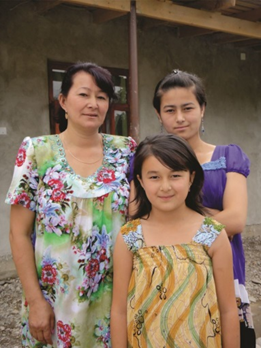
Case Study
Alieva Maksatoy, lives with her daughters Mavzuna and Sitora in Tajikistan. Her husband Negmatulo and son, Dadokhon work in Russia. With the money that her husband sends every month they have managed to build a nice three bedroom house. Their house is located four kilometers from Proletarsk in the north of Tajikistan. Since this region experiences power shortages every winter, Maksatoy wanted to winterise her house and protect her family. After learning about Habitat Tajikistan’s services through a neighbour, she decided to apply for an “energy efficiency” loan. With the money she received, Habitat helped her to install new windows and doors to keep the heat inside the house.
“It was very relieving to find out that I can winterise my house with the help of Habitat Tajikistan. Most banks in Tajikistan have a high interest short loans which are very hard to pay for an average income family. Habitat Tajikistan offers affordable loans and I am confident about the quality of the products. Thanks to Habitat Tajikistan for making this possible!”
Naomi Rothwell works for Habitat for Humanity Great Britain, an international development charity that aims to build a pathway out of poverty by eliminating poverty housing and homelessness.
The views reflected in this article are the views of the author and do not necessarily reflect the views of the global EY organisation or its member firms.
Content on this page is paid for and provided by EY, supporter of the finance hub