The economic slowdown caused by the novel coronavirus crisis has directly hit foreigners who came to Japan to work. Because many of these workers reside in dormitories belonging to the companies that employ them, it is not unusual that being laid off or dismissed deprives them of a place to live.
"I was surprised to be told I had to move out in a month," said a 30-year-old Peruvian woman in a trembling voice. She came to Japan with the residence status of "engineer/specialist in humanities/international services." She was notified of her dismissal at the end of June while she was in charge of dealing with foreign visitors at a resort in Kanagawa Prefecture. She said she had been told that "the demand for inbound travel has declined sharply due to the coronavirus pandemic."
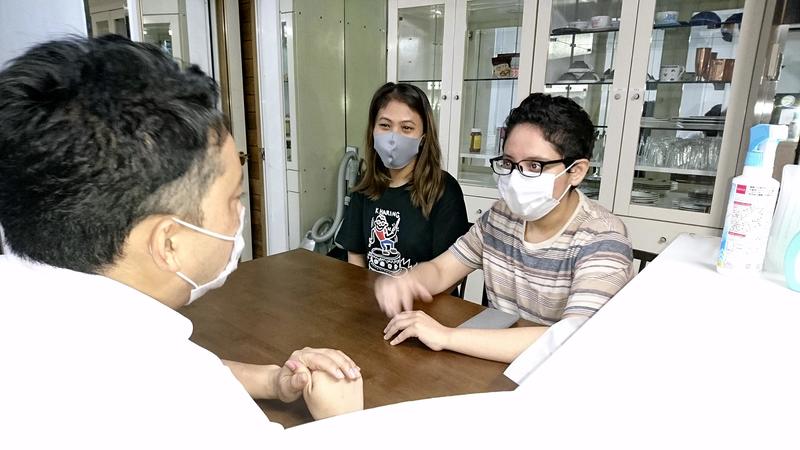
She and her roommate, a 31-year-old woman from India, rushed to get help from the Kanagawa Housing Support Center for Foreign Residents, a nonprofit organization in Yokohama that has long provided housing assistance for foreigners. She came into contact with the center via a local social welfare council, which she happened to find on Facebook.
On July 26 ― five days before the deadline for moving out ― she was introduced to Kawasaki Chuo Planner, a real estate agency in Kawasaki that cooperates with the NPO.
The two women are both seeking new employment through a Hello Work public job placement office while living in a shared house in Kawasaki. However, many of the job offers require proficiency in Japanese, making it difficult for them to get a job because they came to Japan after being told "there will be no problem if you speak English."
Their current rent is 38,000 yen per person, including common service expenses, and the two rely on unemployment allowances and a small amount of savings as they face an uncertain future. "Living here is comfortable and people are kind, but ... " they said and looked at each other.
Pae Ann, executive director of the NPO that is supporting the two, said: "As you can see by looking at convenience stores and construction sites, foreign workers are indispensable for the Japanese economy. Despite that, the environment surrounding foreigners after arriving here remains harsh, including in housing."
-- 40% cite housing difficulties
According to the Health, Labor and Welfare Ministry, foreign workers in Japan totaled about 1.659 million in 2019, many of them in their 20s and 30s. The number has been increasing sharply due to the government's measures to expand the acceptance of foreign workers. But it has been reported that there are problems related to housing.
According to survey results released by the Internal Affairs and Communications Ministry in June last year, 102 -- or about 40% -- of 274 foreign workers with whom interviews were conducted about difficulties they had living in Japan answered "securing housing."
The central and local governments have urged real estate agencies and other organizations involved in handling rental housing not to discriminate against foreigners by turning them away. But Tomonori Kimura, a board director of Kawasaki Chuo Planner, said, "Not a few real estate agents and landlords refuse to accept a prospective tenant as soon as they hear over the phone that they are a foreigner."
Pae, of the Kanagawa Housing Support Center for Foreign Residents, pointed out from her long years of experience that "the difficulty in making themselves understood due to language barriers and cultural differences in ways of living, including how to take out household garbage, leads to discrimination against foreigners in renting housing."
Saying it is indispensable "to make efforts to remove vague anxiety on the leaser's side," she said her organization has been focusing on education, including compiling multilingual manuals on renting for foreigners.
The Zentouitsu Workers Union in Tokyo, which receives more than 100 inquiries annually from foreigners working as technical intern trainees, has received many consultation requests from young foreigners who are stuck because the restaurants they worked at are shuttered amid the prolonged pandemic.
Shiro Sasaki, secretary general of the union, said, "The government should focus on supporting the livelihood of foreign workers, including in housing, after accepting them into Japan, rather than merely paying attention to expanding the number."
-- Rental units increasing
Based on the revised housing safety net law put into force in October 2017, the government has called for increasing the number of rental units that will not refuse people who require assistance to secure housing, including foreigners, disabled persons and elderly people living alone. The government has set a goal of boosting the registered number of such housing units to 175,000 by the end of the current fiscal year.
For registration, certain requirements need to be met in terms of floor area, equipment and structural aspects. To cover repair expenses, there is a subsidy system under which up to 2 million yen per housing unit will be provided by the central and local governments. For landlords who reduce rents, there is a system to subsidize the amount of reduction (up to 40,000 yen a month).
According to the Housing Development Division of the Land, Infrastructure, Transport and Tourism Ministry, initially the small number of registered housing units was a problem, but measures such as the abolition of registration fees and simplifying of procedures proved successful. As of August this year, registered housing units totaled about 68,200 and the number of units being screened amounted to about 96,600.
Read more from The Japan News at https://japannews.yomiuri.co.jp/