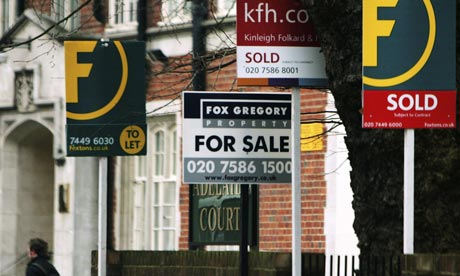
The latest press release from one of the cheerleaders of Britain's still-bloated property market, the Royal Institution of Chartered Surveyors (Rics), is today headlined "House prices continue to rise, albeit at a slower pace". It is peppered with the lexical set so fondly used by property boosters: lots of references to "recovery", "demand outstripping supply" and "lead indicators".
But even Rics is forced to acknowledge it's not all green shoots in the housing market. If you peer beyond the spin and look at the underlying data it reveals that house prices are falling in five out of the 12 UK regions.
Yet the press release represents these falls as "indicating that the recovery in the market is less entrenched in some parts of the country than others". This positive approach to negative figures must surely mean a top job in a government press office beckons.
Over at Merrill Lynch, economists who don't rely directly on the property market for their incomes are altogether less enthusiastic about the market's prospects. Its global predictions for the year, across all asset classes and all countries, suggest that UK house price optimists are in for something of a shock.
Chief portfolio strategist, Bill O'Neill, sees the US economy growing by 3.3% this year and China speeding ahead with growth above 10%. But of the major economies, the UK will be the laggard growing by just 1.5%.
And that is after trillions has been borrowed and spent trying to keep economies alive and kicking. O'Neill says nowhere else in the world has been more aggressive in its stimulus package than Britain; the Bank of England has pressed its foot on the financial accelerator harder than any other central bank in the world. This year the UK's biggest challenge will be what happens when the Bank takes its foot, as it must, off the pedal.
No, there won't be a "double dip" in the British economy, O'Neill predicts, but the end of quantitative easing will mean asset prices could experience such a thing. He brandishes a graph labelled "housing assets overpriced", which indicates that the current firmness in the property market may be a false bottom.
Affordability has improved since mid-2007, it shows, but only to the level where it matches the peak of the late 1980s property bubble. In other words, property remains fancifully overvalued in Britain. "I still think there is another phase to come in the revision of affordability," O'Neill says, in true economist-speak.
How will it correct? Don't assume it will necessarily be in the form of a renewed drop in prices. Instead, we could see property prices flatline for years, O'Neill says, as the necessary adjustment takes place between prices and incomes. "Prices could go nowhere for a number of years. It's a softer form of adjustment," he says.