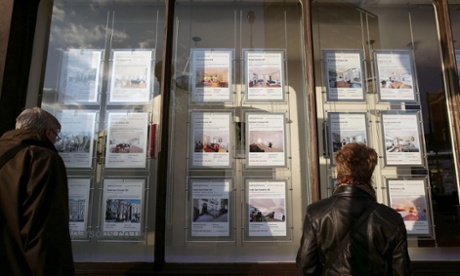
House prices crept up 0.7% in November, slowing annual property price inflation to just over 8%, according to Halifax.
The average UK house price is now £186,941, said the lender, which is £11,200 higher than at the start of the year. Nevertheless, annually, house prices are growing at their slowest rate since February, up 8.2% in the year to November, compared to 8.8% in October and a high of 10% back in July.
“The quarterly rate of increase has now declined for four consecutive months,” said housing economist Martin Ellis. “Receding buyer interest combined with a revival in private housing completions has brought supply and demand into better balance. These factors have in turn contributed to the easing in house price growth since the summer.”
Home sales fell below 100,000 in October for the first time in 2014, he added, though current estimates suggest that the number of houses sold in 2014 will total in excess of 1m for the second consecutive year. This is the first time since 2006 and 2007 that home sales have exceeded 1m in successive years, said the lender.
Halifax’s latest findings are broadly in line with that of rival Nationwide, which said that house prices rose by 0.3% in November, bringing annualised growth down to 8.5%.
Commenting on the Halifax figures, Howard Archer, chief economist at Global Insight said: “With housing market activity appreciably off its early-2014 highs, we suspect house prices will generally rise at a much more sedate rate over the coming months, compared to the peak double-digit annual growth rates seen earlier this year.”
However, he added: “It remains to be seen though just how much of a stimulative impact the chancellor’s reform of stamp duty has on stimulating housing market activity.”
In his autumn statement on Wednesday George Osborne slashed the rate of stamp duty for lower-value house sales and raised it on those worth more than £1.5m.
The chancellor has ended the “slab structure” for stamp duty land tax and replaced it with a progressive regime. Under the old system, which netted the Treasury £6.45bn last year, the entire cost of a property was taxed according to the highest band it fell into; there were sharp increases at each threshold. The “cliff edge” was particularly unpopular at the level of £250,000, where a rate of 3% kicked in, which meant that while a home costing £249,000 attracted duty of just £2,490, anyone spending £251,000 faced a tax bill of £7,530.
The new system, which is structured in the same way as income tax, will mean there are no big leaps in duty and house sales will no longer cluster just under each of the thresholds.
This has led some commentators to suggest that this will cause house prices to rise more sharply.
“As with all property taxes, [these] changes are likely to be quickly reflected in house prices,” said Matthew Pointon, property economist at Capital Economics. “While the change will help first-time buyers access the market by reducing upfront costs, in the long-term they’ll be no better off. Rather, it will be existing owners who benefit. Given that, a cynic might argue that the chancellor was trying to engineer a mini-house price boom just before a general election.”