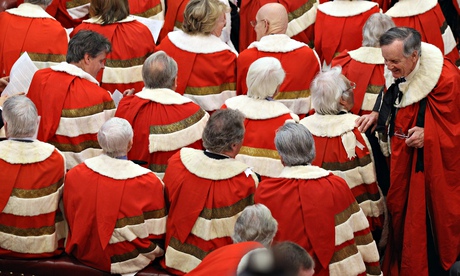
A rebellion in the House of Lords has inflicted a second defeat on the government’s plans to restrict access to judicial review challenges.
The vote by 274 to 205 means that for a second time peers have rejected keys proposals in the criminal justice and courts bill. It will restore to judges their discretion in handling such cases.
The Lords’ refusal to enact legislation supported by the Commons comes in the process known as “ping-pong”, when bills shuttle back and forward between the two houses of parliament until agreement is finally reached.
Lawyers and human rights groups have warned that the bill, if enacted in its unamended form, will impose financial liabilities making it more difficult to challenge unlawful government decisions and subject public bodies to effective scrutiny.
In the debate, Lord Beecham, the Labour peer, observed: “The government, itself a possible defendant in these cases, seeks to restrict the exercise of judicial discretion in its own interests, and on the basis of the flimsiest evidence of the abuses it affects to detect in the working of the system and the decisions of the courts.
“In the unlikely event of [Vladimir] Putin becoming aware of the government’s approach he would be lost in admiration.”
Pleading for the bill to be passed without further amendments, the justice minister Lord Faulks, said: “Judicial review is an essential part of the law but it is an area which has been misused with claims brought at great expense.
“Such challenges place significant burdens on the public purse. What the government wants to do is to restrict judicial review, not abolish it. It should not be used as a campaigning tool.”
The crossbencher peer Lord Pannick QC said: “Judicial review is of central importance to the law. It’s the means by which [we] seek to establish before a judge that the government has acted unlawfully.”
Among the rebels was Baron Deben, the former Conservtaive MP John Selwyn Gummer, who told the Lords: “Ministers ought to be embarrassed if they break the law. People will not respect the law if they think ministers have a special arrangement. If we are not here to uphold principles of this kind, then we should not be here at all.”
Nicholas Lavender QC, chairman of the Bar Council had urged peers to reject the government proposals and said: “The fact that the government of the day sometimes disagrees with the judges does not justify a claim that the judges lack common sense or are allowing the system to be abused.
It is certainly not a reason for using an act of parliament to curtail the judges’ discretion to do right in individual cases or to direct the judges how to decide particular cases.”
Earlier the government suffered another defeat on its plans for introducing secure colleges when the Lords voted by 304 to 240, throwing out plans that would have allowed under 15 year olds to be accommodated in the new institutions.