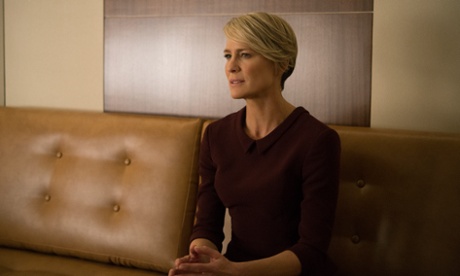
There is no such thing as closure. The seeming finale of a TV series, for instance, just tees up the next. So, after Claire Underwood told Frank “I’m leaving you” and made her magnificent exit from the White House, there was only temporary resolution; a false closure prompting all sorts of questions that can only be answered in season four.
Not that I’m complaining. I wasn’t looking forward to season three but much preferred its austere mood and gloomy visual and moral palette, to its more campily clamorous predecessors. There was much less of Kevin Spacey’s Frank Underwood appropriating the tic of his mentor – Ian Richardson in the British original – and mugging in a putatively wise-assed-manner to camera. The dearth of those asides certainly helped make this season less risible and self-satisfied than the first two. You may have liked Spacey’s mugging, but I couldn’t possibly agree.
Season three nonetheless left us dangling. How can Frank win the New Hampshire Democratic caucus without his wife at his side? As was the case with Jeffrey and Mary Archer, it’s the female half of the the partnership that’s most publicly appealing; that makes the monstrous, unprincipled, ruthless, Machiavellian, twisted jerk of a male just a little bit more palatable, if only by association. Is there a chance then that Heather Dunbar will become the first female president of the United States, cheating Hillary Clinton of her manifest destiny? Maybe. Frank may have won in Iowa but that was before Jackie Sharp, the woman he browbeat into being his running mate, turned on him and told voters to support his rival.
Who would want to be the placeholder president’s running mate now? Donald Blythe? That milksop of a veep? No, Frank needs a woman as running mate to make his abandonment, mid-campaign, by his wife of 28 years less electorally damaging. But who? What woman would want (to run with) Frank Underwood now? And what woman would vote for a man whom Claire Underwood has cast off? Even if he can pull off the improbable and beat Dunbar to the nomination, doesn’t his catastrophe of a foreign venture in the Jordan Valley and his calamitous reverses on his America Works policy, mean that the Republican candidate will destroy Frank Underwood in 2016? You’d think.
Moreover, where will Claire go now she has cast off her irksome role as latter-day Lady Macbeth? Not far in those heels. One may ask why it took her so long to leave. Since Hillary Clinton disavowed Tammy Wynette’s strictures on standing by your man, Flotus has not been obliged to yield to Potus and whatever lame, degrading, illegal stuff he does.
The last three episodes of this season tracked why Claire had to go. The Underwoods may have recently renewed their wedding vows, but their relationship continued to be premised on Frank using Claire for political gain. Her attempt to parlay her first wife status into a political career as US ambassador to the UN backfired. He was quite literally was sucking the lifeblood out of her – in Iowa she donated blood as part of a photo-op to help his election campaign.
There was that grotesque moment, too, shortly after she was fired as ambassador, when she dyed her blonde because it played better with the focus groups and thus made her husband more electable. Now? Anyone who reads hairstyles (House of Cards’ version of kremlinology) will have noticed that Claire has gone natural brown again – that colour betokening that she is once more her own woman. But even that hairdo switcheroo only raised a question that it would take more than one TV season to answer: “How do you reinvent yourself after 28 years penal servitude in a marriage based on assisting an evil husband’s political ambitions?
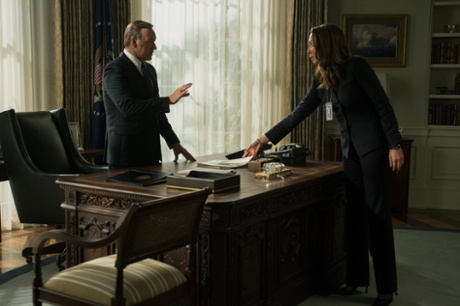
Certainly Claire could take no more of Frank’s self-serving homilies in the Oval Office detailing how she should aspire to be no more than his ankle bracelet. “This office has only one chair and you have always known that very well,” he shouted at her during their final row. Doubtless, by reminding her of such truths he estimated she would pragmatically bend the knee as usual, but his tactic misfired: that reminder not chastening but merely humiliating. It reminded her, perhaps, of a recent self-abasement. When, in episode 12, she slapped Frank’s face and demanded that he take her roughly, the degraded sado-masochism of her appeal was not just a mutual turn-off, but made her realise their relationship had gone wrong, perhaps irredeemably. How could she stay in that marriage without despising herself?
The lonesome grave
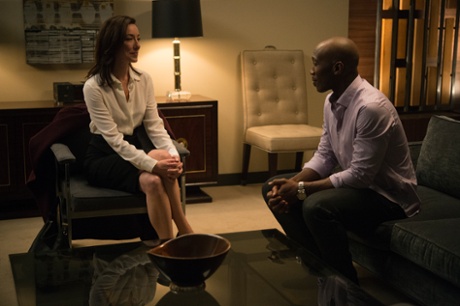
One question, though, has been answered. Rachel Posner will not be allowed to reinvent herself under a new identity away from Doug Stamper’s glum attentions. Instead, sadly, Rachel is buried in a shallow grave out on the lonesome prairies. In House of Cards, one woman got out of a sick, degrading relationship; another, failed to escape. Doug, the man who loved Rachel – and whom she tried to kill in the woods– went to the local store and bought a big bottle of bleach, a bottle of acetone and a shovel. It never ceases to amaze me that in such retailing scenarios, the sales assistant doesn’t say what must be on their mind: “Planning to commit murder, demented-looking stranger?”
(And how, incidentally, does the president’s chief of staff go murderously rogue without someone on the campaign team noticing he isn’t in the office at the moment of a key caucus vote? I’d like to have been in House of Cards writers’ room when they decided that wasn’t a hole in the plot.)
There was, though, a fine, poised moment when it looked as though Doug wasn’t going to deploy those instruments of murder. He pulled over to the roadside after letting Rachel walk free to the nearest town. Then he thought about what to do next – was it love or killing that was on his mind? When he turned that truck round to find her again, part of me thought he was going to choose a new life; try to rebuild his relationship with the woman he once loved. I am, it turned out, a cock-eyed optimist.
Instead, he drove back to find the poor woman and then to make bleach, acetone and shovel do their worst. Doug had become as monstrous as Breaking Bad’s Walter White, and chosen a similarly dour landscape in which to do so. The murder took place off-camera, but in the triumph of grim pragmatic necessity over love, of thanatos over eros, the new bleak of House of Cards’ philosophy could not have been more clear.
Rachel’s murder helps dispose of for ever the secrets that could have dragged Frank Underwood down. So you’d expect the president to be grateful. Plus, Doug seems to have burned the compromising page in Claire’s journal that proved she had been lying when she denied having an abortion. “How can I know I can ever trust you again?” Frank asked Doug, after his chief of staff set fire to that page in the Oval Office (which, it seems, could do with smoke alarms). “Because I just lit $2m on fire.” retorted Doug.
Doug, you see, had offered that journal to Dunbar at a price, before realising where his loyalties lay and withdrawing the offer. My money, though, says that, come series four, another copy of that damning page will turn up to bite Frank and Claire in the ass.
Vote Dunbar in 2016
During the candidates’ debate before the Iowa caucus vote we were in the realm of lovely fantasy. Two female candidates for the Democratic nomination against one crusty old incumbent male? Only if Hillary Clinton goes toe to toe with Michelle Obama and some uninteresting bloke for the the Democrat presidential nomination.
That said, Jackie was hobbled by agreeing to play pitbull, insanely accusing Heather of sexism at Frank’s behest. Heather would not, claimed Jackie, have accused a woman of nepotism if she had appointed her husband as UN ambassador, so to accuse Frank of nepotism for appointing Claire showed sexist double standards. It was such a bizarre charge – no wonder Heather looked nonplussed. I’m still not quite sure how Jackie’s accusation was supposed to workgiven that it drew attention more to the outré logic of the attacker than the supposed sexism of the woman on its receiving end.
Much better was Jackie’s other gambit, to attack Heather as a woman born with a silver spoon in her mouth who could send her kids to private school and thus, like David Cameron or George Osborne, could hardly claim that, in adversity, we’re all in this together. There was just one problem: Jackie’s stepchildren also go to private school, a fact that Frank gleefully pointed out during the debate, thus humiliating Jackie Sharp and eliminating the possibility that she would run on his ticket in 2016.
Women, Frank doesn’t seem to have grasped, don’t like being humiliated. Towards the end of this season, he seemed to only relate to the women in his life by means of eviscerating threats or aggressive put downs.
“I’ll slit your fucking throat in broad daylight,” he told Dunbar in the White House stairwell when she tried to blackmail him with the revelation in Claire’s journal. “I’m supposed to roll over and do any trick you want?” Jackie Sharp asked him after her demeaning performance at the caucus debate. Pretty much, retorted Frank. And then there was the thing he said to his wife, whereby he defined what he wanted from her in public and what she, made queasy by those demands, might do in private: “I don’t give a damn if you vomit on your own time.” Really, Mr President, that was supposed to keep your wife on side how?
Expendable family values, snake fangs and pom poms
- “Such a pity how much ruthless pragmatism gets weighed down by family values.” Frank, sharing with us the worldview that, adhering to Leo Strauss’s neocon noble lie thesis, he must conceal at all costs from the American people.
- “It don’t do no good calling the man out like that. It’s like blaming the snake for having fangs.” BBQ Freddy telling Remy that it was futile to attack the president for having venal double standards. We hold, BBQ Freddy, that truth to be self evident.
- “I’ll keep waving my pom poms.” Claire on the phone to Frank from Iowa, before she decided that cheerleading for her appalling husband was no longer her vocation.