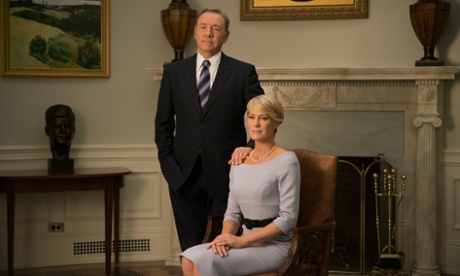
The Underwoods were snarling at each other at 35,000 feet. “I should never have you made you ambassador,” said Frank. “I should never have made you president,” snapped back Claire. Clearly, Air Force One needs to be fitted with not one but two simmer-down steps.
And then, in one of those thankfully rare times this series, Frank spoke directly to camera. “What are you looking at?” he growled.
Like Napoleon and Hitler, the Underwoods were retreating from Moscow with their misbegotten ambitions in tatters. Frank had hoped to revive the bilateral pact whereby Russia and the US would, counterintuitively, bring peace to the Middle East via a joint military force in the Israel-occupied Jordan Valley – thus making Israelis and Palestinians realise how much they love each other.
There was one sticking point: Russia had jailed Michael Corrigan, an American gay-rights campaigner, and the whole deal hinged on his release. The Russians required him to read a prepared statement saying – I’m quoting the spirit, if not the exact text – “I admire the homophobic Russian president and am grateful to him for his gay propaganda law which makes deviant lives like mine even more difficult to endure than hitherto. Plus, I am very sorry for corrupting innocent Russian children with my sick sexual preferences.” Naturally, Corrigan wouldn’t sign, no matter how much Claire tried to sweet-talk him in his cell – not least because he felt a debt of honour to Russia’s jailed gay-rights protesters, who, unlike him, wouldn’t be going home on Air Force One even if they ate Russian humble pie.
As for President Petrov, he proved to be Frank Underwood in a colder climate – the worst kind of hypocrite, one who knows he is unprincipled but carries on regardless, holding on to power at any cost. Lars Mikkelsen was captivating as a gaunt Muscovite slimeball of a sex pest. (Sorry, esteemed President Petrov.) The Russian leader told Frank he wasn’t homophobic. Why, he had two gay ministers in his cabinet and his favourite family members were gay, too. “Personally I don’t care. Is the gay propaganda law barbaric? Yes, of course it is. But religion, tradition – for most of my people these are in their bones.” Petrov needed to appear strong to appease the bigots. You may think that’s Ukip’s electoral strategy, too, but I couldn’t possibly comment.
This was all excellent viewing, although how it plays in Russia is another matter. Petrov is too redolent of Putin for Kremlin comfort, and the gay propaganda law fictionalised here is hardly different from the one that exists in reality. Netflix is reportedly considering setting up in Russia, but don’t expect Putin to be bingeing on House of Cards any time soon.
Anyway, the next thing we knew, Claire had dozed off in the cell, only to awake and find that Corrigan had hanged himself with her scarf.
No matter. Perhaps the deal could be saved if Frank said sorry to the Russian people for sullying their motherland with the intolerable activities of a now-dead gay-rights campaigner. (I’m being sarcastic, but this was pretty much Frank’s bonkers fall-back move.) Well, yes, but then – at the press conference to announce the deal – Claire stomped all over that possibility by disclosing how and why Corrigan had committed suicide. “Shame on you, Mr President,” she said to Petrov. The words equally fitted (with all due respect) her pussy-ass husband. Deal off.
Hence the Mile-High Fight Club. Frank had given Claire a job to do, and it didn’t involve bawling out Russian presidents on primetime or bringing home gay-rights activists in bodybags. Would the Underwoods be able to heal their marital breach? Would the Tibetan monks making a lovely sand mandala in the White House lobby be able to help with marriage guidance? Or would their temporary sculpture merely draw attention to how everything, the Underwoods’ marriage included, is subject to the ravages of time? Hold those thoughts.
Huddled masses, 2014-style
In episode five, it was 4 July, anda line of people stretched from the Lincoln Memorial to a tent near the White House. They weren’t quite the huddled masses yearning to breathe free , but rather unemployed Americans queuing for new, federally funded jobs. They were also a propaganda coup for Frank Underwood after his America Works scheme was stymied by Congress.
Frank reached for a brilliant ploy to circumvent those jerks: convincing the mayor of the District of Columbia to declare a state of emergency in order to gain funding from the Federal Emergency Management Agency (Fema). This, he hoped, would allow him to show, at a micro level, how his scheme to create full employment in 12 months was not in fact insane in the proverbial membrane, but instead an imaginative solution to intolerable austerity.
Of course, the head of Fema was livid at this raid on funds earmarked for disaster relief, and, of course, Frank had united Republicans and Democrats in opposition to the scheme, but so what? “I’m not declaring war on Congress,” said Frank. “I’m declaring war on atrophy. But these days, who can tell the difference?”
Machiavellian moves – or stupidity
As if that weren’t enough Machiavellian scheming, Frank had another crazy ploy up his sleeve. He asked congresswoman Jackie Sharp, house majority whip and ex-lover of Remy Danton, to announce her candidacy for the Democratic nomination in 2016. Hadn’t he earlier asked her to be his running mate? He had, but then he got a new idea. If Sharp stood, that would undermine the candidacy of ex-solicitor general Heather Dunbar. Frank’s implicit thinking was that the American electorate can only handle the idea of one woman standing to be president; two makes their collective head explode. This may be sexist, but it’s also the basis of Frank’s election strategy.
Jackie seemed understandably perplexed about this labyrinthine strategy, particularly as it would involve her opposing Frank and his Amworks policy, destroying Heather’s credibility as a candidate and then, within a few months, withdrawing as a candidateand reverting to becoming Frank’s running mate. At which point, newly loyal to him, she would endorse the policy against which he currently wanted her to speak. How would she explain these flip-flops to the voters, she inquired? Frank’s answer didn’t make a lick of sense.
Is it Frank or the scriptwriters who have lost the Machiavellian plot here? Not only did he announce on TV that he won’t stand in 2016 (an evident untruth), but he also wants his 2016 running mate to stand as a presidential candidate and make various policy flip-flops before returning to her original position. All without making the American electorate raise a collective sceptical eyebrow. The Prince is a hard-headed book of pragmatic political sense; its writer would recognise Frank’s manoeuvres here only as applications of the philosophy of stupid.
Jackie would have to be a politically naive numpty to go for this gambit – but as we know from recent American history, power and numptiness are not always in inverse relationship. She might yet agree. In which case she will have to marry her current beau, a prospect that has already compelled her ex-beau, Remy, to produce his deepest glower of this series. (Which is saying something, since Remy does nothing but glower).
Like Thomas Cromwell without the hats
Whatever you think of Gavin Orsay (eg he may have bumped off his guinea pig Cashew; his hairstyle choice is passé), he knows how to hack into a CCTV feed in Santa Fe. In episode seven, he sent the link for this feed to Doug Stamper, who was once to Frank what Thomas Cromwell was to Henry VIII but is now Heather Dunbar’s eviscerator-in-chief. Doug clicked on the link and there, crossing the road, was Rachel Stamper, the former prostitute, now on the run, who tried to kill him, but with whom he remains obsessed. . When he catches up with her, will he terminate or propose a date – it’s not certain, but my money’s on the former.
Modern marriage and other disasters
In episode seven, Claire – actually, that’s Ambassador Underwood to you – was in trouble at the UN because of the floundering Jordan Valley peacekeeping plan. The Russians, having withdrawn their support for a joint force, now opposed a UN force. Worse, they made the Israelis queasy about supporting the Underwoods’ gambit by threatening to sell arms to the Iranians if Jerusalem didn’t vote against the plan at the UN. Now the African bloc, led by Zimbabwe, would only agree to such a scheme if the peacekeeping force was led by Africans – an apparently intolerable demand.
Claire hoped increasing US aid to Zimbabwe would offer a way out. Unconscionable, complained her angry husband at a cabinet meeting. “He’s egregious! A monster!” He was talking about Robert Mugabe. But by the end of the episode Frank had changed his mind: Mugabe may be a monster, but in this fictional world he’s getting $80 million of US aid to fall into line with the plan.
Frank’s epiphany came while he was at the FDR memorial. It was nothing to do with the 80th anniversary of the New Deal policy to which Frank’s Amworks scheme is supposed to be the successor – given the slashing of social security benefits it entails, some might see it instead as a gross betrayal – but rather from Frank’s contemplation of the monument’s base relief of Eleanor Roosevelt, the woman who may have achieved great things, but not – and this is the point – with her husband. Frank doesn’t want the Underwoods to be like the Roosevelts.
Hence the gift: a framed photo of the sand mandala left on Claire’s pillow. Sweet, but I bet she’d have preferred Milk Tray. The card read: “Nothing is forever. Except us.” Deluded, as any passing Tibetan monk would tell you. Or perhaps, like William Blake, the Underwoods are visionary enough to see eternity in a grain of sand. Still, at least for the moment, there are two people in the marital bed, and they’ve renewed their wedding vows.
Lies, damned lies and life-long monogamy
- “No writer worth his salt can resist a good story, just as no politician can resist making promises he cant keep.” Frank to Tom Yates, the writer he’s hired to pen a biography of his rags-to-Oval Office story to sell the Amworks’ philosophy to the electorate.
- “Honestly, I don’t think it’s how humans are built – to be with each other for 50 years.” Gay-rights activist Michael Corrigan agreeing with Woody Allen’s dictum that monogamy is for pigeons and Catholics.
- “Isn’t that what marriage is about – accepting your partner’s selfishness? You of all people should know that.” Corrigan to Claire, just before he hangs himself.
- “We honour the dead for giving us the world we inherit. However, we must recognise we are doomed if we let the dead govern.” Frank selling the Amworks policy to American.