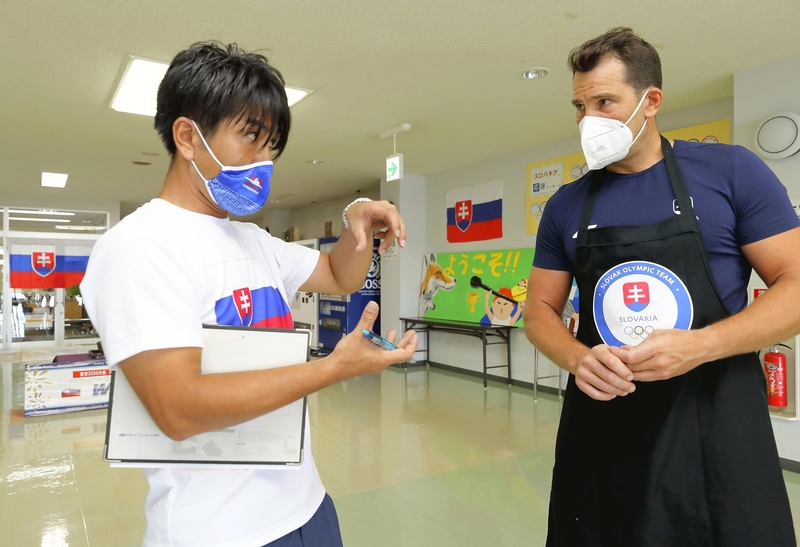
Yoshimi Hayashi, 41, of the Katori city board of education in Chiba Prefecture, was seen Wednesday morning confidently taking notes on what he was told in English at the Omigawa Sports Community Center.
"I'll have watermelons and potatoes today. Oh, and 30 300-gram steaks, please," said Michal Bucek, 40, a chef for the powerful Slovakian men's canoe sprint team.
The city hosted the team's pre-Games camp from July 12 to July 31 on the banks of the Kurobe River, a tributary of the Tonegawa river.
Although local butcher shops were closed that day, Hayashi and other city officials supporting the team called stores in neighboring municipalities and found that many steaks were available at a supermarket in nearby Asahi. They immediately went to the store by car.
As precautions against the novel coronavirus, the activities of athletes and others visiting Japan for the Tokyo Olympics are limited to their lodgings, training grounds and the Games venues. The group of city officials went shopping every day for the athletes, who were not allowed to go out freely. The group even went to as far as Ibaraki Prefecture once to buy lentils.
"I want to do everything I can for them since they have taken the trouble to come to Katori," said Hayashi, wearing a T-shirt with Slovakia's national flag on it. Later that day, Hayashi carried watermelons and potatoes into the center.
-- No exchanges
The city of Katori, where water sports are popular, caught the attention of Slovakian coaches who visited the city in January last year. They apparently thought that the wind and other conditions in Katori were similar to those at the competition venue.
With the spread of the outbreak, however, a planned canoe class by athletes for local children was held at a distance, and children were unable to enjoy their direct instructions on how to paddle. The athletes' planned visit to Katori Jingu, a shrine worshipped for its "god of victory," also was canceled.
With almost no interactions between the Slovakian athletes and local citizens, Hayashi and his colleagues were responsible for providing the athletes "omotenashi," or traditional Japanese hospitality. In addition to shopping for the athletes, Hayashi and three other city officials took turns staying at the center day and night to prepare for emergencies.
Erik Vlcek, 39, a silver medalist at the 2016 Rio Olympics, said, "I'm really grateful for them doing everything they can to support us when many people are worried about the pandemic."
In the case of Anamizu, Ishikawa Prefecture, it rented out a local hotel to accommodate a taekwondo team from the Russian Olympic Committee.
"We had to think from scratch about what we should do to prevent infections, and it was very difficult," an official of the town said.
The town of Nishikawa, Yamagata Prefecture, which hosts a team of canoe sprinters from Moldova in Eastern Europe, serves preprepared meals at their lodgings.
"We are proud to welcome the athletes, but concrete measures for hosting pre-Games camps are left to the local government. It would have been helpful if the national government or the Olympics organizing committee had provided us some kind of support," a town official said.
"Omotenashi" has changed its form amid the coronavirus crisis.
The Tokyo Olympics are being supported by the efforts of local government officials, and they bear a heavy burden.
Read more from The Japan News at https://japannews.yomiuri.co.jp/