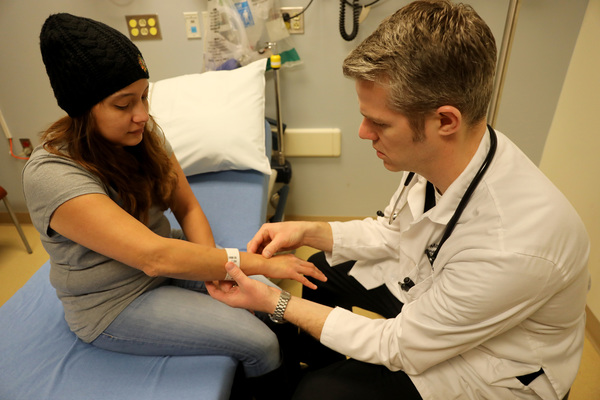
CHICAGO _ Zulidany Cortez came to the emergency room at Amita Health Adventist Medical Center Bolingbrook when she could no longer take the pain from a wrist she hurt moving furniture.
In years past, doctors likely would have given the 32-year-old a prescription for an opioid painkiller to swiftly curb her suffering. But when Cortez met with Dr. Mark Livak, the subject didn't even come up.
"I think Tylenol should be OK," Livak said. "We're going to put you in a splint, a piece of moldable fiberglass that goes in an ACE wrap. I think that's going to give you some pain relief just by not moving it."
So it goes in the emergency rooms and surgical suites of many Chicago-area hospitals, where physicians are trying to overturn their profession's long-standing dependence on opioids.
Drugs such as Vicodin, OxyContin and fentanyl diminish moderate to severe pain, but they also carry a significant risk of addiction. It's not clear how many people swept up in the nation's opioid crisis got started because of a trip to the hospital, but some experts believe the portion is sizable.
"The majority of overdoses come from (people who use opioids to treat) chronic pain, but that doesn't tell you how their use began," said Dr. Andrew Kolodny, a Brandeis University scientist who is executive director of Physicians for Responsible Opioid Prescribing.
"I can't point to data, but I believe that for the vast majority of people who become stuck on opioids, their prescriptions began because of injury or surgery."
But it's not just patients who are in danger from excessive opioid prescribing. People who receive large doses often end up with leftover pills that are taken by others: More than half of Americans who misuse opioids report getting them from a friend or relative, according to the National Survey on Drug Use and Health.
Many hospitals are now moving to alternative methods of treating pain. Some doctors say less potent medications can handle pain equally well _ and that patients are coming to share that view.
In the past six months, Rush University Medical Center has given post-surgical patients Tylenol, Motrin and gabapentin, a medication used for nerve pain. A mild opioid is used just for intermittent pain spikes.
Dr. Asokumar Buvanendran, a Rush pain specialist, said patients greeted the new protocol in a surprising way.
"We were concerned we would have a lot of complaints, but we have not seen any of that," he said. "We have seen the reverse _ patients are more satisfied."
Second thoughts
Opioids, which encompass everything from codeine to heroin, block pain signals to the brain. That trait has made them a prized analgesic for thousands of years, but experts say their use exploded in the 1990s as doctors _ swayed by shifting attitudes about treating pain and aggressive pharmaceutical company marketing _ became more generous about prescribing them.
While most of the pills went to patients with chronic conditions, Kolodny said they also became the first choice for people visiting an emergency room or recovering from surgery.
"There's a notion that the drug can't cause addiction, that the abusers are the ones at fault," he said. "(Doctors) don't think they're creating abusers. They don't quite get that the drugs themselves are causing addiction."
But as overdoses spiked and stories emerged of habits that began with a broken bone or a pill filched from a relative's medicine cabinet, medical professionals began to rethink their use of the drugs.
The U.S. Centers for Disease Control and Prevention called for physicians to prescribe no more than three to seven days' worth of take-home opioids for acute pain. Numerous professional groups also called for restraint.
"We were probably too liberal when we were responding to all this pressure (to prescribe the drugs), but that's really tightened up," said Dr. Mark Reiter, past president of the American Academy of Emergency Medicine.
The same reckoning has happened in operating rooms. At Northwestern Medicine's hospitals, surgeons try to prescribe no more than a small amount of opioids after a procedure, though they don't stick to a specific amount.
"The reality of treating acute pain is we're often guessing how many pills a patient will need," said Dr. Jonah Stulberg, a Northwestern surgeon who has led its opioid reforms. "Some people's pain gets much better in 24 hours; others have significant pain for three to five days. We probably will never be able to exactly match the number of pills a patient needs with their pain."
Instead, Northwestern tutors patients about the potential dangers of opioids and asks them to bring unused medication to follow-up meetings with their surgeons, where the drugs can be disposed of properly.
Lynn Adler, who recently underwent gastrointestinal surgery at Northwestern, said she appreciated that policy.
"I had never been asked that before," said Adler, 70, who returned a bottle of tramadol. "I loved it because I had filled the prescription but never took any. I didn't know what to do with them, so I was really happy when they told me to bring them in."