Ambulance crews are increasingly finding it difficult to find medical institutions to receive patients for emergency treatment, particularly in Tokyo and 10 other prefectures where a state of emergency has been declared due to the coronavirus crisis.
According to a Yomiuri Shimbun tally of 15 emergency services departments in those prefectures, including the Tokyo Fire Department, the number of such incidents in January increased by 2.3 times compared to the same period last year, due to such reasons as a lack of available medical personnel and beds at medical institutions designated to treat novel coronavirus patients
If a hospital refuses requests from emergency crews to treat patients at least three times and an ambulance is left waiting for more than half an hour, the Fire and Disaster Management Agency of the Internal Affairs and Communications Ministry defines the incident as an "emergency patient transfer problem."
The number of such cases recorded by the 15 local emergency services departments totaled 9,865 from Jan. 4 to 31, an increase of 5,676 from the corresponding period last year. The highest number of such cases was recorded in Tokyo at 5,720, or 2.5 times more than last year, while cases in Osaka reached 1,048, or 1.7 times more, and Yokohama reported 885 cases, or 3.5 times more. The highest year-on-year rate of increase was registered in Kawasaki, which recorded 4 times as many cases.
In early January, an emergency crew transporting a man in his 70s who had fallen at his home in Chiba was rejected by as many as 27 hospitals. The crew arrived at the hospital that finally admitted the man 3 hours and 9 minutes after the first call for the ambulance was made. The man was not infected with the coronavirus.
-- Patients turned away
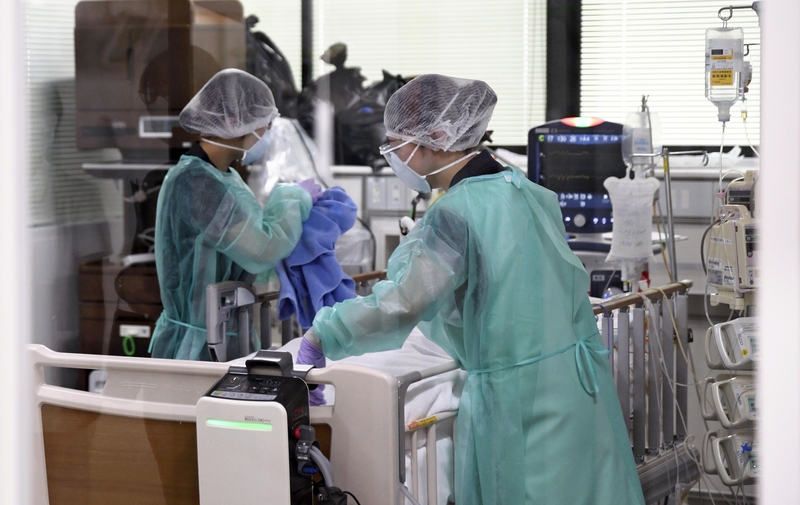
At the intensive-care unit of Chiba University Hospital in Chuo Ward, Chiba Prefecture, coma patients including severe coronavirus cases and others were being treated in two depressurized rooms on Tuesday, with two to three nurses attending to each patient.
"Patients were arriving in waves and the situation at the hospital became dysfunctional pretty quickly. There was nothing we could do," said a doctor who supervises the emergency unit at the hospital, recalling chaotic scenes at the hospital last month.
Its nine-patient emergency ward filled to capacity soon after the New Year, and beds in the 18-patient intensive care unit to which seriously ill patients are transferred also became fully occupied.
The hospital said it had to reject requests to admit acute patients while taking into consideration degrees of urgency. The hospital took the unusual step of closing one of its 20 wards closed and assigning 22 nurses to deal mainly with coronavirus patients.
But in late January, it was forced to cut the number of personnel in some of its clinical departments and it stopped accepting coronavirus patients after a cluster broke out in a general ward that affected hospital staff members and inpatients.
Tokai University Hospital in Isehara, Kanagawa Prefecture, accepted coronavirus patients from outside its service area, including patients from Yokohama and Kawasaki. Its 20 beds reserved for seriously ill patients and 10 for moderate cases have remained full.
To increase its capacity to treat coronavirus patients, the hospital took such measures as reducing the number of beds in general wards and putting off surgical operations with relatively low urgency.
Although the number of patients the hospital admitted has been declining gradually since late January, many seriously ill patients have been hospitalized for several weeks, and beds are not readily available.
Seiji Morita, director of the emergency and critical care center of the hospital, said: "We have been carrying out our work with a sense of mission. But feelings of hopelessness and signs of mental pressure are becoming more apparent."
Read more from The Japan News at https://japannews.yomiuri.co.jp/