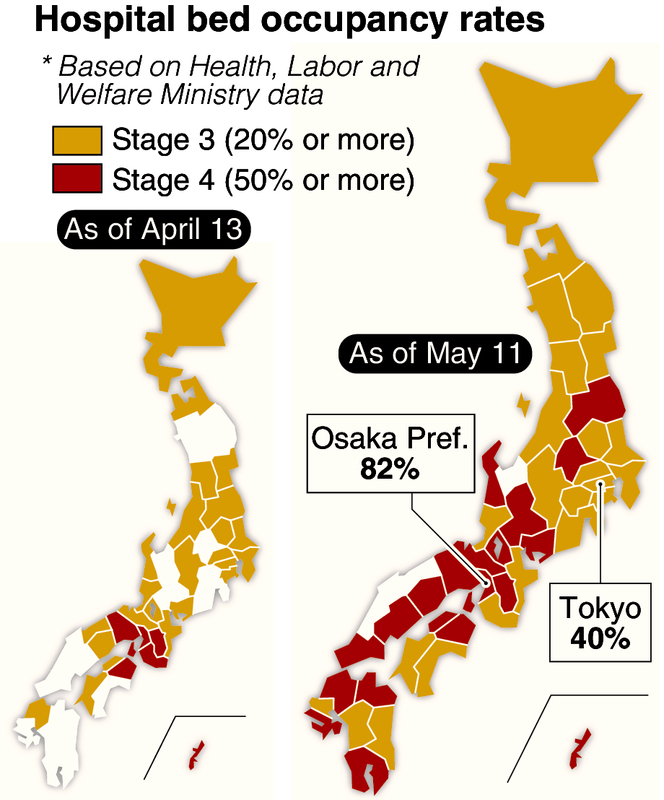
Occupancy rates of hospital beds exceeded 50% in 20 prefectures as of Tuesday amid a surge in coronavirus cases, according to a tally by the Health, Labor and Welfare Ministry.
The number of prefectures with high hospital occupancy rates rapidly increased from six recorded a month ago. The rise is due to the spread of coronavirus variants, which are highly infectious and likely to cause serious symptoms. Health care systems are strained even in regional areas.
The hospital bed occupancy rate, which indicates the percentage of hospital beds secured by prefectures that are used by inpatients, is one of the six criteria set by the government to analyze the infection situation in the nation. The ministry releases updated data once a week.
The benchmark for Stage 4, the most serious infection level, is 50% or more.
As of Tuesday, Osaka and Ishikawa prefectures had occupancy rates of 82%. The rates in five prefectures, such as Okayama, where a state of emergency was issued Sunday, were in the 70% range, while 13 prefectures saw their figures in the 50% to 60% range.
The rates as of April 13 exceeded 50% in only six prefectures: Osaka, Hyogo, Nara, Wakayama, Tokushima and Okinawa. The daily number of new infection cases in Japan at that time was around 4,000. Since then, the figure has been on the rise nationwide especially in urban areas, topping 7,000 this month.
The occupancy of hospital beds was severe in the week until Tuesday in Hiroshima Prefecture, which became subject to the state of emergency on Sunday. Hiroshima's rate jumped about 20 percentage points to 57% from the previous seven-day period. The prefectures of Kagoshima, Nagasaki and Fukushima also saw their rates rise more than 20 percentage points.
The surge of infections is attributable to the spread of the British and other coronavirus variants. According to the National Institute of Infectious Diseases, the variants began to become more common, replacing the ancestral virus in the Kansai region in March, and in the Tokyo metropolitan area in April. The institute estimated that newly confirmed infections involving coronavirus variants accounted for more than 90% of the total cases as of May 9.
"The speed of infections is very fast [due to the spread of the variants], and the health care system will come under pressure quickly," said Shigeru Omi, chairman of the government's COVID-19 subcommittee.
With 24 prefectures categorized as Stage 3, for which the threshold is 20% or more, implementing stronger measures to prevent infections and secure hospital beds is an urgent task.
The hospital bed occupancy rate for Tokyo is 40%.
Read more from The Japan News at https://japannews.yomiuri.co.jp/