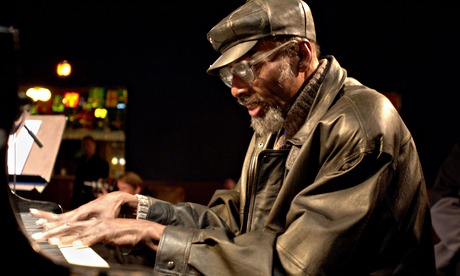
In 1931, Horace Parlan was left on the steps of a Pittsburgh orphanage. A case of polio contracted at the age of five left him only able to use two fingers on his right hand. He grew up playing jazz piano, and went to the clubs to jam with the big names. They told him to go away and get better. He did. Eventually, Charles Mingus said he could stay, which led to a distinguished career playing with the likes of Archie Shepp and Eddie “Lockjaw” Davis. Horace moved to Denmark in the early 70s and now lives in a care home near the sea. He can no longer walk, is blind and was recently widowed. Still, Archie Shepp calls from Paris and asks what he’s had for lunch. He sees Eddie “Lockjaw” Davis in his dreams. In the last one Eddie was working as a steward on a jumbo jet. He doesn’t know why. Nor did Eddie. On special days, Horace’s wheelchair is lifted into Copenhagen’s main jazz club and people come to pay homage. The Documentary: A Portrait Of Horace Parlan (Tuesday, 5.30pm, BBC World Service) is produced beautifully by Rikke Houd, and is full of warm, authentic voices of the jazz age.
Destroyer Of Worlds (Saturday, 8pm, Radio 4) tells the profoundly educational story of how British advances in nuclear fission during the 1930s were unwisely traded away by Churchill in exchange for some of those chimerical benefits which are supposed to flow from the “special relationship” with the United States. It’s full of Ealing comedy detailing: the British project was christened “Tube Alloys” (bonus ball – by a man named Perrin) because that sounded appropriately mundane; Roosevelt’s secretary looked at the name, shrugged and mistakenly sent it on to the Navy department; James Chadwick, the man who wrote the MAUD report summarising British research into the bomb, was so shaken by its implications he took sleeping pills for the rest of his life; Ernest Bevin, the Labour foreign secretary, insisted we have our own bomb, preferably “with a bloody Union Jack on top”. If only it were possible to get finance for a movie about British naivety and American betrayal, this programme would make a great starting point.
Annie Nightingale wrote her memoirs in 1981. The book was called Chase The Fade in recognition of the need to record the memories while they were still there. She didn’t know that another career beckoned as a club DJ. The two-part programme that marks her sixth decade as a broadcaster, On Air With Annie Nightingale (Wednesday, 10pm, Radio 2), begins in the 60s when she was distracted from the honest trade of journalism by the chance to be one of those TV presenters that some producer hopes “the kids” will be able to identify with.
If I had my way, political historian Peter Hennessy would have his own channel. He’s the man in charge of pointing out that whatever’s happening in British politics has happened, in some form or other, before. Reflections (Monday, 9am, Radio 4) is a three-part series in which he talks to politicians of similar vintage about their lives and careers. In future programmes he has Clare Short and Nigel Lawson. He starts with David Owen, one of the last of the generation of politicians who had done manual labour at some point in early adult life. When the Suez crisis happened in 1956, Owen was digging trenches for a sewage plant in Plymouth and was amazed to find that his fellow workers thought “the gypos” should be resisted. “I learned that you couldn’t assume that liberal views would always be held by Labour voters.”