Alexis Tsipras’s decision to head to Brussels on Wednesday night suggests he’s not prepared to accept the creditors’ new proposals without a fight.
By meeting Jean-Claude Juncker, Tsipras may be hoping to get support for his own 47-page list of proposals, rather than cave in (or be seen to cave in) to the former Troika...
The financial markets, incidentally, are pricing in an eventual Greek debt restructuring, sooner or later.....
Greek PM Tsipras to present #Greece's proposal to EU's Juncker in Brussels on wed as 10yr default probability at 95%. pic.twitter.com/L9eZCnsni2
— Holger Zschaepitz (@Schuldensuehner) June 2, 2015
Just when we thought things were over...... Athens journalists are reporting that prime minister Alexis Tsipras will visit Brussels tomorrow.
He’ll be carrying the Greek proposal to end the deadlock, rather than the one being sent by creditors to Athens tomorrow.....
#Greece PM #Tsipras 2 meet with #EC President @JunckerEU in BXL 2morrow.
— Konstantinos Pappas (@kpappas1955) June 2, 2015
Tsipras going to Brussels Wed, taking Greek proposal with him, after invite by Juncker, gov source says. Mtg Wed night
— NikiKitsantonis (@NikiKitsantonis) June 2, 2015
OK, events really seem to have calmed down for the night, so I’m going to wrap up here. Big day tomorrow, when we learn how the offer crafted by Greece’s lenders goes down in Athens.
Will it be acceptable to the Athens government, paving the way to unlock bailout funds and avert a default that could rock Europe to its core? Tune in on Wednesday to find out..... GW
A good laugh. #Greece #Grexit #Brexit pic.twitter.com/nFwwiiCxVx
— The Greek Analyst (@GreekAnalyst) June 2, 2015
Our Athens correspondent, Helena Smith, sums up the situation tonight:
A full moon is rising over Athens tonight. A good omen?....
#fullmoon on in #Greece https://t.co/31aMNJ9uHF
— spyros gkelis (@northaura) June 2, 2015
Ανατέλει από Ταύγετο.. pic.twitter.com/uWaY6pOgmm
— Nαυσικά (@nafsika71) June 2, 2015
Updated
Reuters is now also reporting that the ECB, IMF and EC have agreed a cash-for-reforms proposal to put to Greece on Wednesday (as Peter Spiegel tweeted earlier)
PPS: Christine Lagarde is expected to brief the IMF board about the situation in Greece, having jetted back across the Atlantic following the Berlin talks.
She’ll need good answers about Greek debt sustainability, and the prospect of the Fund receiving its €1.6bn this month.
IMF chief Lagarde is likely to face more questions about the the fund’s eroding credibility when she briefs the board on Greece later today.
— Ian Talley (@IanTalley) June 2, 2015
Extra #IMF Board meeting on #Greece with Lagarde briefing on yesterday's 5-party meeting & institutions' proposal (via @pitrofos4 & @skaigr)
— Manos Giakoumis (@ManosGiakoumis) June 2, 2015
Creditors' plan is ready to be presented
PS: The latest word from Brussels is that creditors have completed a deal to present to Athens on Wednesday, the FT’s Peter Spiegel reports.
That means technical teams have finished their work, which was prompted by last night’s emergency meeting in Berlin.
Technical teams from #Greece's creditors completed text of bailout deal this afternoon; presentation tomorrow.
— Peter Spiegel (@SpiegelPeter) June 2, 2015
Roll on Wednesday, when we’ll also be treated to a press conference with ECB chief Mario Draghi #cannotwait
Updated
Markets edgy on Greek and eurozone inflation
With Monday’s late night meeting but seemingly no proposals yet agreed by either Greece or its creditors, investors continue to be nervous as the clock ticks down towards the country running out of money. With eurozone inflation coming in higher than expected, there was also the concern that the ECB’s supportive bond buying programme might end sooner than anyone anticipated. So markets had another nervous day, with the final scores showing:
- The FTSE 100 fell 25.31 points or 0.36% to 6928.27
- Germany’s Dax dropped 0.94% to 11,328.80
- France’s Cac closed 0.41% lower at 5004.46
- Italy’s FTSE MIB edged up 0.6% to 23,576.16
- Spain’s Ibex ended up 0.3% at 11,271.4
- The Athens market fell 2.47% to 804.96
But on Wall Street, the Dow Jones Industrial Average shrugged off early Greece jitters, and is currently up 34 points or 0.18%.
On that note, it’s time to close up although we may be back if anything major develops. Thanks for all your comments, and we’ll be back tomorrow.
Over in Athens, the minister of state Nikos Pappas has also racheted up the pressure this afternoon describing the proposal the Greek government has made as “complete, unified and solid,” reports our correspondent Helena Smith.
“Greece last night officially submitted a text of proposals to the institutions that were complete, unified and solid just as the decision on the 20 February called for,” said the minister referring to the decision of creditors to extend Greece’s current bailout until the end of June.
“Whoever has something specific to say about the proposal, so be it. There is no more time to waste. As the prime minister Alexis Tsipras himself said recently, “whoever wants a solution should contribute now, whoever doesn’t want a solution should hold their tongue.”
The statement is important not least because Pappas, who rarely speaks in public, is Tsipras’ closest ally. The Glasgow-educated politician is the only man to have attended the tete-a-tetes the Greek prime minister has had with Merkel in recent months.
Updated
#ELA cash buffer remains unchanged at €3 bln, decision on higher collateral haircut postponed again. #Greece #ecb https://t.co/7ca8TMLTBU
— Manos Giakoumis (@ManosGiakoumis) June 2, 2015
More support for Greece from the European Central Bank (ahead of tomorrow’s meeting) it would appear:
#ECB said to raise Greek ELA ceiling to €80.7bn, BBG reports.
— Holger Zschaepitz (@Schuldensuehner) June 2, 2015
That would be an increase of €500m.
Updated
And another suggestion the two sides - Greece and its creditors - remain some way apart in their separate proposals:
Greek source just told me: "Both sides have tabled completely irreconcilable proposals" Here's our story: https://t.co/uLNKdEPVMA
— Simon Marks (@MarksSimon) June 2, 2015
Here’s the latest summary from Reuters about the state of play between Greece and its creditors:
Greece’s creditors are close to finishing a draft agreement to put to the leftist government in Athens, a source close to the talks said on Tuesday, injecting new momentum into long-running negotiations to release aid for the cash-strapped country.
Hours earlier, Greek Prime Minister Alexis Tsipras said Athens had submitted its own proposal to lenders - an apparent effort to pre-empt a take-it-or-leave-it offer by the creditors and to show Greek voters that Athens made its move first.
The statements of proposal and counter-proposal came after leaders of Germany, France and the lending institutions held emergency talks on the Greek debt crisis in Berlin late on Monday in a sign of top-level concern about the impasse.
But:
EXCLUSIVE: EC/IMF TO SUBMIT 'POLITICAL' AGREEMENT TO GREECE - SOURCES
— econhedge (@econhedge) June 2, 2015
PROPOSAL TO ASK GREECE TO NEGOTIATE WITHIN ITS FRAMEWORK
— econhedge (@econhedge) June 2, 2015
PROPOSAL LACKS CONSENSUS ON PENSIONS, DEBT SUSTAINABILITY
— econhedge (@econhedge) June 2, 2015
And:
Asked whether the creditors also discussed a possible 'plan B' in case #Greece rejects their proposal, an EU source said "Yes" ~MNI
— Yannis Koutsomitis (@YanniKouts) June 2, 2015
Updated
Greek official sources saying they will definitely make the IMF payment this Friday
— Ed Conway (@EdConwaySky) June 2, 2015
Eurobank estimates #Greece funding gap at €10-15 bln until 2016, assuming disbursement of pending bailout tranche of €7.2 bln. #ec #imf
— Manos Giakoumis (@ManosGiakoumis) June 2, 2015
The US concern about the situation in the eurozone has been reinforced by a speech in Washington by Federal Reserve board member Lael Brainard. Although mostly about the US economic outlook and the implications for monetary policy, one of the points Brainard mentions involves the eurozone:
Recently, the euro area has seen some encouraging data on retail sales, industrial production, and inflation, auguring well for some sustained improvement in aggregate demand within the euro area. Nonetheless, there remain risks and uncertainties surrounding foreign growth that could prolong or intensify foreign headwinds going forward.
Most immediately, negotiations between Greece and its creditors are challenging, and the risk of further deterioration cannot be ruled out. While the euro area has broadened its policy toolkit and most member states have made significant strides in building resilience in the past couple of years, the recovery is still fragile in several member states, and vulnerabilities to financial stresses remain.
Reuters has further comments from Brainard:
- 02-Jun-2015 15:38:32 - BRAINARD SAYS COMPROMISE OVER GREECE STILL POSSIBLE
- 02-Jun-2015 15:38:54 - BRAINARD SAYS FED “VERY ATTENTIVE” TO POTENTIAL VOLATILITY IF GREEK TALKS DON’T WORK OUT
Afternoon Summary: Creditors eye Friday deal
A quick recap....
The Greek bailout crisis is rattling towards a crescendo, as its creditors scramble to put the finishing touches to a proposal to send to Athens – possibly by the end of the day.
Last night’s emergency summit in Berlin has been followed by further technical work today, as the IMF, the ECB and the European Commission. Lenders hope to get the proposal onto Alexis Tsipras’s desk within hours, paving the way to a ‘political agreement’ by Friday.
The WSJ suggests creditors are prepared to compromise on some key issues.....
....while the FT reports that Brussels is also considering a new plan to extend Greece’s bailout over the summer.
But there is also “strong foreboding” in Europe’s capitals that the crisis could spiral out of control. Our Europe editor Ian Traynor reports:
The radical Greek prime minister, Alexis Tsipras, and his governing hard-left Syriza movement “is underestimating unity in the rest of the EU,” said a senior EU official involved in five years of negotiations with the Greeks.
“That will probably cause default or breakdown. No one is trying to prevent it anymore.”

Greek insiders they’ve heard nothing official yet. And prime minister Alexis Tsipras is refusing to be bounced into an ultimatum by lenders.
Instead, Tsipras has fired his own 47-page proposal to creditors, which suggests we could face further nailbiting deadlock.
He told a press conference today that:
“We are not waiting for them to submit a proposal, Greece is submitting a plan - it is now clear that the decision on whether they want to adjust to realism ... the decision rests with the political leadership of Europe.”
There are also rumblings among Tsipras’s own party that elections could be called, if whatever creditors propose is not acceptable. 28 June and 5 July have been mooted (good luck to anyone booking holidays this summer).
But the Bank of Greece governor, Yannis Stournaras, has warned that most Greeks want to stay in the euro.
Yannis Stournaras, Governor of Bank of Greece: Nobody has a mandate for #Grexit, either by accident or on purpose.
— Dimitris Kourkoulas (@kourkoulasdim) June 2, 2015
Hopes of a deal sent the euro surging today, with the latest eurozone inflation data providing extra rocket fuel. Euro CPI rose by 0.3% annually in May.
Incredible #euro rally. Now up >2%, among its 10 biggest rallies (ex-Lehman period volatility) since launch in 1999: pic.twitter.com/LWq1HrX1Yx
— Jamie McGeever (@ReutersJamie) June 2, 2015
But eurogroup president Jeroen Dijsselbloem calmed the excitement, saying a deal isn’t theoretically possible this week, and more work is needed....
@ManosGiakoumis Dijsselbloem seems to be saying the exact opposite: http://t.co/MnhnDO8Tss
— Peter Spiegel (@SpiegelPeter) June 2, 2015
Updated
What does Dijsselbloem mean by saying a Greek deal is ‘not theoretically possible this week’?
He’s probably concerned that any deal would need to be signed off by his eurogroup, which next meets on June 18. Some European parliaments may also want a vote.
But as flagged earlier, creditors are hoping for a ‘political deal’ by Friday, and a concrete agreement a week later.
Dijsselbloem may also be irked that he missed out on the Berlin mini-summit.
Eurogroup Chief Dijessbloem says agreement with #Greece unlikely this week (@RANsquawk) - note he was not at the late night Berlin meet...
— Open Europe (@OpenEurope) June 2, 2015
Oh dear. Jeroen Dijsselbloem, the Dutch finance minister who chairs the eurogroup of finance minister, has just dampened our hopes.
- EUROGROUP HEAD DIJSSELBLOEM SAYS: GREECE DEAL NOT THEORETICALLY POSSIBLE THIS WEEK
- EUROGROUP’S DIJSSELBLOEM SAYS GREEK GOVERNMENT MUST BE “HONEST WITH VOTERS” ABOUT FINANCES
#Eurogroup's Dijsselbloem says that there is progress in Greek talks but not sufficient. It’s not right to think that we can meet half way.
— Holger Zschaepitz (@Schuldensuehner) June 2, 2015
Greece: No-one's told us anything yet

Over in Athens the government is still insisting that it has had no contact with creditors since the 5-way meeting of institutional heads, the EU president and German and French leaders last night, reports Helena Smith.
In a tersely worded statement, prime minister Alexis Tsipras’ leftist led coalition announced:
“The Greek government has not received an agreement plan from the institutions, nor has there been contact between the prime minister or some other official of a government with corresponding officials from the institutions.”
But detailed reports regarding the content of Greece’s proposal are beginning to filter through with government sources saying the proposal runs to 47 pages and is divided into “elements” agreed by teams of technical experts, known as the Brussels group, and “elements” that have yet to be resolved.
The anti-austerity government, has it seems, agreed to overhaul the social security system and roll back on pension reform - but is still insisting that the primary surplus demanded of Athens be less than 1%.
It is also believed to be digging in its heels on its primary demand of reducing what it has repeatedly said is an unsustainable debt load - perhaps the biggest impediment to any kind of deal for creditors.
Expressions of optimism are coming in thick and fast with officials saying they expect an agreement to be sealed within days.
The governor of the Bank of Greece and former finance minister Yannis Stournaras (no friend of the government) has also said that he believes the distance between the two sides is finally being bridged and that a compromise is not far away.
Stournaras reminded an audience at London’s Chatham House that 80% of Greeks did not want euro exit and 65% were willing to make further sacrifices to stay in the single currency.
Updated
There is growing angst in the eurozone’s corridors of power about the looming ultimatum for Greece, reports our Europe editor, Ian Traynor.
Last night’s emergency talks in Berlin have shown that a political deal will be needed, but the failure of creditors to reach a common position is causing alarm:
In Brussels and eurozone capitals, there is a strong sense of foreboding that the extreme brinkmanship on both sides is careering out of control and will end badly.
The radical Greek prime minister, Alexis Tsipras, and his governing hard-left Syriza movement “is underestimating unity in the rest of the EU,” said a senior EU official involved in five years of negotiations with the Greeks. “That will probably cause default or breakdown. No one is trying to prevent it anymore.”
Several eurozone countries are particularly reluctant to take a soft line with Greece:
“Belgian, Finnish, Dutch opinion is hardening. The Germans are actually the softies compared to the Slovakians and Estonians.”
We’ll have more from Ian later...
Updated
This episode of the Greek crisis will probably end with another helping of EU fudge, writes our economics editor, Larry Elliott.
After all, a Grexit is too alarming and Athens remains unwilling to cave in:
Greece does not want to leave the euro. Merkel does not want to be the politician held responsible for derailing the European project. So there is a temptation to do what Europe has done throughout its six-year sovereign debt crisis: play for time.
This would involve Greece’s creditors providing bridging finance that would allow Tsipras to meet the series of debt repayments due this summer and for a referendum to be held on whether the Greeks believe yet more austerity is a price worth paying for staying in the euro.
Athens would give a solemn commitment to step up the pace of economic reform; the troika would say that any backsliding will result in the money being cut off...
FT: Creditors hope for political agreement by Friday
So if Greece’s lender are nearly ready to fire over a proposal to Athens, what timescale are we looking at?
The FT’s Peter Spiegel reports that the IMF, ECB and EU have ‘narrowed their differences’, and hope to agree a final text outlining what is expected from Athens by the end of Tuesday.
Officials are hoping that a “political agreement on principles” can be hammered out before this Friday, when Athens must repay €300m to the IMF, he writes.
A full deal could then be agreed by the end of next week, officials in Brussels reckon.
However, there’s still one sticking point -- the budget surpluses that Greece must sign up to (as the old targets are now unachievable given the economic turmoil this year)
The IMF remains sceptical and continues to seek assurances that eurozone governments would agree to restructure Greek debt — mostly now held by EU creditors — if a credible reform programme is not agreed and the targets are not met.
#Greece's creditors hoping for political deal by Fri; staff-level agreement next wk. Also weighing bailout extension http://t.co/lGAgDhIrU7
— Peter Spiegel (@SpiegelPeter) June 2, 2015
Peter also has another important piece of news... the creditors are also devising a way of getting Greece through the summer once its bailout programme expires on 30 June, he reports.
One wheeze is to ‘repurpose’ almost €11bn of funds allocated to recapitalise Greece’s banking sector as general purpose bailout aid, which could then be used to repay the ECB in July and August.
That would “kick the can down the road” until the autumn, as the ECB could continue to provide emergency liquidity to Greece’s banks.
BUT.... is this proposal going to be acceptable to Alexis Tsipras, and the more hardline members of his party, who have been making noises about elections this morning?
Updated
Greek creditors 'close to agreeing a deal'
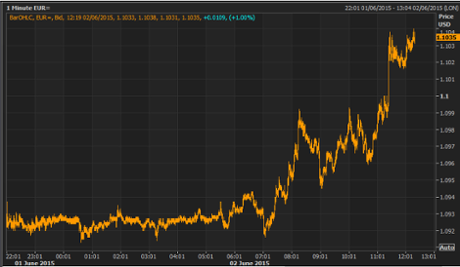
The euro has jumped on reports that Greece’s creditors are close to agreeing a proposal to send to Athens.
It’s a confusing picture (as so often!); Reuters is hearing that a draft deal is almost ready.
- GREECE’S EU/IMF CREDITORS CLOSE TO COMPLETING DRAFT OF DEAL TO PUT TO GREEK GOVT - SOURCE CLOSE TO TALKS
The Wall Street Journal also reckons an accord is imminent, with creditors prepared to compromise a little:
Marcus Walker, the WSJ’s European economics editor, writes:
Greece’s creditors have reached a consensus on the terms of a proposed deal to put to the Greek government, according to two people familiar with the talks.
Officials representing European institutions and the International Monetary Fund on Tuesday morning completed the draft of an agreement to unlock bailout aid for Greece, after key European and IMF leaders met in Berlin late Monday to overcome differences between Greece’s creditors, they said.
Eurozone governments and the IMF have agreed to press Greece for far-reaching economic overhauls, while the IMF has softened its insistence that Europe offer explicit commitments to relieve some of Greece’s debt burden, the people said....
Greece’s creditors agree on proposed deal to submit to Athens. Tough times ahead for Tsipras http://t.co/yru2Ibpyx8 my story via @WSJ
— Marcus Walker (@MMQWalker) June 2, 2015
Caution is needed here; there’s no guarantee that any proposal from the creditors will match the ‘comprehensive plan’ pinged to Berlin by the Greeks.
But still, any sign of progress is being cheered by the market, sending the euro to its highest level in 10 days.
Speculation about elections at the end of June continues to swirl in Greece, this time from the junior member of the country’s coalition:
#Greece junior coal partner ANEL's spox sees elections on June 28th. (It's the 2nd time he alludes to elections) https://t.co/1h7wzabpAl
— The Greek Analyst (@GreekAnalyst) June 2, 2015
Many papers are being exchanged between Athens and its creditors, says European Commission spokeswoman Annika Breidthardt.
She’s taking the daily media briefing in Brussels right now, and was asked about these “comprehensive proposals” which Greece apparently whizzed over to the Berlin talks last night.
"The fact that docs r exchanged is a good sign" says @A_Breidthardt without commenting on specific doc sent from Athens 2Brussels last night
— Eleni Varvitsiotis (@Elbarbie) June 2, 2015
This is known as ‘paperology’ in the trade; the EU doesn’t like talking about it.
EU finally hails paperology: 'The fact that documents are being exchanged is a good sign', says @A_Breidthardt
— Danny Kemp (@dannyctkemp) June 2, 2015
Breidthardt also cautioned against being over-optimistic, warning that the two sides “are not there yet”.
"We're not there yet," says @A_Breidthardt on Greece talks.
— Gabriele Steinhauser (@gksteinhauser) June 2, 2015
Looks like Alexis Tsipras got a warm reception from employees at the Greek education ministry this morning:


EU insiders say the proposals sent by Greece last night weren’t comprehensive enough....
Sources: Greek proposal didn't contain major new concessions on key issues such as pension and labour issues http://t.co/tDMBTpp8x5
— Jarno Hartikainen (@JarnoHa) June 2, 2015
Greece’s prime minister, Alexis Tsipras is insisting he’s not prepared to be bounced into a deal by creditors.
The Syriza leader insists that his government sent “realistic” plans of its own to Berlin last night, which he urges them to back...
He says:
“We have submitted a realistic plan for Greece to exit the crisis....and end divisions in Europe.
“We are not waiting for them to submit a proposal, Greece is submitting a plan - it is now clear that the decision on whether they want to adjust to realism ... the decision rests with the political leadership of Europe.”
@tsipras_eu says not waiting for proposal from creditors, Greece sent own 'comprehensive plan' ystdy. Seeks decision by EU political leaders
— NikiKitsantonis (@NikiKitsantonis) June 2, 2015
Tsipras's take on Monday's meeting in Berlin is that EU's political leaders came together to examine proposal made by Greek gov't #Greece
— Nick Malkoutzis (@NickMalkoutzis) June 2, 2015
But EU officials say that Merkel et al considered a paper drawn up by the Commission, showing the ‘core principles’ they need to meet to get a deal.
He is wrong #imho. https://t.co/xPR1zCTzkk
— Ilias Siakantaris (@iliassiak) June 2, 2015
Updated
Alexis Tsipras adds that he is optimistic that an agreement will be reached in time.
I believe European leader will respect our proposals, he tells his audience in the Athens education ministry.
Greek PM: Decision rests on Europe's leaders
Back in Greece, prime minister Alexis Tsipras is speaking now - repeating that Europe’s leaders are the only people who can deliver a solid agreement.
He also revealed that Greece sent a “comprehensive proposal” to its lenders last night [Tsipras held a cabinet meeting with top ministers on Monday evening].
- GREEK PM TSIPRAS SAYS THE NEGOTIATIONS ARE TOUGH, WE ARE DETERMINED, WE ARE NEGOTIATING WITH A STRATEGY IN DIFFICULT CONDITIONS
- GREEK PM TSIPRAS SAYS GREECE HAS SPECIFIC, REALISTIC PROPOSALS, WE HAVE ALREADY MADE CONCESSIONS
- GREEK PM TSIPRAS SAYS GREECE SUBMITTED A COMPREHENSIVE PROPOSAL FOR AGREEMENT TO LENDERS ON MONDAY NIGHT
- GREEK PM TSIPRAS SAYS DECISION ON AGREEMENT RESTS ON POLITICAL LEADERS IN EUROPE
Tsipras: "Greek people know that 'day after will be difficult' regardless of negotiations #Greece pic.twitter.com/pq0wq9kAaa
— Derek Gatopoulos (@dgatopoulos) June 2, 2015
The European Central Bank might have to revise its forecasts higher at tomorrow’s monetary policy meeting, reckons Credit Agricole’s Fred Ducrozet.
Eurozone HICP now *above* ECB’s most optimistic scenario – staff forecasts to be adjusted slightly higher tomorrow. pic.twitter.com/BWW6GvumAg
— Frederik Ducrozet (@fwred) June 2, 2015
Updated
Eurozone inflation beats expectations
Breaking: Inflation across the eurozone has started rising again, and by more than many economists expected.
The eurozone consumer prices index, which tracks the cost of living across the euro area, rose by 0.3% in May, having been flat in April (and negative since January). The City had expected a reading of 0.2%.
Inflation in the service sector rose by 1.3%, up from 1.0% in April, while food, alcohol & tobacco prices rose by 1.2% (up from 1.0%). And the prices of non-energy industrial goods rose by 0.3%.
Cheaper oil prices continued to drag the cost of living down, but not as much as previously. Energy prices were down by 5% year-on-year, compared with -5.8% in April).
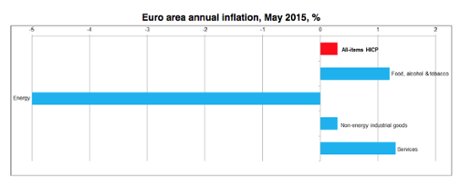
And core inflation, which strips out volatile factors, rose by 0.9%, indicating that underlying price pressures are increasing.
It shows that the ECB’s huge quantitative easing programme (buying up €60bn of bonds with new money each month) is having a real impact.
#Eurozone back to #inflation: Consumer Prices rise for 1st time in 6months. May Core CPI also rose to 0.9%. pic.twitter.com/Onj0CRt9FO
— Holger Zschaepitz (@Schuldensuehner) June 2, 2015
#Greece | Scores of Syriza ministers & MPs this am talk of snap elections "if compromise goes beyond our election program".
— Yannis Koutsomitis (@YanniKouts) June 2, 2015
Helena Smith: Greece rumour mill in overdrive
There is much chatter in Athens this morning that the country could hold elections if Greece isn’t given the “honourable compromise” that it wants, says our correspondent Helena Smith.
It is indicative of the mood in Athens this morning that even the mild-manned deputy premier Yannis Dragasakis has come out all guns. “As a government neither do we accept ultimatums not do we bow to blackmail,” tweeted the ex communist who is now in charge of the anti-austerity coalition’s economic policy.
Ως κυβέρνηση ούτε δεχόμαστε τελεσίγραφα ούτε υποκύπτουμε σε εκβιασμούς #studydays
— Γιάννης Δραγασάκης (@YDragasakis) June 2, 2015
If an honourable compromise isn’t reached “then we’ll have elections,” the labour minister, Panos Skourletis, told SKAI TV. “When you are elected you are not given carte blanche,” he said, adding:
“If a deal is achieved that is not deemed honourable and promoting of compromise, the people will have to be asked before we sign it.”
Nikos Filis, the governing Syriza party’s representative in parliament, also insisted this morning that in the event of an agreement not being endorsed by government MPS (but being voted through with the help of the opposition) the country would necessarily have to go to the polls.
The great Greek rumour mill is suggesting that fresh polls could be held on June 28. It should be noted that prime minister Alexis Tsipras’ radical left Syriza party is by far the most popular party - and would almost certainly win an elections hands down. Europe or indeed the IMF would not be dealing with a new face in power!
Updated
European markets fall as investors watch Greece
After a calm start, Europe’s stock markets have just fallen into the red, with the FTSE 100 shedding 0.8% or 55 points.

Traders are trying to deduce whether last night’s meeting in Berlin between Merkel, Hollands, Draghi, Lagarde and Juncker is a positive sign, or not.
KBC strategist Mathias van der Jeugt says:
“The fact that five such political and financial heavyweights met about Greece means they are trying to force a break in the political deadlock and that’s a positive development that’s likely to lift risk sentiment. But we will have to wait to see the Greek reaction.”
The Athens stock market is flat this morning.
And the euro has risen by 0.35% against the US dollar, to $1.0966.
German minister warns Greek bankruptcy would have gigantic consequences
Germany’s minister for Economic Affairs, Sigmar Gabriel, is urging Greece to “embrace” its creditors efforts to reach a deal and avoid bankruptcy:
- GERMAN ECON MIN GABRIEL SAYS THE CONSEQUENCES OF A GREEK BANKRUPTCY WOULD BE “GIGANTIC” FOR EUROPE
- GERMAN ECON MIN GABRIEL SAYS HOPES GREECE WILL EMBRACE ATTEMPTS BY MERKEL AND OTHERS TO GET A DEAL
But it’s not clear that Greece actually has anything to cling onto, as Athens officials say they’ve not yet received any new information from the IMF, ECB and EC.
Updated
Just in: Germany’s unemployment total has fallen by another 6,000.
That leaves the country’s jobless rate at its record low of 6.4%.
GERMAN UNEMPLOYMENT FELL 6,000 IN MAY VS EST. 10,000 DROP
— Francine Lacqua (@flacqua) June 2, 2015
A Greek official has told Reuters that Athens hasn’t yet received any text or document from its creditors following last night’s meeting.
Greece is confident it can meet its next debt repayment, €300m to the IMF on Friday, as long as it has an agreement with creditors (even if new funds haven’t been released).
#Greece will make June 5 #IMF payment if deal with lenders reached. http://t.co/Aqkspfrnk5 pic.twitter.com/ZurqXJxOEP
— Holger Zschaepitz (@Schuldensuehner) June 2, 2015
Over to Spain’s briefly...and the country’s unemployment crisis has eased a little.
The number of people out of work fell by almost 118,000 in May, a slightly bigger drop than expected. That brings the total out of work down to 4.215m.
Spain unemployment fals 118k v -115k expected ..... compare that with France where it is still increasing.
— Steve Collins (@TradeDesk_Steve) June 2, 2015
Moscovici: Greece has made pension proposals
European commissioner Pierre Moscovici has just revealed that Greece has offered new proposals on pensions reforms.
He told France Inter radio that:
“We are starting to work in depth on pensions. The Greek government has made some first proposals and the pros and cons are being considered.”
Greece’s creditors have been pushing hard for reform of its pension scheme, which they claim is too generous and encourages citizens to retire early. Many pensioners, though, have already seen their payments slashed since the crisis began -- and in some cases still find themselves supporting the rest of their family.
My colleague Helena Smith covered this crucial issue last month:
Fight to save the Greek pension takes centre stage in Brussels and Athens
Updated
There are plenty of rumours and theories swirling this morning, about what the heads of Germany, France, the IMF, ECB and EC discussed last night. Here’s a few:
Merkel, Hollande and Draghi obviously ready to offer debt relief to #Greece conditional on structural reforms, says @TomMayerEuropa
— Yannis Koutsomitis (@YanniKouts) June 2, 2015
Spanish radio @La_SER: Creditors plan to offer #Greece access to €10,9bn bank funds if Tsipras accepts 70% of program http://t.co/92jzxUgYs2
— Yannis Koutsomitis (@YanniKouts) June 2, 2015
If #Greece accepts creditors' plan, third bailout program to be discussed in the summer together with new funds for Greek banks ~@La_SER
— Yannis Koutsomitis (@YanniKouts) June 2, 2015
Greek spokesman: We can't accept an ultimatum that breaches our mandate

Nikos Filis, the parliamentary spokesman of Prime Minister Alexis Tsipras’s ruling Syriza party, insists Greece will not be bounced into a ‘take it or leave it’ offer from its creditors.
We can’t sign an agreement that was incompatible with our anti-austerity programme, he told Antenna TV, saying:
“If we’re talking about an ultimatum... which is not within the framework of the popular mandate, it is obvious that the government cannot co-sign and accept it.”
(quotes via Reuters)
Updated
Greece’s labour minister, Panos Skourletis, has warned that Athens cannot make more compromises.
Any concessions must come from the Greek creditors, he argued, as part of a ‘political deal’.
He told Skai TV this morning that:
“There is no room for more compromises. We are waiting for the other side to assume its responsibilities.”
FT: Creditors could present new proposal this week
Merkel, Lagarde, Draghi, Hollande and Juncker worked on a technical paper last night prepared by the commission, showing possible ways of reaching a deal , according to the Financial Times.
One official said there were no new concessions to Athens in the commission paper. Rather, it was intended to spell out the core principles creditors need to conclude a deal. Yanis Varoufakis, the Greek finance minister, has long argued that Athens accepts 70% of the existing bailout programme, and creditors are hoping any compromise reached in Berlin could serve as the 70% Mr Varoufakis and Mr Tsipras can accept.
Officials cautioned that the final creditor position may need to be fleshed out in the coming days, but their intention would be to present it to Athens this week.
More here:: FT: Greek bailout monitors hold emergency summit
Moscovici: Talks are bearing fruit
European commissioner Pierre Moscovici says he’s hopeful of a breakthrough with Greece, but warned that more work is needed.
Speaking on France Inter radio a few minutes ago, Moscovici said:
“The discussions are fruitful, they are bearing fruit, there is real progress with a better understanding by both the Greek government and its creditors.”
“In the coming weeks we have to find a solution, I think we are doing it but efforts still need to be made on both sides.”
He added that he ‘fervently’ hopes that Greece remains in the eurozone.
"Etre dans la zone euro, c'est un ensemble de droits et de devoirs. Je souhaite ardemment que la #Grèce reste ds la #zoneeuro" @franceinter
— Pierre Moscovici (@pierremoscovici) June 2, 2015
Last night’s Berlin gathering may have been triggered by growing pressure from America to resolve the Greek crisis, says our Europe editor Ian Traynor.
#grexit merkel's mini-summit. seems she doesn't want a friday drama to spoil her weekend G7 summit in bavaria. americans restive
— Ian Traynor (@traynorbrussels) June 2, 2015
Washington officials fear that a Greek default could trigger the kind of chaos seen after Lehman Brothers failed in 2008, so president Obama could push for action when G7 leaders meet in Bavaria this weekend.
The Agenda: Greek emergency meeting raises the stakes
Good morning, and welcome to our rolling coverage of Greece’s bailout and other events across the world economy, the financial markets, business and the eurozone.
The Greek crisis has stepped up another notch overnight after German chancellor Angela Merkel held an unscheduled emergency meeting in Berlin.
As we covered in last night’s liveblog, a planned meeting between Merkel, Francois Hollande and Jean-Claude Juncker turned into a top-level mini-summit with Christine Lagarde and Mario Draghi.
On the table, whether creditors could find a way to break the deadlock with Greece and avert a default, and the risk of the country exiting the eurozone.
The meeting lasted from 9.30pm local time until around midnight, as speculation swirled that creditors were planning to make a new offer to Greece.
German media reported that Merkel was determined to find a “common position” on Greece. One official told Die Welt:
“The endgame is beginning. The meeting is aimed at making the Greeks a final offer.”

After the meeting broke up, a German government spokesman gave little detail away, saying only that:
“They agreed that work must continue with real intensity,”
“The participants in the talks were in close contact in recent days and want this to remain the case in the coming days both among themselves and of course with the Greek government.”
European leaders call to "intensify" Greece talks after late-night emergency session http://t.co/LflD1QY0nJ pic.twitter.com/mzpkNCr7pB
— Bloomberg Business (@business) June 2, 2015
We may find out in the hours ahead whether the meeting actually yielded a breakthough, or not.
Also coming up today
We get new inflation data from across the eurozone at 10am BST. Economists predict that process started rising again in June, with the Consumer Prices Index tipped to rise by 0.2%.
And we also get unemployment data from Germany and Spain this morning.
Michael Hewson of CMC Markets explains:
A decline of 115k is expected in Spain which is likely to be most welcome given the current governments unpopularity, but it will still have to go some to make any sort of dent in the current 23% unemployment rate. German unemployment is set to stay at a record low of 6.4%.
Last night, we learned that France’s jobless rate had risen to a new history high.
French unemployment rises 0.7% in April to historic high (a staggering +21% since May 2012!)) http://t.co/oNNgYQUKQl pic.twitter.com/A1TjOxDkEB
— yannick naud (@yannicknaud) June 1, 2015
The economy may be growing, but so are the numbers out of work: France 2 News leads with dire unemployment figures pic.twitter.com/Y6mMNqg6Se
— Simon Atkinson (@SimonMAtkinson) June 1, 2015
I”ll be tracking all the main events through the day....