When a friend called recently at the adobe bungalow in Kabul that was my home for four years, I asked him how things were going with the band he played in. He shrugged – there was nowhere to play, no one would come to listen and all the other members of the band had left the country.
Britain has just marked the end of its latest war in Afghanistan with solemn tributes to the dead but little mention of the fact that it was departure, rather than peace, that ended the conflict for British troops.
As British soldiers packed up last year, Afghan civilian deaths and injuries spiralled upwards to their highest levels since the fall of the Taliban. Afghan police and soldiers also died in “unsustainable” numbers.
As I prepared to move back to London with my two dogs, I felt sick with guilt about the many people I knew who would have happily joined the animals on the uncomfortable journey, but had no way of leaving.
As they digest the bitter lessons of the past few decades of Afghan history, with instability escalating repeatedly into full-blown conflict, friends who were once settled in the country are plotting a way to get out.
One is already making regular trips to visit a wife and children living in Turkey. Another, who has a passport full of Turkish stamps from work and business trips, berates himself for waiting too long to secure a residency permit; the embassy has been deluged by applicants and will no longer grant him a visa. A third has taken his family to India, ostensibly for a holiday but really to find out whether he could leave the rest of the family there when he returns to work.
My last few days in the city felt gloomy: the normally brilliant blue skies had been turned the colour of heavy slate by snowstorms. It felt easy to slip into despair. I thought often of my grandmother’s stories about living in 1930s Germany, watching helplessly as the shadow of the second world war drew closer.
But not everyone shared the same sense of foreboding. The government of the new president, Ashraf Ghani, is attempting the almost unthinkable: trying to stamp out the worst of the corruption and privilege that cripple the economy, as well as reaching out to neighbouring Pakistan, which provides the Taliban with a safe haven and potentially holds the key to peace.
For the first time in years, negotiations seem a real possibility, with Islamabad’s patron, Beijing, apparently also pushing the Taliban leadership toward talks.
A charm offensive in the west has paid dividends. Politicians who were weary of the antagonistic positions taken by Ghani’s predecessor, Hamid Karzai, have welcomed the new president with open arms. They have promised that the money Afghanistan needs to run its government and military will not stop flowing, and that military support will continue. The White House is even considering slowing down the departure of American troops.
For some in Kabul, this alone seems to guarantee a peaceful future. Opposite my house, builders were working to construct a 15-storey block as fast as possible. Its owner was confident that peace would hold long enough for him to sell apartments untouched by bullets or shells, at prices undented by fear.
A steady flow of customers stream into Mr Cod, an immaculate fast-food joint serving expensive fish and chips to the middle classes.
I ate with a colleague beside floor-to-ceiling glass windows overlooking a square that was once the target of a major Taliban attack but which, more recently, has been troubled only by congested traffic.
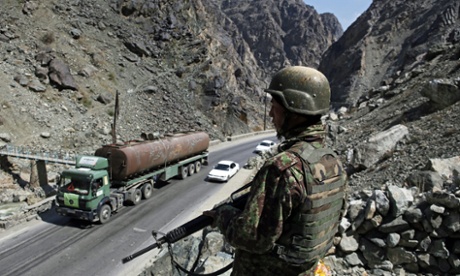
Fear has been clogging the city for years, through escalating layers of checks and guards, and more and more blocked-off roads. Each attack brings a tightening of controls, and they are rarely relaxed. A visit to my old office, on a street that was open to drivers when I first arrived in the city, now requires slow passage on foot through razor wire and blast walls, then a full body, bag and ID check.
The daily frustrations are exacerbated by fraying infrastructure, much of it built with western cash and expertise with little thought for long-term sustainability. It is struggling now, as support drains away.
The first big snowfall of the winter destoyed a pylon bringing electricity from Central Asia. No one knows when it might be repaired, and while Kabul waits the city authorities can only eke out meagre supplies from an ancient hydro-electric dam, offering each district an hour or two of power a day. Ours has been arriving at around 3am, and vanishing soon after.
Landing systems at the challenging, high-altitude airport have broken down, a diplomat told me, after I described how my plane had struggled to land through the low clouds – approaching the runway and then veering sharply away.
Ghani has put the economy at the top of his agenda – together with peace – but patience about his ability to tackle such basic problems is already running low. Afghans are frustrated at the way that, after a heavily disputed election, the president and his poll rival Abdullah Abdullah are spending more time arguing over the division of power than taking up the reins of government.
Cabinet posts remain empty because parliament rejected several candidates agreed only after months of wrangling. Ghani is vulnerable personally and politically as he chases his ambitious plans for transformation.
His desire to get out of the palace regularly exposes him to assassination attempts from an insurgency that has never made any secret of its desire to kill senior leaders.
His efforts to build a better relationship with Pakistan are a high-stakes gamble, with a raft of senior politicians lining up to accuse him of selling out the country to its arch enemy.
Meanwhile, former president Karzai is a brooding presence just outside the palace gates, meeting regularly with a “kitchen cabinet” made up of many of the men who used to run his government.
If the attempt at peace talks fails, the fighting is still likely to drag on for years. The Afghan army has no shortage of courage and has notched up important victories against the Taliban in recent months, but it lacks a functioning air force, is short of heavy artillery and struggles with key military skills.
And the army is losing men faster than it can recruit them to a job that gets more dangerous by the month. The spectre of Isis, which has declared its ambitions for the region and recruited dozens, perhaps hundreds, of men, has been added to the attacks in cities and battles in rural areas.
There are even fears for the Afghan press – often hailed as one of the country’s unsung achievements because of its many freedoms – after a well-known photographer was jailed suddenly in connection with a murky years-old case.
A presidential pardon secured his release just before I flew out of Kabul, and was hailed by some as proof of Ghani’s commitment to a free press, but the government never clarified why he was locked up in the first place.
I left Kabul wondering if I will look back and see this as the moment that Afghanistan managed to turn away finally from war and corruption, or the moment I fooled myself into believing that a country I had lived in and loved for years could muddle towards peace.