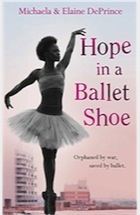
To those who are way into the reading world and tend to avoid over–sized novels with fancy shining covers this book might seem like one they should avoid but, trust me, this is not the case!
For the people who are not involved in the dance world at all, let me introduce you to the 20 year old Michaela DePrince, principle ballet dancer at the Dutch National Ballet. This is her story about how ballet saved her life. Well it might sound too dramatic but in this case it is true.
Even though Michaela was raised in the USA and is a USA passport holder she originally comes from Sierra Leone. She lived there up until the age of 4, her father was shot by the rebels (at the time Sierra Leone was experiencing a civil war) and after a while her mother died from starvation. Because she was born with vitiligo, a skin disorder that formed spots on her skin, no one wanted to take care of her, not even her uncle, so she was sent to an orphanage. However from there she was adopted by an American couple and her life changed dramatically towards the better.
I am sure that now you are wondering how ballet contributed to Michaela's
survival in Sierra Leone. This is something you will have to find out on your on
by reading the book though!
Now about the book as a whole, the style of writing is very simplistic with baby Michaela being the narrator. It is worth noticing though how the writing develops and becomes more complex as the book progresses and Michaela becomes a grown up. I am not here to judge the author's writing skills. This is not her job anyway; her job is to tell stories through her body and not through her words.
Because of this I insist on recommending this book to everyone. Through her humble style of writing Michaela narrates a great story. Great, not only because of its uniqueness, but also because of the points it raises. She was the lucky one amongst hundreds of thousands of children, victims of the civil war in Sierra Leone, whose lives did not have a turning point. She is the lucky one amongst hundreds of black ballet dancers who are never going to make it into a soloist, principle or even a corps de ballet member because their physique is too 'athletic'.
This second point is what Michaela herself tries to promote the most. Ballet is in my opinion one of the less versatile forms of art, but it shouldn't be that way. Many people do not realise that but the arts influence to a great extent the way we think. Having such a major art form like ballet not embracing black dancers, not because they are not capable but because they are different, says a lot about our society. It's time for the ballet world to accept change and it's also time for the audiences to demand change. For this we put our hopes not only into Michaela's ballet shoes but onto ourselves.
• Buy this book at the Guardian Bookshop.
Want to tell the world about a book you've read? Join the site and send us your review!