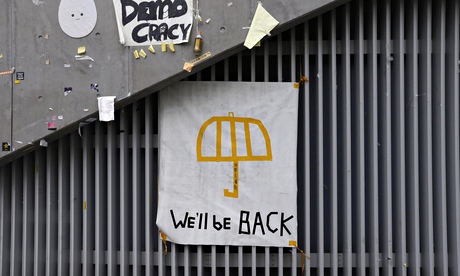
Hong Kong authorities have issued an order that could separate a 14-year-old pro-democracy protester from his parents, heightening fears of a gradual, retroactive campaign against demonstrators only days after their final encampment was cleared.
Police detained the boy on 25 November as they cleared a demonstration site in the gritty, densely-populated area of Mong Kok. They held him for about 24 hours alongside about two dozen other protesters and then took him before a juvenile court judge. Rather than charge him with a criminal offence, the court applied for a protection order, alleging that his parents’ neglect put him at possible risk of harm.
Bloomberg reported that the boy, whose name has not been revealed for legal reasons, visited the protest sites frequently but returned to his parents’ home in an impoverished neighbourhood each night.
“The [authorities’] attitude, generally, is retributive,” the boy’s lawyer, Patricia Ho, told the Guardian. “The government has shown a general stance of not wanting to get a lot of students arrested. But on the other hand, I think they want to make an example out of a few of them.”
She added that police told the boy that if he didn’t “behave” he would “find [himself] in a boys’ home.”
Police cleared the main protest site near government headquarters in the Admiralty district last week, arresting 249 people, including prominent politicians and protest leaders.
On Monday, they dismantled the last remaining protest site, a 100 metre swath of tents in the shopping district Causeway Bay. That afternoon, the city’s embattled chief executive, Leung Chun-ying, declared the “illegal occupation” to be officially over.
Protesters demanded a more democratic voting process for the city’s next chief executive elections, in 2017, rejecting Beijing’s mandate that candidates be screened by a mainland-friendly committee. Despite nearly 100,000 people turning out at the protests’ peak, neither the Hong Kong government nor Beijing made any meaningful concessions.
Rather, since the protests began in late September, Beijing has barred protest leaders from travelling to the mainland. This month, it denied British members of parliament from visiting Hong Kong, alleging that they planned to interfere in China’s domestic affairs.
Local authorities fought back protesters with batons and pepper spray, injuring hundreds, and detained a handful of activists for urging people to join the protests in online posts.
Ian Wingfield, a barrister with Tower Chambers and former solicitor-general of Hong Kong, said that the 14-year-old boy’s case will be handled by the court’s “care and protection jurisdiction” rather than its criminal jurisdiction.
A social worker will investigate his family background, then recommend further measures at his next hearing, which is slated for mid-January. “In the grand scheme of things, this is not a penal measure, it’s a protective measure,” he said.
Wingfield continued that while many young people participated in the protests, the police did not pursue wholesale arrests until late last month, when they began enforcing a court injunction to clear the sites. “My sense is that he was the only juvenile who was around at that stage,” he said.
On Sunday, a prominent mainland official said that Hong Kong needed “re-enlightenment” about the “one country, two systems” arrangement – a political framework by which Beijing has governed the city since 1997.
“It seems that some people [in Hong Kong] still cannot find an identity with the country,” said Zhang Rongshun, a high-ranking official in the National People’s Congress, China’s legislature, according to the South China Morning Post.
“There is a need to have a re-enlightenment about the ‘one country, two systems’ principle and national identity.”
David Zweig, a professor at the Hong Kong University of Science and Technology, said that Beijing had framed the protests as a national security concern, and that Zhang’s comments could portend a clampdown. “They’ve somehow invented this foreign conspiracy,” he said. “And they’re convinced that there’s a strong force here for independence.”
He continued: “My own sense is that they don’t quite get it. Each time that they’ve really pushed hard, that’s when they get a strong reaction. If they would just be more confident, and show some faith in the people of Hong Kong, things might go better.”