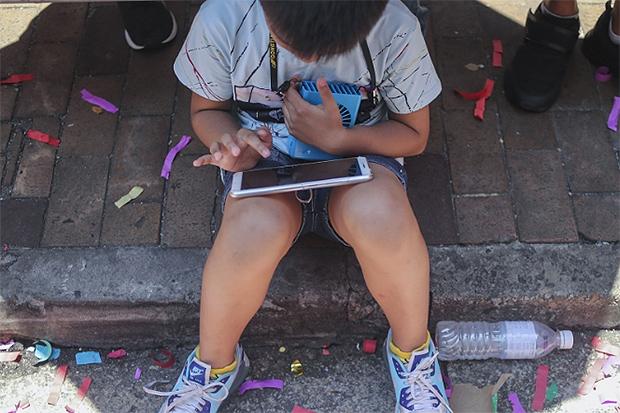
More than half of Hong Kong schoolchildren spend more than two hours daily on electronic devices and, in the most extreme cases, up to eight hours glued to screens, according to a poll by the city’s largest pro-establishment political party.
The survey by the Democratic Alliance for the Betterment and Progress of Hong Kong (DAB) also found that more than 40% of pupils covered wore glasses, and one in five parents did not limit the time their children spent on devices.
The findings sparked concern about lack of eye health awareness among parents.
In all, 1,027 parents with children aged three to 12 were polled. DAB lawmaker Ben Chan Han-pan said some 46.8% of children in the study had developed eye problems between the ages of four and six, implying that eye defects started earlier than previously thought.
Of the parents interviewed, 31.4% said their children used mobile phones, tablets or computers for more than two hours a day. In the most extreme cases, 6.1% said their children stared at screens six hours a day, while 2% said the duration was eight hours. About 41% of pupils in the poll wore glasses.
The numbers reflect a worrying trend of increasing eye problems in the city’s young, with a similar Chinese University poll last year finding that about 40% of children polled had myopia at the age of eight.
Chan said such proportions surpassed World Health Organisation levels, released in 2016, which suggested 27% (1.9 billion) and 2.8% (170 million) of the world population were affected by myopia and high myopia respectively in 2010.
The latest local poll also found that 49.6% of parents capped their children’s usage of devices at two hours daily, while 24.2% set a limit of four hours. Some 20% had no limits.
“I’m very worried to see 20% of parents with no usage limits for their children. The situation tells us some parents are not aware of such issues,” Chan said.
The survey was conducted through face-to-face interviews citywide from August to December last year.
Among the children polled, about 75% had myopia, 38.4% had astigmatism, and the rest had farsightedness or weak vision.
Chan urged the government to quickly formulate prevention and control measures to tackle myopia in children.
He suggested that the government set up a school allowance for children’s eye tests and to buy glasses, as an incentive for them to go on to private eye care services.