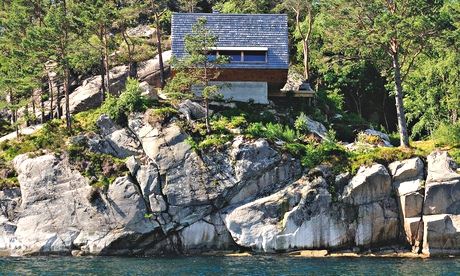
Clad in larch and partly hidden by pine trees, this summerhouse all but disappears into its craggy landscape. “We fell in love with the site first,” says owner and architect Gudrun Molden. “The pinkish-grey granite, the sea, the sunsets – they’re beautiful.”
This contemporary retreat, designed by Molden and her husband, Per Højgaard Nielsen, is located on Skåtøy, a small island west of Bergen, in Norway. As well as using the cabin as a weekend bolthole, the couple, who work as partners in a Bergen architectural practice (hlm.no), commute to their office for two months during the summer, returning to the peace of their rocky eyrie each evening. It offers a very different pace of life. “We cook simple food and gaze at the sea,” Molden says.
Reaching Skåtøy from Bergen entails a one-hour drive, followed by a 10-minute boat trip. Until the 1950s, the island had a tiny year-round population, but when a promised bridge didn’t materialise, its last inhabitants left. Today, there are nearly 30 summerhouses dotted around the island, with the couple’s plot situated on the more sheltered north-westerly side.
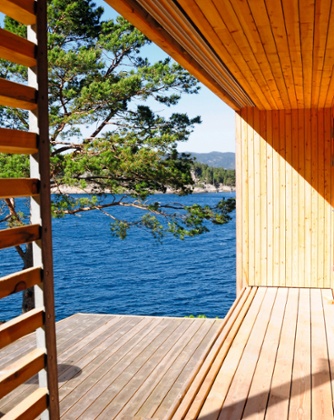
“If this had been a normal site, we would have opened the building to the sea,” Molden says. “But the plot called for a long, narrow structure, so we faced it east-west, leaving it more closed on the north-facing side, and sheltered from the wind.” The roof is sloped in order to collect rainwater, the cabin’s sole source of water.
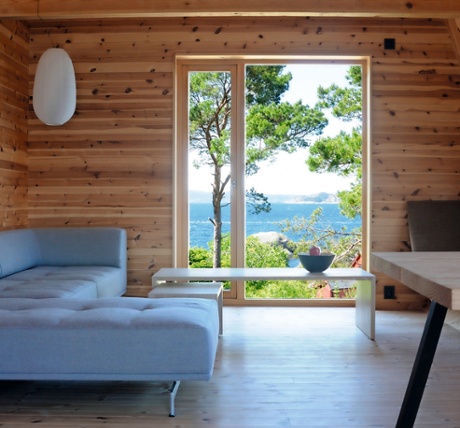
The design is a simple, single-storey structure that houses a living space and kitchen-diner, three bedrooms, a shower room and toilet. A double-sided woodburning stove, the cabin’s only heat source, separates the kitchen/dining area from the living room, which features a built-in bench (occasionally doubling as a guest bed), a sofa and a hammock strung from a beam. “We would have loved to create a bedroom for each of our three grownup daughters when they visit, but we couldn’t make the building any longer,” Molden says. “We built a boathouse at the bottom of the cliff, and that gets used as an extra room. If we have a lot of guests, we can also sleep three on the boat.”
The rooms are accessed from covered walkways that flank the cabin. “The whole point was to connect with nature, so we wanted to be outside as much as possible, whatever the weather,” Molden says. Inside, all the surfaces – floor, walls and ceiling – are clad with solid pine. “A lot of glass can make a building quite noisy and this helps to absorb sound,” says Molden.
The couple’s friends and family have likened the house to a boat, a bridge, or an angular amphibian looking out to sea. “I think the bridge description is the most appropriate, as the cabin actually spans a small ravine,” Molden says. A rocky mound in the middle of the plot had to be dynamited, with the excess rocks used to fill the ravine.
Days on the island pass peacefully, with dips in the sea (one of their daughters likes to jump in from the roof of the cabin), visits from neighbours and fresh fish cooked on the barbecue. “It’s a very contemplative place to be,” Molden says. “The only entertainment here is nature, and that is what makes it so wonderful.”
House rules
Favourite thing? The bizarre feeling that the sun sets on one side of the house, goes under the bed and then rises on the other side.
Design heroes? Herzog & de Meuron, for their elegant and radical architecture.
Best design classic? The Alvar Aalto vase (above) makes flowers even more lovely.
Pet hate? A building that ruins a site.
What’s on the menu? Crabs and fish such as mackerel and a kind of deep-sea cod, all caught from our boat.
I couldn’t live without…
Close relations and the sea.