Accepted design wisdom is that British gardens cannot take bold colour. It is all very well painting your walls turquoise and plant pots cerise if they are going to be bathed in glorious Mediterranean light and viewed against a deep blue sky, but such colours jar on a drizzly October day in Nantwich. And so we plant our gardens inoffensively in pale pinks, purples and blues as temperate and soft as our weather.
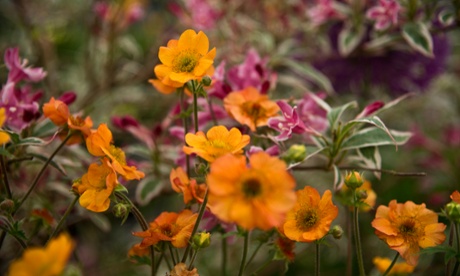
Garden designer Jo Thompson thinks it a shame that when British gardeners do stray from safe pastels, they put bold-coloured flowers into the ghetto of a “hot garden”: reds, oranges and yellows alongside tropical leaves such as cannas and bananas, in the style of Christopher Lloyd’s Exotic Garden at Great Dixter. She describes her own planting style as “country perennial”, and although she often plants using soft colours, she finds she can work in bolder colours just as successfully. A favourite combination is orange Geum ‘Totally Tangerine’ and Digitalis ‘Suttons Apricot’ alongside colour-wheel opposites Geranium ‘Rozanne’, Allium ‘Purple Sensation’ and Astrantia ‘Claret’. “The colours are as bold as those in a hot garden,” she says, “but the shapes are softer and more likely to work in harmony with most garden locations.”
An increasing number of Thompson’s clients are asking for bold colours in their planting. “It is often men who ask for the strong colours, followed quickly by, ‘Stay away from pink’, but I often work a bit of pink in without anyone noticing: it’s fantastic in many bold combinations.” For her Chelsea flower show garden this year, Thompson is combining pink roses ‘Comte de Chambord’ and ‘Reine des Violettes’ with the orange-toned peony ‘Coral Charm’. “The trick is to temper them with moodier colours, such as deep burgundy, to prevent the combination becoming too sickly.”
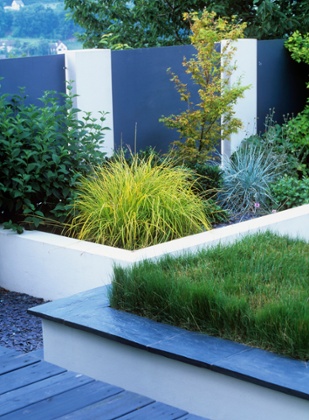
Ann-Marie Powell is another garden designer who pushes against the pastel predominance. She thinks more of us should try the same, and use paint as well as plants. “It’s true we can’t do a Jardin Majorelle here [Yves Saint Laurent’s classic, primary-coloured Moroccan garden], but bold colour used well can add huge depth and resonance.” For British gardeners starting to dabble with bold colour, she recommends smokier shades such as deep aubergine and charcoal – “[Mark] Rothko colours,” she says – on a single wall, much as you might use a brightger colour on a feature wall indoors. “Aubergine with a matt finish sucks light into it, and when plants are placed against that, you create an almost physical feeling of energy and warmth.” Such colours work particularly well in smaller gardens, where large blocks of bright colours would be overwhelming.
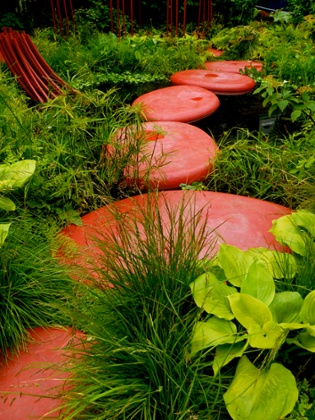
But Powell also thinks we should be less afraid of the bolder end of the scale, and often uses large blocks of stronger colour in bigger gardens. “I have always enjoyed landscape interruption, a term used by sculptors when they purposely disrupt a view. It is like detonating a visual bomb.” Her 2011 Chelsea flower show garden featured bright red platforms and structures in a sea of ferny greens. “Strong colour makes the greens greener, and the greens make the colours fizz.” North-facing gardens suit this treatment particularly well, because ferns, hostas and other good textural foliage plants do well in low light, while many flowering plants struggle. The result can be lush and zingy.

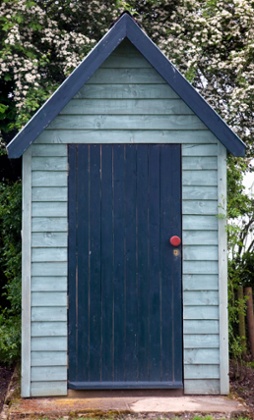
If you don’t want to paint an entire wall fuchsia, there are less permanent ways to introduce splashesof colour via garden furniture and plant containers. (Choose garden furniture that is UV resistant, otherwise your bold choice will fade to brittle pastel after the first couple of summers: Fermob and Paola Lenti offer beautiful, bright-coloured furniture that should stay that way.) Powell also uses brightly coloured hammocks from the Mexican Hammock Company, outdoor rugs and plant pots (from Capital Garden Products), though not all at the same time and always surrounded by – or filled with – plenty of green plants. “Too many colours together create comedy, but bold colour doesn’t have to be shouty and childlike if used in the right way,” she says. “It can create its own energy, mood and drama. It is such a shame to overlook the benefits of being a little bold.”
How to grow summer colour – fast
• Summer bedding is the quickest route to a burst of colour: buy plug plants now and keep them in a sheltered, sunny spot until all risk of frost has passed – that’s when it’s safe to plant outside.
• The flowers of the annual climber thunbergia (aka black-eyed Susan) come in oranges, yellows and reds with a black central “eye”, and look great scrambling up a trellis. My favourite is the burnt-orange ‘Arizona Glow’.
• For a fiery display in your hanging baskets, try fast-growing begonia ‘Inferno’. It’s more tolerant to fluctuating weather than many other popular annuals, and will keep on flowering until the first frosts.
• Dahlias with bright blooms set against dark leaves can look stunning in patio containers and en masse in borders, so get planting the tubers now. Try pink-orange ‘Star Wars’ and ‘Braveheart’.